Valve's Steam Machine: Zen 4-Powered Living Room PC Launches 2026
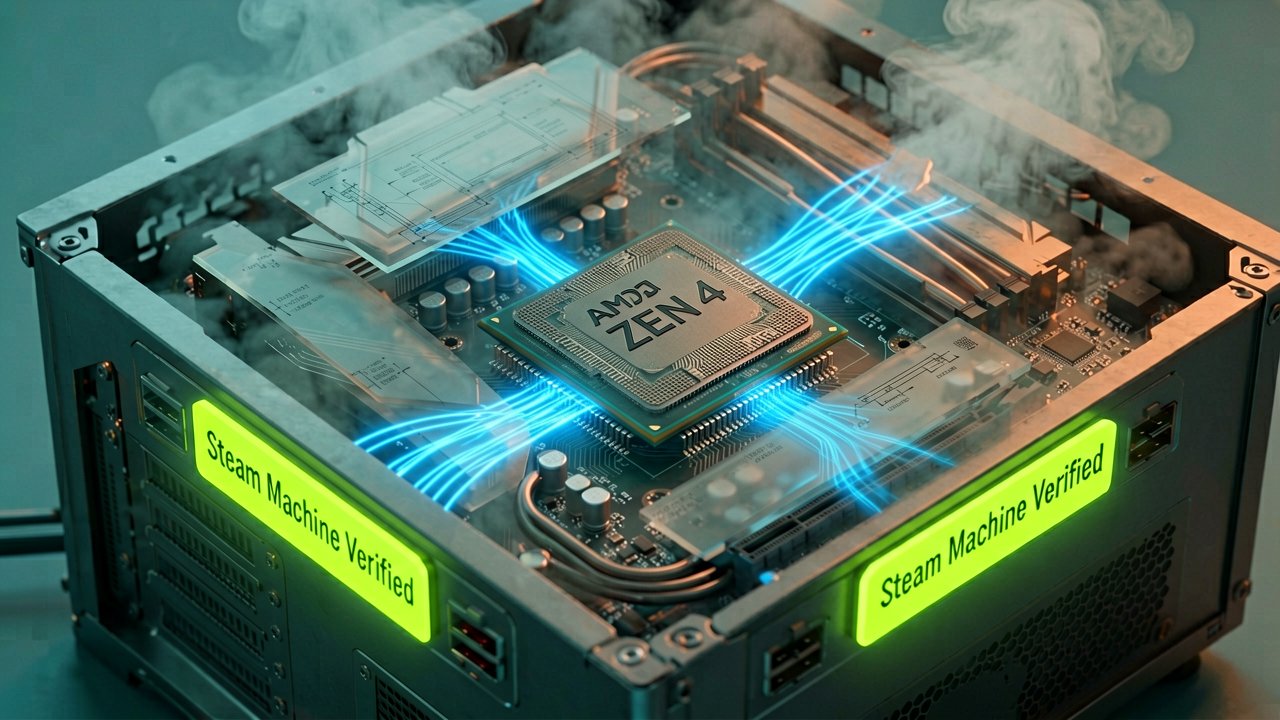
Valve has officially confirmed its second attempt at a living room gaming PC with the Steam Machine, a compact console-like device powered by AMD's Zen 4 architecture and running SteamOS. The announcement, made in late 2025, positions this as a direct evolution of the successful Steam Deck, targeting a Spring 2026 launch alongside a new Steam Controller and Steam Frame VR headset.
The Steam Machine represents a significant departure from Valve's 2014 Steam Machine initiative, which failed due to inconsistent hardware, limited game support, and an underdeveloped SteamOS ecosystem. This new iteration leverages lessons learned from the Steam Deck's success, which demonstrated substantial consumer interest in portable PC gaming with Linux-based SteamOS.
According to Windows Central's coverage of Valve's announcement, the Steam Machine features a semi-custom AMD Zen 4 CPU with six cores and up to 4.8 GHz clock speeds, paired with a semi-custom RDNA3 GPU. Valve claims the device delivers "over 6x more powerful than Steam Deck" performance, targeting native 4K 60 FPS gaming with AMD's FidelityFX Super Resolution (FSR) technology.
Technical specifications include 16GB DDR5 RAM, 8GB GDDR6 VRAM, and storage options of 512GB or 2TB SSDs with microSD expansion. The compact form factor (5.98 x 6.39 x 6.14 inches) is designed to blend into living room setups, featuring ports including DisplayPort 1.4, HDMI 2.0, and multiple USB connections for peripherals.
Valve has explicitly stated the Steam Machine will not be subsidized like traditional consoles but will instead be priced "like a PC with similar performance," according to Engadget's analysis of Valve's pricing strategy. This positioning places it in the premium hardware market rather than the traditional console price bracket, potentially making it more expensive than PlayStation 5 or Xbox Series X.
The most significant innovation appears to be the Steam Machine Verified certification system, introduced in the XDA Developers report. This system tests games for compatibility and performance on the Steam Machine, providing consumers with clear expectations about gameplay quality before purchase. As XDA explains, "Steam Machine Verified is a very important shift in this ecosystem. It tells you, before you even install a game, what kind of experience you're walking into."
This certification system addresses a critical weakness in Valve's previous Steam Machine attempt, when Linux gaming support was thin and many titles failed to run properly. The Steam Deck's success has proven that consumers want PC gaming flexibility in a console-like package, and Steam Machine Verified aims to make that experience reliable and predictable.
Despite the announcement, Valve has faced challenges with the launch timeline. According to Linus Tech Tips' reporting on component shortages, the company has delayed announcing exact pricing and launch dates due to "memory and storage shortages" affecting the industry. Valve stated these shortages "have rapidly increased since [the] announcement," forcing them to "revisit our exact shipping schedule and pricing."
The memory crisis affecting Valve's plans is part of a broader industry trend, with TechPowerUp noting that "flash memory and storage fabs are already fully booked through '27Q1." This shortage impacts not only gaming hardware but also automotive and other tech sectors, potentially delaying the Steam Machine's release beyond its initial early 2026 target.
Valve's approach to the Steam Machine reflects a strategic shift from its previous attempts. Rather than competing directly with consoles through price, the company is focusing on creating a seamless living room experience that leverages the open nature of PC gaming. As Innotechtoday observed, "The Steam Machine is effectively a compact PC built around SteamOS 3, and is capable of running the full Steam library of games without requiring a separate desktop rig."
The device's compatibility with Proton, Valve's Linux compatibility layer for Windows games, ensures it can run the vast majority of Steam titles. However, as Digital Foundry noted in their analysis, the 8GB GDDR6 VRAM configuration "falls short of the maximum VRAM pools and memory bandwidth available on both Xbox Series X and base PS5," potentially limiting performance in some modern titles.
For consumers, the Steam Machine represents a potential middle ground between console simplicity and PC flexibility. Unlike traditional consoles, it supports peripherals like keyboards and mice, allows for multiple displays, and can run alternative operating systems if desired. Yet, it's designed to feel like a console when used in a living room environment, with an interface optimized for TV screens.
With the Steam Deck's success proving there's a market for PC gaming in portable form, Valve is now applying those lessons to the living room. The Steam Machine's success will depend not just on its hardware capabilities but on the reliability of the Steam Machine Verified certification system and how well it addresses the ecosystem challenges that doomed the 2014 Steam Machines.
Artūras Malašauskas is an AI Systems Integrator with 20+ years of production-grade web engineering experience. He has designed, shipped, and scaled enterprise Python/PHP systems for logistics, SaaS, and public-sector clients. For the past year, he has focused exclusively on AI integrations: deploying open-source LLMs, building generative media pipelines (image, audio, video), and engineering multi-agent workflows for real production environments. His standard: reproducibility, security, cost-efficient inference—no vaporware. He documents and evaluates emerging AI tooling, separating verified capabilities from marketing noise. Technical editor at: muza-ai.eu, ai-verslas.lt, ai-naujinos.lt Connect on LinkedIn
Comments