NVIDIA Launches Ising, First Open AI Models for Quantum Computing
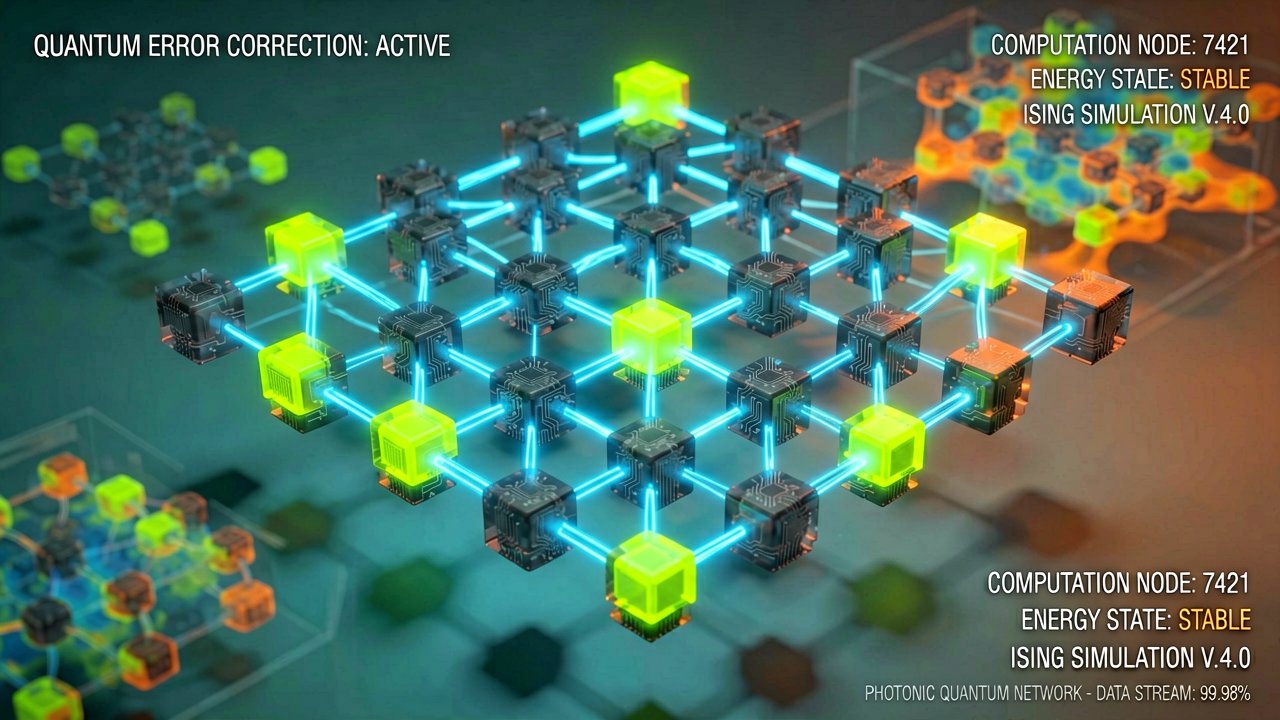
NVIDIA has unveiled the world's first family of open source quantum AI models, NVIDIA Ising, designed to address critical challenges in quantum computing including processor calibration and error correction, according to an official announcement on the NVIDIA Newsroom.
The Ising family includes two key models: Ising Calibration, a vision language model that automates quantum processor calibration, and Ising Decoding, two variants of 3D convolutional neural networks optimized for speed or accuracy in quantum error correction. These models deliver up to 2.5x faster performance and 3x higher accuracy for quantum error correction decoding compared to the current industry standard, pyMatching, as stated in NVIDIA's official documentation.
Named after the landmark Ising model in physics that simplified understanding of complex physical systems, the Ising family provides high-performance, scalable AI tools for quantum error correction and calibration—two of the most critical challenges in building hybrid-quantum classical systems. Jensen Huang, NVIDIA's founder and CEO, emphasized that "AI is essential to making quantum computing practical... With Ising, AI becomes the control plane—the operating system of quantum machines—transforming fragile qubits to scalable and reliable quantum-GPU systems."
Quantum error correction requires processing terabytes of qubit measurement data thousands of times per second, a process that has historically been computationally intensive. Ising Decoding addresses this by providing ready-to-use AI solutions for decoding, while Ising Calibration enables AI agents to automate continuous calibration, reducing setup time from days to hours. The models are available pre-trained with documentation for retraining, fine-tuning, and deployment, allowing developers to customize for specific hardware architectures and use cases.
Leading quantum enterprises, academic institutions, and research labs are already adopting Ising, including Academia Sinica, Fermi National Accelerator Laboratory, Harvard John A. Paulson School of Engineering and Applied Sciences, Infleqtion, IQM Quantum Computers, Lawrence Berkeley National Laboratory's Advanced Quantum Testbed, and the U.K. National Physical Laboratory (NPL). The quantum computing market is projected to surpass $11 billion by 2030, according to analyst firm Resonance, with progress in error correction and scalability being critical to this growth trajectory.
NVIDIA Ising was released with permissive licensing and includes documented data provenance, training methods, datasets, and tools for retraining and fine-tuning. The models provide robust verification, physics-consistency, and uncertainty quantification (UQ), with transparent, reproducible benchmarks defined against reputable baselines. NVIDIA also provides a cookbook of quantum computing workflows and training data, along with NVIDIA NIM microservices, to equip developers for minimal setup when fine-tuning models for specific hardware architectures.
As noted in NVIDIA's developer blog, quantum processors currently make an error roughly once in every thousand operations, but to become useful accelerators for scientific and enterprise problems, error rates must drop to one in a trillion or better. AI is identified as the most promising path to closing this gap at scale, with NVIDIA Ising providing the tools to accelerate this progress through open, customizable AI models that can run locally on researchers' systems while protecting proprietary data.
The NVIDIA Newsroom announcement details how Ising Calibration outperforms all other models across six tests measuring calibration performance, while Ising Decoding delivers significant improvements over existing solutions. This open approach to quantum AI models represents a strategic shift toward democratizing access to advanced quantum computing tools while maintaining control over proprietary data and infrastructure.
Artūras Malašauskas is an AI Systems Integrator with 20+ years of production-grade web engineering experience. He has designed, shipped, and scaled enterprise Python/PHP systems for logistics, SaaS, and public-sector clients. For the past year, he has focused exclusively on AI integrations: deploying open-source LLMs, building generative media pipelines (image, audio, video), and engineering multi-agent workflows for real production environments. His standard: reproducibility, security, cost-efficient inference—no vaporware. He documents and evaluates emerging AI tooling, separating verified capabilities from marketing noise. Technical editor at: muza-ai.eu, ai-verslas.lt, ai-naujinos.lt Connect on LinkedIn
Comments