Nvidia Forges Historic South Korean Alliances to Dominate Next-Gen AI Silicon

Nvidia CEO Jensen Huang announced a massive, multi-tiered expansion of collaborative partnerships with South Korea's premier technology corporations and institutions. This strategic initiative, unveiled following high-level bilateral discussions with South Korean President Lee Jae Myung during his diplomatic visit to the United States, represents a concerted effort to accelerate global artificial intelligence infrastructure and solidify critical semiconductor supply chains. The expansive sweep of agreements firmly cements Seoul's position at the vanguard of the rapidly evolving AI landscape.
The centerpiece of the sweeping announcement is a staggering $500 billion business partnership with SK Group designed to deploy cutting-edge infrastructure capable of feeding the world's voracious appetite for raw compute. According to reporting from Korea JoongAng Daily, the collaboration will leverage Nvidia’s upcoming Vera Rubin platform powered directly by SK Hynix’s next-generation HBM4 high-bandwidth memory. By formalizing these deep structural ties, Nvidia secures a definitive pipeline for the ultra-fast memory components essential to its advanced graphics processing units, successfully outpacing hardware constraints that threaten to bottle up the industry.
Deepening Alliances with Samsung and Naver
Beyond the blockbuster deal with SK, Nvidia is engineering a comprehensive co-design ecosystem with Samsung Electronics to pioneer breakthrough innovations in chip architecture. Concurrently, the Silicon Valley titan is executing a major capital injection into Naver, Korea’s dominant cloud provider, expanding an AI factory footprint at the GAK Sejong data center to a massive 200 megawatts. This infrastructure expansion relies on the GamesBeat reported buildout of roughly 100,000 GPUs, allowing Naver to scale its operations both domestically and across the global stage.
Building 'Korea AI' and Beyond
This initiative extends far deeper than standard corporate supply agreements, embedding Nvidia directly into Korea's domestic academic and industrial fabric. To anchor these technical triumphs locally, Huang confirmed that a select contingent of Nvidia's leading researchers will relocate from California to South Korea to establish a joint AI Frontier Lab with the Korea Advanced Institute of Science and Technology (The Elec). This research hub will focus on engineering a localized large language model "in Korea and for Korea," ensuring sovereign digital autonomy while pushing boundaries across physical AI, autonomous Genesis vehicles with Hyundai Motor Group, and industrial power solutions alongside LG.

The Sovereign AI Imperative and the High-Stakes Battle for Memory Supremacy
Beyond the Billion-Dollar Handshakes: This dramatic expansion of Nvidia's footprint across South Korea is less about standard supply chain management and more about an aggressive geopolitical restructuring of the AI industry. For years, Silicon Valley has treated Asian tech giants as mere fabrication facilities and component vendors. However, as the computational requirements for training frontier models balloon exponentially, Nvidia CEO Jensen Huang recognizes that the hardware bottleneck is no longer just about logic processors—it is about high-bandwidth memory. By embedding Nvidia engineers directly into the design cycles of SK Hynix and Samsung, the silicon pioneer is effectively verticalizing its development pipeline to guarantee that memory speeds can match the explosive performance leaps of its upcoming Rubin architecture.
This unprecedented deep integration carries immense risk and reward for South Korea’s tech titans, who have historically operated under a model of fierce, siloed competition. Samsung and SK Hynix are locked in a relentless, multi-billion-dollar race to master the packaging of advanced HBM4 modules, which utilize custom logic foundations rather than standard DRAM processes. By establishing a shared co-design ecosystem, Nvidia is playing a masterful game of balancing dependencies. For Samsung, this is a golden opportunity to reclaim its absolute dominance in the memory space after facing early yields hurdles. For SK Hynix, it serves as a validation of its early-mover advantage, cementing its status as an indispensable anchor for Nvidia's hyperscale AI factories.
From the Blue House to the research labs of KAIST, the true underlying victory for Seoul is the preservation of digital and economic sovereignty. While Western tech giants dominate the consumer application layer of artificial intelligence, South Korea is uniquely positioned to control the physical layers of production. The joint creation of a sovereign, localized large language model at the new AI Frontier Lab ensures that the nation’s cultural, political, and industrial data remains insulated from foreign cloud monopolies. Industry analysts note that this blueprint allows Korea to export localized AI solutions tailored for other regions looking to escape the gravity of American hyper-scalers, turning a domestic defense strategy into a lucrative global product line.
The ripple effects of these alliances will immediately disrupt adjacent sectors, most notably the automotive and industrial manufacturing landscapes. The inclusion of Hyundai Motor Group and LG in these high-level discussions signals a shift from purely virtual software models to physical AI systems capable of operating in the real world. By deploying custom Nvidia stacks into the next generation of Genesis autonomous platforms and optimizing LG’s heavy industrial factories, the partnership bridges the gap between digital intelligence and physical execution. It is a long-term play that ensures South Korea remains the automated workshop of the world, powered by the definitive silicon architecture of the era.
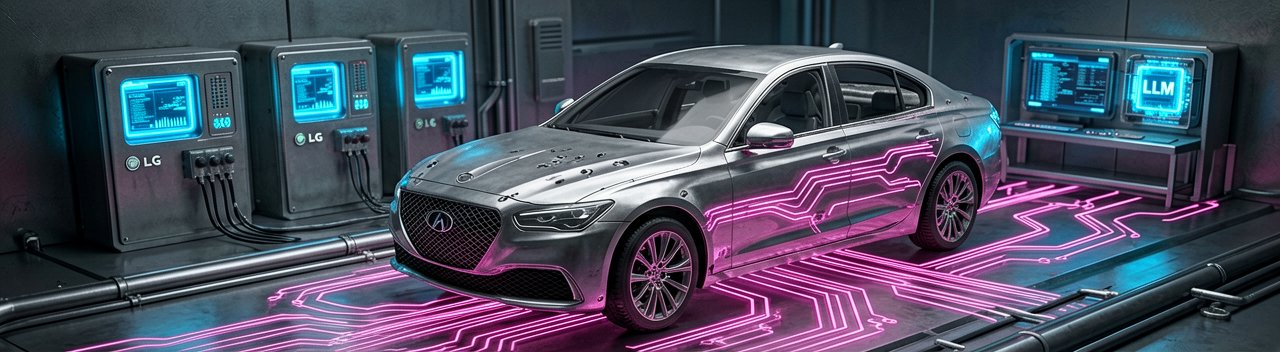
The Hidden Fault Lines of Silicon Geopolitics
Reading Between the Lines: The breathless narrative surrounding Nvidia’s new South Korean alliances frames the agreement as a seamless, mutually beneficial triumph of global tech cooperation. Yet, beneath the corporate handshakes lies an undercurrent of profound strategic vulnerability for both parties. Nvidia is currently walking a razor-thin wire by placing nearly all its next-generation technological bets on a highly concentrated, geopolitically volatile geographic corridor. By deepening ties simultaneously with SK Hynix, Samsung, Hyundai, and Naver, Jensen Huang is doubling down on East Asian hardware dominance at the exact moment global policymakers are frantically demanding the decoupling and regional diversification of critical silicon supply chains.
This aggressive integration also introduces an inherent tension into South Korea’s domestic technology landscape, threatening to upend the delicate balance of power between its two largest conglomerates. For over a year, SK Hynix enjoyed a lucrative near-monopoly as Nvidia’s primary high-bandwidth memory supplier, riding that wave to record-breaking financial heights. By aggressively pulling Samsung into the co-design fold for the Rubin platform, Nvidia is executing a classic vendor-diversification play designed to drive down memory component costs and dilute SK Hynix's pricing leverage. While presented as a collaborative ecosystem, this structure forces Samsung and SK Hynix into an existential price and yield war, where Nvidia holds all the cards and dictates the margins.
Furthermore, the lofty promise of "Sovereign AI"—building localized models at Naver's expanded GAK Sejong data center—deserves a heavy dose of skepticism. While the narrative of national digital autonomy sounds compelling to regulators in Seoul, the stark reality is that this localized infrastructure remains entirely dependent on American proprietary hardware and software stacks. A truly sovereign AI cannot be built on leased foundations; so long as Korea's premier models require Nvidia's proprietary CUDA software ecosystem and hardware architectures to function, true digital independence remains a corporate mirage. The alliance ultimately secures South Korea's role as a high-tier client state in Nvidia's global compute empire, rather than an equal, independent superpower.
Ultimately, the long-term risk for South Korea is the potential for severe overcapacity if the global AI infrastructure buildout hits a demand wall. Tech giants worldwide are spending hundreds of billions on data centers, yet the consumer monetization of AI applications has yet to match the capital expenditure. By dedicating its industrial crown jewels—from Samsung’s advanced foundries to Hyundai’s automotive pipelines—to Nvidia’s architecture, Korea is tethering its macroeconomic health to the continuation of the AI bubble. If hyperscaler demand cools, the economic hangover for Seoul's specialized manufacturing sector could be severe, leaving the nation with an abundance of highly specialized, incredibly expensive infrastructure and no one left to foot the bill.
In the modern tech gold rush, it turns out that being the undisputed shovel salesman requires buying up the entire hardware store, rewriting the local zoning laws, and convincing the town’s wealthiest families to build a factory dedicated entirely to polishing your handles.
Artūras Malašauskas is an AI Systems Integrator with 20+ years of production-grade web engineering experience. He has designed, shipped, and scaled enterprise Python/PHP systems for logistics, SaaS, and public-sector clients. For the past year, he has focused exclusively on AI integrations: deploying open-source LLMs, building generative media pipelines (image, audio, video), and engineering multi-agent workflows for real production environments. His standard: reproducibility, security, cost-efficient inference—no vaporware. He documents and evaluates emerging AI tooling, separating verified capabilities from marketing noise. Technical editor at: muza-ai.eu, ai-verslas.lt, ai-naujinos.lt Connect on LinkedIn
Comments