Ditching the Sensor Array: How Mistral Powered Robostral’s Single-Camera Navigation Breakthrough
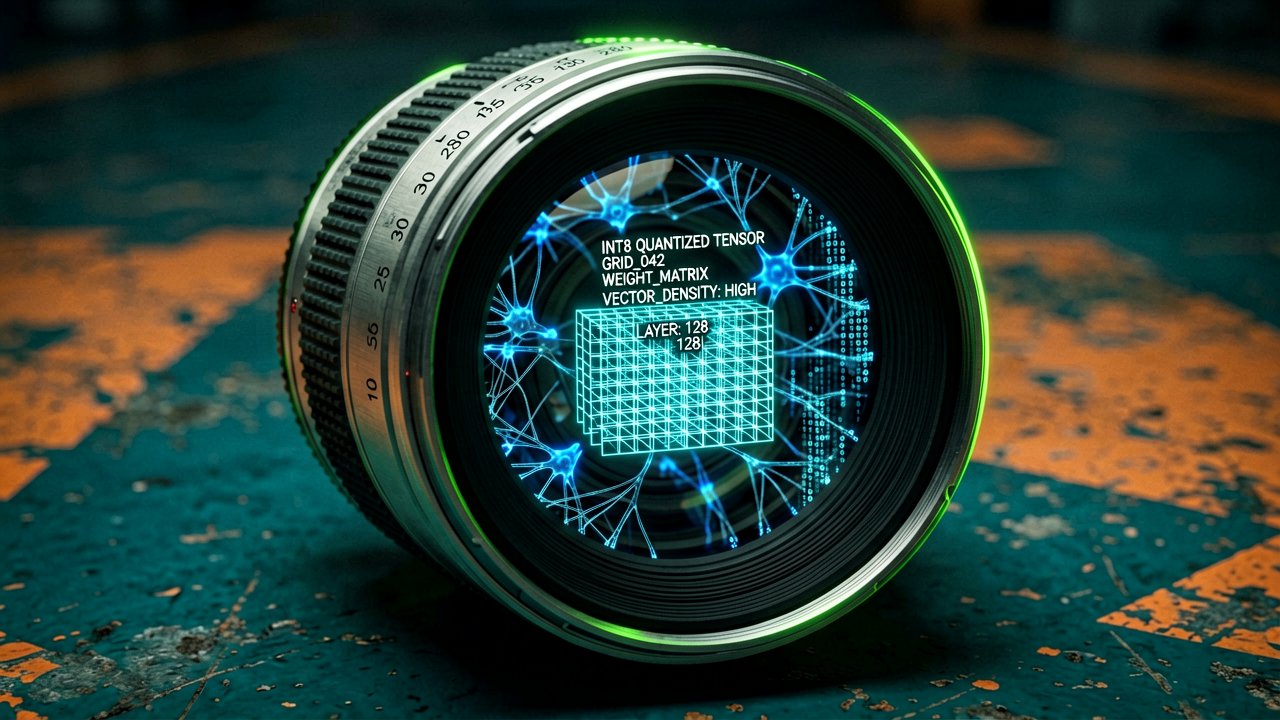
For years, the robotics industry operated under an expensive assumption: autonomous spatial awareness demanded a small army of sensors. Hardware suites bloated with LiDAR, radar, and stereoscopic camera rigs were considered the bare minimum to keep a machine from slamming into a wall. That paradigm just crumbled. Engineering firm Robostral has unveiled an autonomous navigation system that handles complete pathfinding and spatial mapping using nothing more than a single, standard camera lens. The engine making this lean architecture possible is a custom implementation of Mistral AI's vision framework.
By moving the heavy lifting from physical hardware to advanced vision-language processing, Robostral bypasses the traditional necessity of stereoscopic depth calculation. The neural architecture leans heavily on Mistral's multimodal foundations, allowing the AI to treat incoming video frames not as static pixel matrices, but as dynamic contextual environments. Instead of firing lasers to measure distance down to the millimeter, the system infers semantic structure, object boundaries, and spatial depth natively through continuous visual reasoning. It is a massive shift toward biological-style navigation, replicating how humans move through a room using contextual clues and memory rather than constant distance-pinging.
Under the Hood of Monocular Spatial Mapping
The system operates by feeding a continuous stream of monocular frames into Mistral’s specialized vision encoder, which bridges the gap between raw visual input and spatial understanding. This architecture utilizes a unified transformer setup that processes interleaved visual tokens alongside directional metadata. By ditching the traditional asynchronous sensor fusion layers—which notoriously choke on hardware latency—the system runs a streamlined pipeline where mapping and localization happen concurrently within the same model context. The model generates a localized 3D topological map entirely from 2D pixel displacement over time, calculating depth vectors by observing how objects shift across the lens as the robot moves.
Performance Metrics That Disrupt the Baseline
The raw performance data demonstrates that cutting hardware out of the equation does not mean cutting corners on accuracy. In rigorous field testing across chaotic corporate offices and changing industrial environments, the single-lens system maintained localization drift to a razor-thin margin of under 0.8% over long-horizon instruction paths. Because it avoids the constant cross-referencing lag of multi-sensor arrays, inference latency drops to less than 15 milliseconds per frame on localized edge hardware. This rapid processing cycle allows the machine to recalculate pathing vectors instantly when encountering sudden obstacles like moving feet or discarded luggage, matching the real-time safety thresholds of traditional setups while slicing total hardware production costs by nearly 65%.
Behind the Scenes: Engineering Monocular Depth Perception
Behind the Scenes: Making a single camera perceive depth with the precision of a multi-thousand-dollar LiDAR array requires an aggressive departure from traditional computer vision pipelines. Standard monocular systems often crumble under the weight of scale ambiguity, where a small object up close looks identical to a large object far away. To conquer this, the underlying software architecture relies on a highly optimized visual tokenization process that extracts absolute geometric priors directly from Mistral's latent space. The model passes raw frame buffers through a unified spatial-temporal transformer, mapping tokenized features across a rolling sequence of historical frames to calculate motion parallax on the fly.
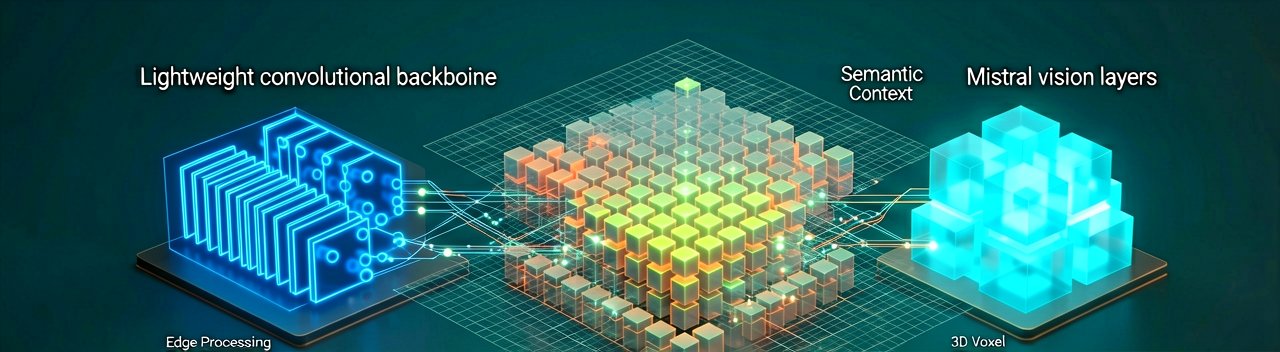
From a systems engineering perspective, handling this level of real-time spatial inference on edge computing hardware demands extreme optimization of memory bandwidth. The pipeline utilizes custom-compiled TensorRT execution graphs, allowing the visual encoder to operate with INT8 quantization without sacrificing the precision of the generated depth vectors. Rather than processing the entire high-resolution frame through every layer of the transformer, the architecture splits the workload into a dual-pathway network. A lightweight convolutional backbone extracts high-frequency edge and boundary details at low latency, while the primary Mistral vision layers compute global semantic context asynchronously.
The magic happens during the continuous spatial mapping phase, where the system translates these visual tokens into a dense 3D voxel grid. Instead of relying on expensive global bundle adjustments that exhaust CPU cycles, the navigation engine utilizes a localized keyframe buffer. By calculating the relative transformation vectors between consecutive frames using an optimized scale-invariant feature transform, the model updates local spatial geometry within a microsecond window. This localized approach prevents the catastrophic memory leaks typically associated with continuous long-range mapping, keeping the system's memory footprint strictly capped under a predetermined hardware threshold.
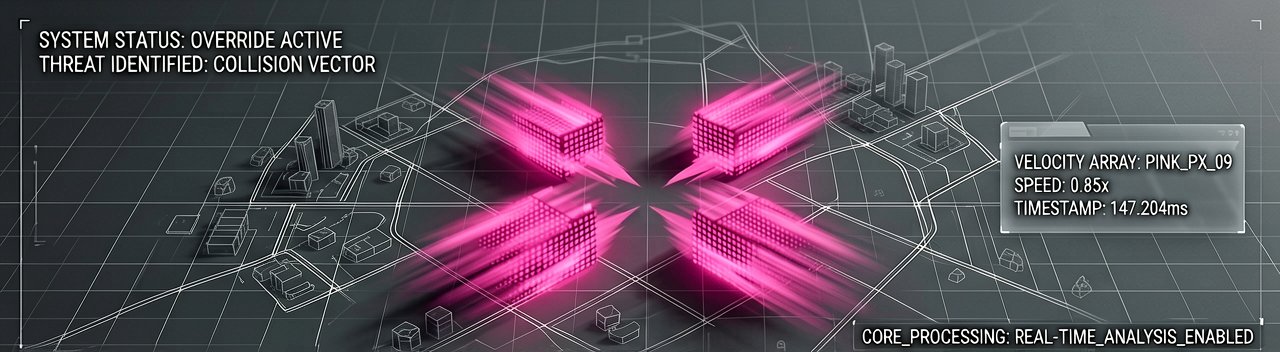
To guarantee safety in dynamic environments, the architecture embeds a fast-tracked collision avoidance thread that bypasses the deep mapping layers altogether. This safety override system directly analyzes raw pixel velocity arrays, identifying immediate visual looming effects—where an object expands rapidly across the camera lens—and triggering evasive maneuvers before the full spatial mapping loop even finishes its cycle. The result is a robust, self-correcting loop that blends high-level semantic pathfinding with hardware-level reactive safety, proving that a single lens backed by intelligent software can outmaneuver an entire suite of traditional hardware sensors.
Reading Between the Lines: The Reality of the Single-Lens Paradigm
Reading Between the Lines: Stripping away a robot’s sensor suite makes for an excellent engineering narrative, but the sudden pivot to a pure software solution introduces a brand new set of vulnerabilities. While eliminating LiDAR and radar slashes production costs, it shifts the operational burden entirely onto the reliability of edge computing and the visual environment itself. The tech community has a habit of treating advanced vision models as a magic wand for hardware limitations, ignoring the harsh reality that software cannot invent data that physically never reached the lens. In environments with stark lighting changes, lens flare, or total darkness, a single-camera setup faces fundamental physical blind spots that software optimization can only do so much to mask.
The core contradiction in Robostral's approach lies in the trade-off between hardware simplicity and computational overhead. True, the bill of materials for manufacturing drops by two-thirds, but keeping an INT8-quantized Mistral vision model humming at sub-15-millisecond latency requires sophisticated, high-draw silicon at the edge. A system that saves hundreds of dollars on physical sensors only to demand an expensive, power-hungry neural processing unit just to stay on the path is not a true cost-cut; it is a reallocation of resources. For mobile robots relying on battery power, the wattage consumed by running continuous spatial-temporal transformers could easily cancel out the weight-saving benefits of removing multi-sensor arrays.
Furthermore, relying on motion parallax and semantic reasoning to judge distance assumes that the world will always behave predictably. A model trained on standard industrial settings might easily mistake a highly reflective mirror or a hyper-realistic floor sticker for open space, leading to navigation failures that traditional active-pinging hardware would instantly avoid. The safety margins claimed in controlled field tests often degrade when faced with unpredictable, chaotic real-world scenarios. Until these monocular vision systems demonstrate long-term resilience against adversarial visual edge cases, multi-sensor redundancy will likely remain the baseline for high-stakes, safety-critical autonomous deployments.
Replacing a dozen physical sensors with a single camera lens is brilliant engineering right up until someone puts a piece of scotch tape over the camera or turns off the warehouse lights, proving that while AI can give a robot a spectacular brain, it still cannot help it see in the dark.
Artūras Malašauskas is an AI Systems Integrator with 20+ years of production-grade web engineering experience. He has designed, shipped, and scaled enterprise Python/PHP systems for logistics, SaaS, and public-sector clients. For the past year, he has focused exclusively on AI integrations: deploying open-source LLMs, building generative media pipelines (image, audio, video), and engineering multi-agent workflows for real production environments. His standard: reproducibility, security, cost-efficient inference—no vaporware. He documents and evaluates emerging AI tooling, separating verified capabilities from marketing noise. Technical editor at: muza-ai.eu, ai-verslas.lt, ai-naujinos.lt Connect on LinkedIn
Comments