The Price Collapse of Frontier AI Is Here, and Elon Musk Is Leading the Charge
Elon Musk and his newly integrated AI powerhouse, SpaceXAI, have officially upended the elite artificial intelligence market with the public launch of Grok 4.5. This week's release represents a massive philosophical shift for a company that was once mocked as a mere Twitter-sidekick project. By deploying a top-tier, "Opus-class" large language model at a price point that undercuts established giants, the company is attempting a brutal land grab for mainstream developers and corporate engineering departments.
This is not just an incremental software update; it is an aggressive, mathematically calculated economic assault. For months, building software with high-end models like Anthropic's Claude Opus family was a luxury reserved for deep-pocketed tech giants. By introducing a model that targets those exact performance brackets for a fraction of the cost, Musk is actively trying to force a price war that could democratize agentic AI tools overnight.
Unpacking the Numbers of the Token Price War
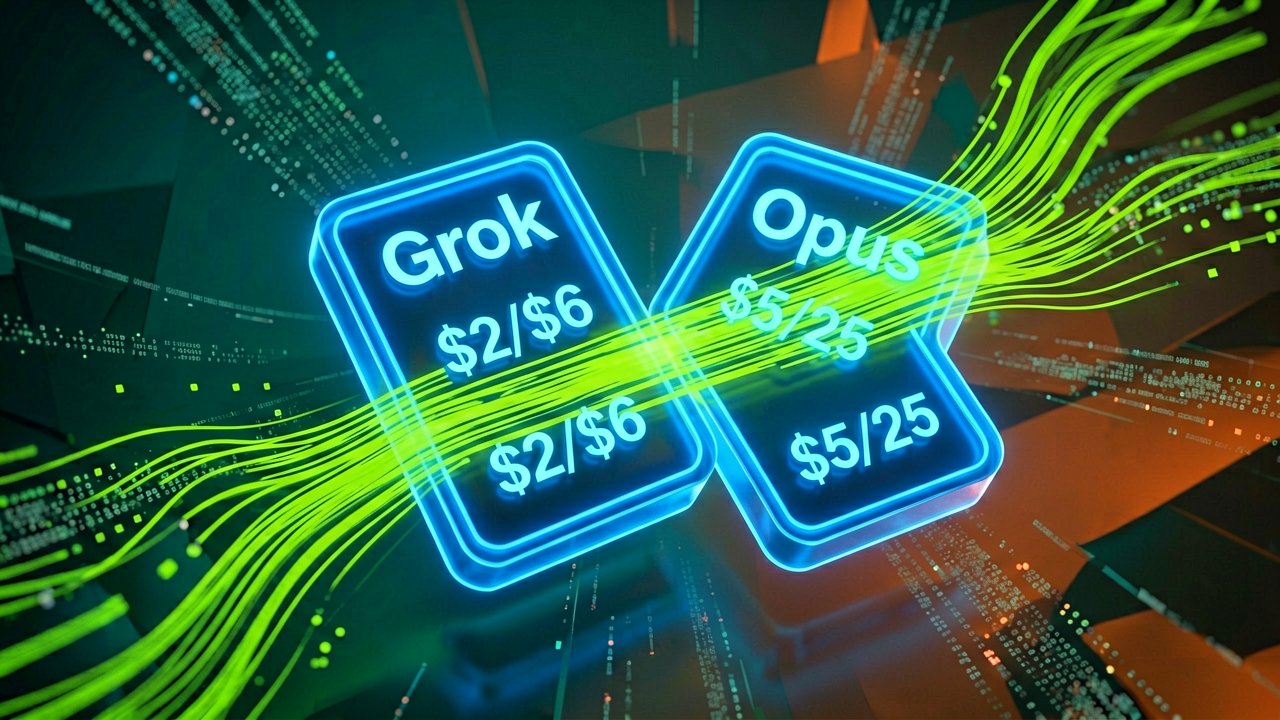
The headline story here is the sheer audacity of the pricing structure. SpaceXAI has priced the standard tier of Grok 4.5 at $2 per million input tokens and $6 per million output tokens, according to the official SpaceXAI Developer Docs. To put that in perspective, Anthropic charges $5 per million input tokens and $25 per million output tokens for its comparable Opus 4.8 model. That makes Grok 4.5 roughly 60% cheaper on ingestion and a staggering 76% cheaper on generation.
However, the real financial kicker lies in how the model handles data. According to benchmark insights compiled by MLQ AI, Grok 4.5 exhibits superior token efficiency, requiring roughly 4.2 times fewer output tokens than Opus to solve identical software engineering tasks. When you multiply a lower baseline per-token rate by a significantly lower token volume, the cost to complete a complex engineering assignment plunges from dollars to literal pennies. It is an economic reality that is already forcing competitors to rethink their monetization strategies.

The Powerhouse Strategy of Cursor and Colossus
This release also marks the first major deployment resulting from SpaceX's monumental $60 billion acquisition of Anysphere, the startup behind the widely popular AI code editor Cursor. Unlike general-purpose chatbots trained entirely on static, dead web repositories, Grok 4.5 was co-trained using anonymized, live interaction data from millions of active developers. It learns how real engineers fix mistakes, trace obscure bugs across vast codebases, and handle messy refactoring workflows. This deep integration is exactly why Tesla has already started aggressively capping its employees' spending on external AI tools, ordering staff to transition to Grok 4.5 for technical tasks as reported by Yahoo Finance .
Musk’s advantage is his completely verticalized AI pipeline. He controls the massive Colossus training supercluster, owns the foundation models via the newly consolidated SpaceXAI division, and now owns the primary distribution vector through Cursor. While independent labs are forced to pay massive premiums to third-party cloud providers, Musk's infrastructure allows him to absorb the massive financial hit of deep price cuts. For developers who have spent the last year watching their API bills skyrocket, this hyper-competitive, developer-first pricing model might be too enticing to ignore.
Behind the Scenes of the Silicon Valley Margin Squeeze
Behind the Scenes: The launch of Grok 4.5 marks a turning point where the AI industry transitions from a race for raw parameters to a brutal war of economic attrition. For the past two years, foundation model providers have operated under the assumption that premium intelligence could command premium margins indefinitely. Venture capitalists willingly poured billions into companies like Anthropic and OpenAI, trusting that developers would pay whatever it took to access frontier-class reasoning. By slashing prices so aggressively, Musk has essentially signaled that raw intelligence is on a fast track to becoming a low-margin commodity, forcing competitors to defend their pricing models far sooner than they anticipated.
This economic pressure is reverberating through the venture capital ecosystem, causing a distinct chill among mid-tier AI startups. Industry insiders note that smaller labs, which rely on external cloud providers like Microsoft Azure or Amazon Web Services, cannot survive a sustained price war against a vertically integrated giant. Musk's infrastructure advantage means SpaceXAI can treat foundation models as a loss-leader to drive adoption for its broader ecosystem, including enterprise cloud services and specialized developer tooling. For independent labs that do not own their own data centers or hardware pipelines, matching these sub-market rates is a mathematical impossibility without burning through their remaining runways at an unsustainable pace.
From the perspective of enterprise software architects, however, this price collapse is an absolute godsend that solves a massive scaling bottleneck. Up until now, chief technology officers have kept a tight leash on production deployments of frontier models due to the unpredictable, compounding costs of multi-turn conversational agents. A single automated customer service workflow or automated codebase migration could easily rack up thousands of dollars in API fees over a weekend if a model got stuck in an algorithmic loop. With token costs plummeting by more than half, enterprises are suddenly greenlighting complex, high-volume agentic workflows that were previously deemed too financially risky to move out of the prototyping phase.
The strategic acquisition of Cursor plays a far larger role in this market shift than most industry observers realize. By embedding Grok 4.5 directly into the primary interface where millions of engineers write code every day, SpaceXAI has built an incredibly powerful telemetry loop. Every time a developer accepts a code completion, rejects a suggestion, or asks the model to explain a stack trace, they are actively generating high-value reinforcement learning data. This continuous, real-world feedback loop allows the model to iterate and patch its reasoning flaws in near-real-time, bypassing the slow and expensive synthetic data generation pipelines that other labs are forced to rely on.
Historically, tech disruptions follow a predictable pattern where hardware costs plummet, software becomes ubiquitous, and value shifts entirely to the application layer. Musk is attempting to compress this multi-year cycle into a matter of months by forcing the entire frontier AI tier into the commodity phase of its lifecycle. As the initial shock of the launch settles, the broader tech landscape is beginning to realize that the true value of Grok 4.5 lies not just in its raw benchmark scores, but in its ability to make elite, enterprise-grade machine reasoning cheap enough to be deployed everywhere, completely reshaping how modern software is built.
Reading Between the Lines of the Open-Source Gambit
Reading Between the Lines: The tech industry has a habit of mistaking a corporate price war for a charitable act of democratization, and this Grok 4.5 rollout is no exception. While mainstream developers are celebrating what looks like an unprecedented discount on elite AI, a closer look at the unit economics suggests this move is less about empowering the masses and more about creating a classic platform monopoly. By undercutting the market so severely, Musk is running the standard Silicon Valley playbook: bleed the competition dry on margins today, secure total developer lock-in tomorrow, and adjust the pricing levers once the independent alternatives have been starved out of the ecosystem.
There is also a glaring contradiction in SpaceXAI's positioning of Grok as a champion of open-source and open-weights ideals. Deploying a model via an incredibly cheap proprietary API is still, at its core, a closed-ecosystem play that forces developers to route their proprietary data through a single corporate pipeline. For all the rhetoric about breaking the proprietary grip of incumbent tech giants, this strategy merely swaps one centralized gatekeeper for another. True open-source developers are already pointing out that a cheap API token is a temporary lease on intelligence, whereas a genuinely open model weight downloaded to local hardware represents permanent technological autonomy.
Furthermore, the heavy reliance on Cursor telemetry as a primary training vector introduces a subtle, long-term risk regarding code quality and algorithmic monoculture. If a massive percentage of the global developer community begins relying on the same heavily subsidized model to generate, debug, and refactor code, the model will inevitably begin learning from its own ubiquitous outputs. This creates a feedback loop where architectural blind spots and specific coding biases could become deeply institutionalized across thousands of independent software projects. The short-term financial savings of cheap tokens could eventually be offset by the long-term technical debt of debugging a global software ecosystem built in the image of a single AI's quirks.
Ultimately, this aggressive pricing strategy assumes that enterprise buyers prioritize cost over absolute reliability and corporate compliance. While a startup or an independent developer will happily jump ship to whichever API saves them sixty percent on their monthly bill, Fortune 500 companies operate under strict data-provenance and liability frameworks. For these risk-averse institutions, the unpredictable nature of Musk’s broader corporate ecosystem—frequently characterized by sudden executive pivots and public legal battles—presents a non-monetary cost that a simple price cut cannot fully erase. Competitors like Anthropic and Microsoft will likely survive this initial onslaught by positioning themselves as the predictable, boring, and safe options for enterprise scale.
"In the grand tradition of Silicon Valley, the initial phase of any tech revolution is always heavily subsidized by a billionaire's balance sheet. Developers should absolutely enjoy the luxury of elite, pennies-on-the-dollar machine reasoning while it lasts, keeping in mind that when the API tokens are priced like water, you aren't just building the future of software—you are also the data fueling the engine that intends to automate your job."
Artūras Malašauskas is an AI Systems Integrator with 20+ years of production-grade web engineering experience. He has designed, shipped, and scaled enterprise Python/PHP systems for logistics, SaaS, and public-sector clients. For the past year, he has focused exclusively on AI integrations: deploying open-source LLMs, building generative media pipelines (image, audio, video), and engineering multi-agent workflows for real production environments. His standard: reproducibility, security, cost-efficient inference—no vaporware. He documents and evaluates emerging AI tooling, separating verified capabilities from marketing noise. Technical editor at: muza-ai.eu, ai-verslas.lt, ai-naujinos.lt Connect on LinkedIn
Comments