Google's Android Halo Wants to Pull Back the Curtain on Sneaky AI Agents
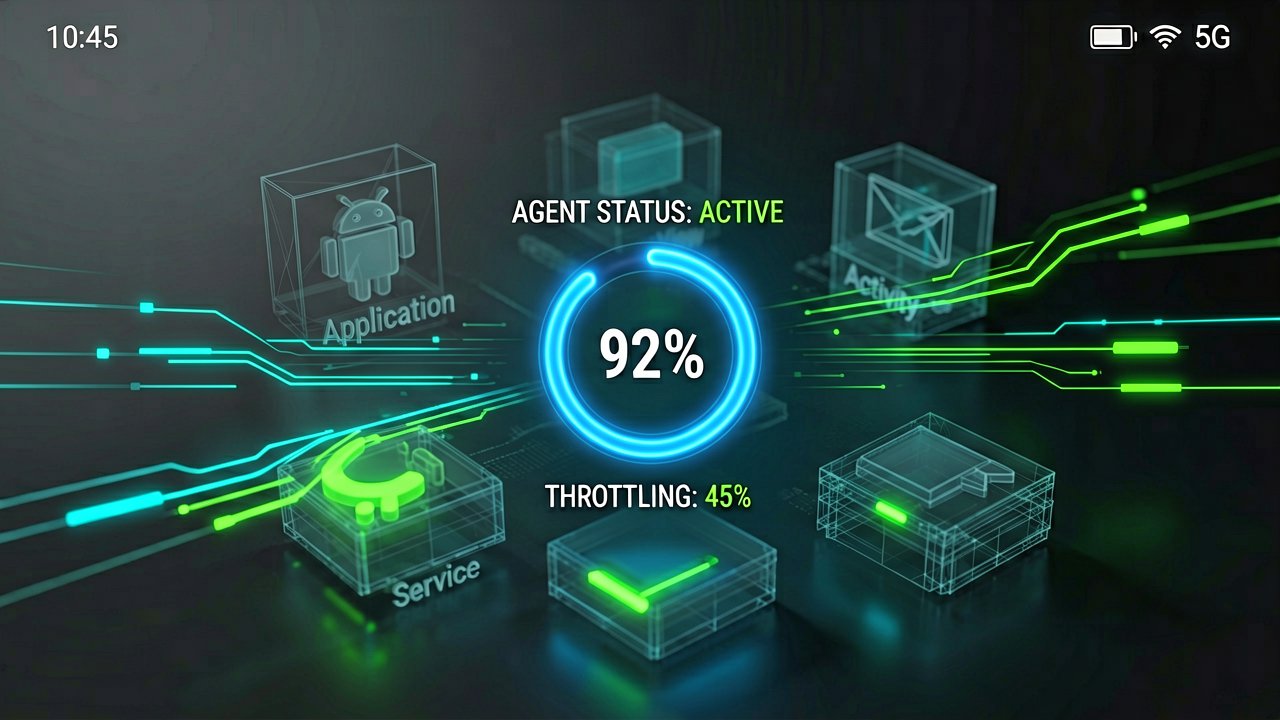
Google is tired of your phone’s artificial intelligence feeling like a black box. In a bid to demystify what autonomous digital assistants are actually doing in the background, the tech giant officially pulled back the curtain on Android Halo, a dedicated operating system environment and interface layer designed specifically for managing smartphone AI agents. Originally teased in May at Google I/O 2026, the company recently shared granular technical details in July 2026, confirming that this persistent UI ecosystem will act as a centralized hub to orchestrate and track complex, multi-step automation without forcing users to jump between different applications.
For years, mobile operating systems have treated apps as walled gardens, forcing us to constantly tap, swipe, and switch contexts to get anything done. Android Halo fundamentally flips the script by embedding a dedicated visual container directly into the status bar, where a subtle glow indicates that an agent is actively working on a task. According to details shared by Android head Sameer Samat on the 9to5Google platform, the system introduces a virtual window environment where an agent can operate independently. If an agent like Gemini Spark is compiling a travel itinerary or executing background research, it does so within its own discrete system layer, giving users real-time visibility and a literal progress tracker right at the top of their screens.
Solving the Trust Problem in an Agentic Future
The real genius—and the real gamble—of Android Halo lies in how it tackles the inherent anxiety of autonomous software. It is easy to feel uneasy when a digital assistant has the clearance to manage your calendar, parse your emails, and interact with third-party software on your behalf. As reported by Gagadget, Halo gives these agents a dedicated sandbox to prompt users for permissions, surface intermediate results, or present finalized data cleanly. By moving away from disruptive pop-ups and opaque background processes, Google is attempting to establish a fluid, transparent interaction model that keeps users in lockstep with their virtual helpers.
An Open Ecosystem for Android 17
Crucially, this is not just a proprietary playground built exclusively for Google's own ecosystem. While it natively supports Gemini, the framework leverages Android’s new AppFunctions infrastructure to allow developers to expose specific data and application functions to third-party assistants. Per details tracked by tech media like Android Authority, Google intends for Halo to eventually host an "agent of your choice," signaling a broader paradigm shift where Android itself evolves from a standard launcher into an intelligence-first operating system. Slated to arrive fully alongside Android 17, the new layer marks a definitive line in the sand: tomorrow's smartphones will not just run our apps; they will manage the software that runs them for us.

What Most Reports Miss: The Deep Tech Re-engineering Android
Behind the Architecture: Android Halo is far more than a glossy cosmetic skin or an updated notifications tray. To make real-time agent tracking possible without killing battery life, Google had to re-engineer core components of the Android runtime environment. Historically, mobile operating systems treat background tasks with extreme suspicion, aggressively killing processes to preserve juice and memory. Halo circumvents this by introducing a privileged virtual container that operates directly alongside the system UI, utilizing hardware-accelerated sandboxing to isolate AI agent operations from standard application loops.
This structural isolation solves a massive security headache that has quietly stalled the deployment of autonomous on-device agents. By siloing the agent's workspace, Android Halo ensures that a third-party assistant scanning your banking app to compile a budget cannot accidentally leak that data to an unauthorized background process. Silicon valley engineers have long warned that malicious prompt injection could hijack an AI assistant mid-task; Google's response is a hardened cryptographic barrier that treats agent actions with the same scrutiny as biometric authentication.
The Developer Pivot and AppFunctions
For the broader developer community, Halo represents a fundamental shift in how software must be built for the next generation of mobile hardware. The traditional goal of app development has been maximizing user engagement and screen time, keeping eyes glued to a proprietary interface. Halo turns that business model on its head by forcing developers to expose granular code snippets through the newly standardized AppFunctions API, essentially turning full-scale applications into modular data pipelines that outside AI agents can strip down and consume on demand.
Early pushback from major app publishers suggests this transition will not be entirely smooth. Major streaming platforms, social networks, and e-commerce giants are notoriously protective of their in-app ad ecosystems and user funnels. By allowing an AI agent to bypass the app interface entirely—say, buying a concert ticket or reserving a table without the user ever seeing a single ad—Google is disrupting established monetization structures. The tech giant's counter-argument is simple: adopt the framework or risk being left behind as users migrate toward a completely hands-off interface layer.

Silicon Partnerships and the On-Device Future
The success of this ecosystem also hinges on deep, unannounced collaborations with silicon heavyweights like Qualcomm, MediaTek, and Google’s internal Tensor team. Running multiple LLM-driven agents simultaneously requires localized, high-throughput Neural Processing Units (NPUs) capable of handling hybrid cloud-to-edge switching without lag. Halo's visual status bar indicator is actually tied directly to dynamic NPU throttling, scaling computational power up or down depending on whether the agent is performing a simple text summary or a massive multi-app data synthesis.
Ultimately, this architectural gamble positions Android to preempt Apple’s rolling out of advanced Siri agent capabilities. By open-sourcing the underlying AppFunctions infrastructure and providing a dedicated visual home for autonomous software, Google is trying to set the global industry standard for agent-to-OS interaction before the competition can solidify its own footprint. It is a high-stakes play to ensure that even if users stop opening individual apps, they will still remain completely anchored to the Android ecosystem.
Reading Between the Lines: The Monopoly of the Middleman
Reading Between the Lines: For all of Google’s lofty rhetoric surrounding transparency and user trust, Android Halo introduces a glaring paradox into the mobile ecosystem. The platform is pitched as a tool to liberate users from the tyranny of the app store, shifting our focus from fragmented app silos to a seamless, unified assistant interface. Yet, in dismantling the walls of individual apps, Google is quietly constructing an even larger, more impenetrable fortress around the operating system itself. By positioning Android as the mandatory orchestrator for all digital agents, the company ensures that no transaction, search, or automation occurs without passing through its own proprietary tollbooth.
This creates an immediate conflict of interest with the very developers Google relies on to populate the AppFunctions ecosystem. Tech giants and independent creators alike are being asked to hand over the keys to their functionality, trusting that Google's system layer will fairly distribute user intent. It requires a massive leap of faith to believe that a Google-controlled platform will treat a third-party shopping agent with the exact same speed and algorithmic priority as its native Gemini Spark, especially when ad revenue and marketplace dominance are on the line.
The Realities of the Battery and Processing Tax
There is also a stark disconnect between the idealized marketing of a frictionless "agentic future" and the rigid constraints of consumer hardware. Localized AI processing is notoriously resource-heavy, and running continuous background agents within Halo’s sandbox presents a massive technical tax. While a status bar glow looks elegant, it represents an intense computational load that could easily translate to degraded battery health, thermal throttling, and a sluggish user interface on anything but the most expensive flagship devices. Google is essentially asking users to trade physical phone longevity for the luxury of not having to tap a screen themselves.
Furthermore, the promise of total transparency through a persistent progress tracker may backfire into sheer user fatigue. The human brain adapted to smartphones because we dictate the cadence of our interaction; we open an app, finish a task, and close it. Halo introduces an environment of constant, low-level background activity, transforming our primary communication devices into hyperactive control rooms. Instead of reducing digital anxiety, watching an AI agent perpetually cycle through micro-tasks at the top of the screen might just replace app clutter with constant cognitive noise.
Ultimately, Android Halo is less about simplifying the smartphone experience and more about a desperate race to commoditize the user relationship before hardware sales stagnate entirely. Silicon Valley has bet its entire future on the assumption that consumers want to stop interacting with software and start managing employees. If that assumption proves wrong, Halo risks becoming a highly sophisticated, incredibly expensive solution to a problem that the average smartphone user never actually had.
We spent two decades begging developers to build beautiful, immersive mobile apps, only to invent a brand-new operating system layer whose sole purpose is to make sure we never have to look at them again.
Artūras Malašauskas is an AI Systems Integrator with 20+ years of production-grade web engineering experience. He has designed, shipped, and scaled enterprise Python/PHP systems for logistics, SaaS, and public-sector clients. For the past year, he has focused exclusively on AI integrations: deploying open-source LLMs, building generative media pipelines (image, audio, video), and engineering multi-agent workflows for real production environments. His standard: reproducibility, security, cost-efficient inference—no vaporware. He documents and evaluates emerging AI tooling, separating verified capabilities from marketing noise. Technical editor at: muza-ai.eu, ai-verslas.lt, ai-naujinos.lt Connect on LinkedIn
Comments