The Illusion of Enlightenment: Why AI is Breeding Omniscient Amnesiacs
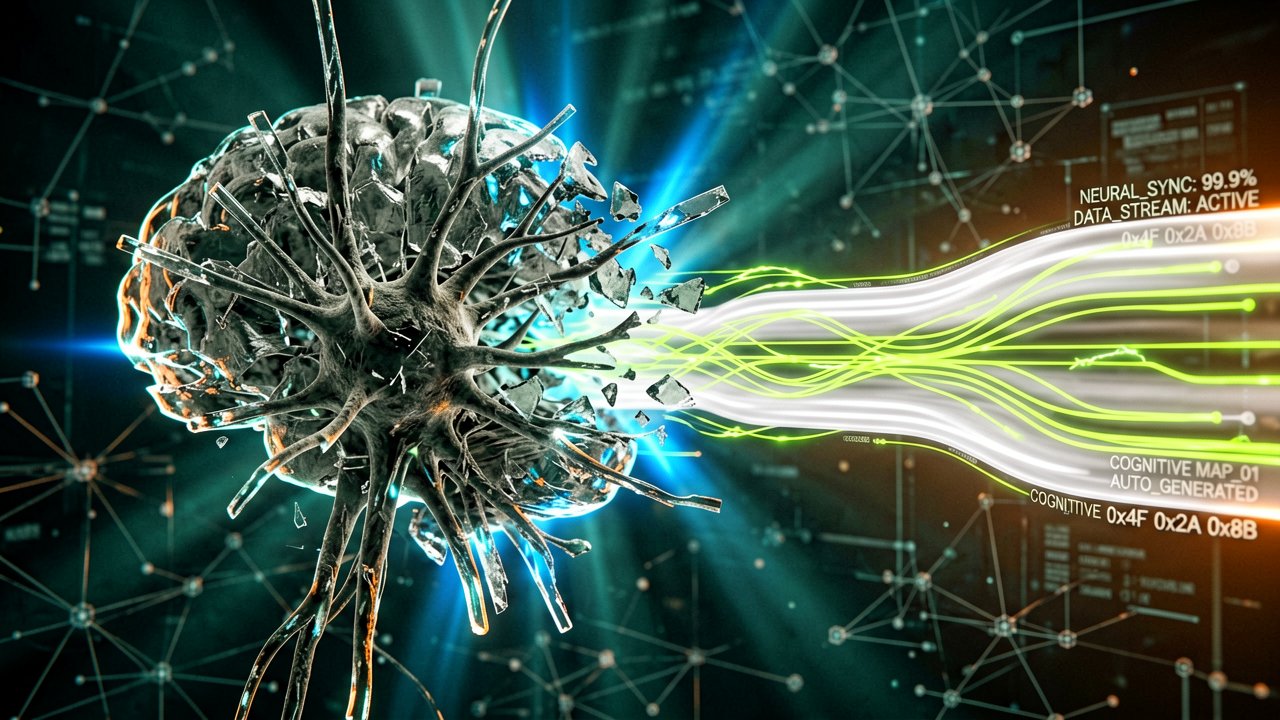
We are quietly restructuring the human mind, and the early returns are deeply unsettling. Walk into any university library or secondary school today, and you will see students staring into the glowing oracle of large language models, generating pristine, flawlessly structured essays in seconds. On paper, this generation looks like a fleet of hyper-educated polymaths capable of dissecting macroeconomic policy or debugging complex code at the push of a button. Yet, beneath this veneer of instant intellectual triumph lies a hollow truth: we are outsourcing the very friction that makes us think.
The tech industry’s grand narrative sells artificial intelligence as the ultimate equalizer in education, a tireless personal tutor that democratizes knowledge. But there is a fundamental difference between a tool that helps you locate data and a machine that digests it for you. By transforming the arduous, messy process of learning into a frictionless transaction, we are transforming students from active critical thinkers into passive information consumers. They can retrieve everything, but they own nothing.
The Death of Productive Struggle
Real learning requires a biological tax. When a student grapples with a difficult text, hits a wall while writing an essay, or struggles to balance a chemical equation, their brain is doing the heavy lifting necessary to build robust neural frameworks. This concept, known as productive struggle, is where genuine comprehension is forged. When artificial intelligence steps in to instantly smooth over these intellectual potholes, it denies the brain its workout.
The consequences of this shortcut are already moving from anecdotal warnings to hard empirical data. A striking survey published by the The Guardian revealed that two-thirds of secondary school teachers observed a noticeable decline in their pupils' core abilities, explicitly noting that overreliance on AI was destroying independent problem-solving and critical thinking. When a machine handles the synthesis, the human brain undergoes a process called cognitive offloading. Why learn to navigate the terrain when you can just look at a digital map that walks for you?

The Paradox of Perfect Answers
The deep danger of generative AI tools lies in their sheer eloquence. Because these models are built on probabilistic pattern recognition rather than actual understanding, they deliver answers with an unearned air of absolute authority. They are statistical chameleons, mimicking the tone of an expert without possessing a shred of consciousness or real-world judgment.
When students rely on these systems as "solution engines," they fall prey to an illusion of competence. They review a beautifully generated explanation and mistake the clarity of the machine's output for their own comprehension. This eliminates the necessity of deep cognitive processing. A student who relies on an AI to write a literary analysis might turn in an A-grade paper, but ask them to defend that thesis in an unscripted, face-to-face debate, and the intellectual scaffolding quickly collapses. They have bypassed the critical evaluation of information, which remains a uniquely human skill that cannot be packaged into an algorithmic prompt.
Reclaiming the Human Edge
If we want to prevent education from devolving into a hollow loop of machines generating text for other machines to grade, we must fundamentally shift our pedagogical framework. The traditional reliance on static take-home assignments and factual recall is dead; AI has made them obsolete. Educators must pivot toward active, inquiry-based learning environments where the human element is non-negotiable.
This means prioritizing spontaneous oral examinations, collaborative problem-solving, and real-time analytical debates that require students to think on their feet. AI can remain a valuable tool for brainstorming or organizing messy thoughts, but it cannot be the entity that signs off on the final judgment. We must explicitly teach students to treat AI outputs with fierce skepticism, forcing them to interrogate the machine’s biases and occasional hallucinations rather than accepting them as gospel. The goal of education has never been to turn minds into flawless databases, but to cultivate sharp, independent architects of thought who know exactly how to question the world around them.

The ultimate test of modern education will not be how effectively we train our machines, but how aggressively we protect our citizens from becoming as predictable as the algorithms they use. If we continue on our current trajectory, we risk establishing a devastating intellectual paradox: a society that possesses an unprecedented reservoir of collective technical data, yet lacks the cognitive baseline required to interpret it safely. We are rapidly constructing an educational framework that prizes immediate output over the internal architecture of the human mind, mistaking fluency for depth and confusing a fast download speed with genuine intellectual authority.
To avoid this algorithmic trap, educational institutions must entirely abandon the illusion that technology is a neutral utility. Every platform we introduce into the classroom carries explicit behavioral biases, and generative AI is inherently biased toward minimizing human cognitive friction. If the primary goal of our school systems becomes the seamless optimization of learning, we will inevitably produce a compliant workforce capable of execution, but entirely unequipped for disruption. True intelligence is inherently messy, inefficient, and disruptive, requiring a level of rebellion that cannot be programmed into an optimization matrix.
The Final Stand for Cognitive Agency
Reclaiming human agency in an automated landscape requires a cultural commitment to intellectual resistance. We must deliberately reintroduce friction into the learning process, creating spaces where speed is penalized and slow, methodical contemplation is rewarded. This means designing curriculum pathways that force students to confront ambiguity, embrace nuance, and tolerate the discomfort of not having an immediate answer. The primary value of a teacher in the algorithmic age is no longer to provide information, but to serve as a vital barrier against easy certainty, forcing minds to think rather than merely retrieve.
Ultimately, the preservation of critical thinking is not an aesthetic preference; it is a structural necessity for democratic survival. A population that relies entirely on synthetic systems to synthesize reality is uniquely vulnerable to manipulation, unable to distinguish between an objective truth and a highly polished statistical probability. If we surrender our cognitive sovereignty to the convenience of the machine, we will yield a generation of passive observers who know the price of every piece of data but understand the value of none.
"We are dangerously close to creating an educational paradise for the intellectually lazy, where the questions are answered before they are understood, and the highest achievement is to perfectly echo a machine that does not care if you exist."
Artūras Malašauskas is an AI Systems Integrator with 20+ years of production-grade web engineering experience. He has designed, shipped, and scaled enterprise Python/PHP systems for logistics, SaaS, and public-sector clients. For the past year, he has focused exclusively on AI integrations: deploying open-source LLMs, building generative media pipelines (image, audio, video), and engineering multi-agent workflows for real production environments. His standard: reproducibility, security, cost-efficient inference—no vaporware. He documents and evaluates emerging AI tooling, separating verified capabilities from marketing noise. Technical editor at: muza-ai.eu, ai-verslas.lt, ai-naujinos.lt Connect on LinkedIn
Comments