NASA Just Dispatched an Orbital Tow Truck for an Emergency Space Telescope Rescue
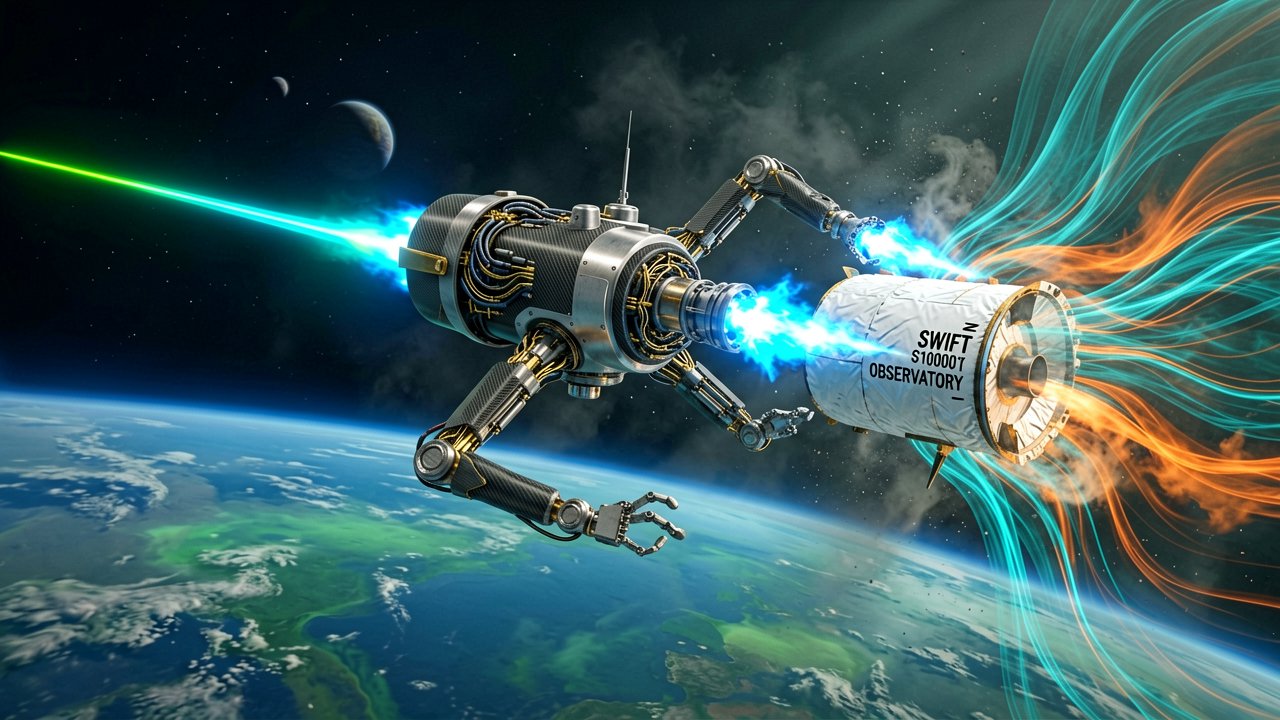
Low Earth orbit is getting crowded, but it's rare that we see a literal salvage operation play out in real time. On Friday, July 3, 2026, a highly unconventional, three-armed robotic spacecraft blasted off from the Marshall Islands in the Pacific Ocean. Its target isn't space debris, but rather a prized piece of American hardware that's falling to Earth faster than anyone anticipated. Space agency engineers are tracking the descent, hoping this eleventh-hour intervention can avert an early, fiery demise for an invaluable eye on the universe.
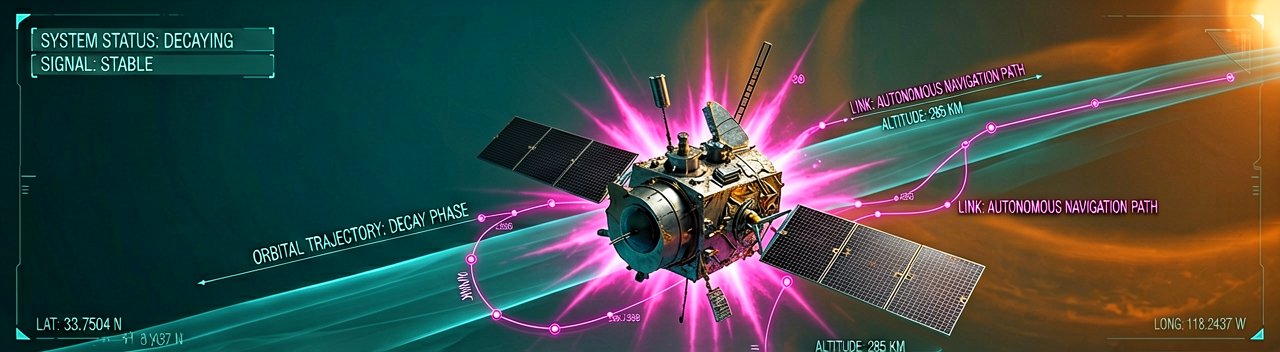
The telescope in jeopardy is the Neil Gehrels Swift Observatory, a $250 million workhorse launched back in 2004. Originally intended for a brief two-year stint, it has spent over two decades serving as the scientific community's premier celestial first responder, specializing in detecting lightning-fast gamma-ray bursts. However, intensive solar activity has heated and expanded Earth's upper atmosphere, generating unexpected drag that's pulled the unpowered telescope down to about 249 miles. Without a boost, NASA estimates the spacecraft will experience an uncontrolled reentry and completely burn up by the end of the year.
The $30 Million Gamble on Autonomous Servicing
To pull off this deep-space save, NASA bypassed traditional aerospace giants and partnered with a United States startup called Katalyst Space Technologies. The recovery craft, appropriately named LINK, was tucked inside a Northrop Grumman Pegasus rocket, which achieved orbit using an air-dropped release from a modified carrier aircraft. According to reporting by ABC News, the mission represents a highly compressed, high-stakes development timeline for a problem that only became critical over the last year.
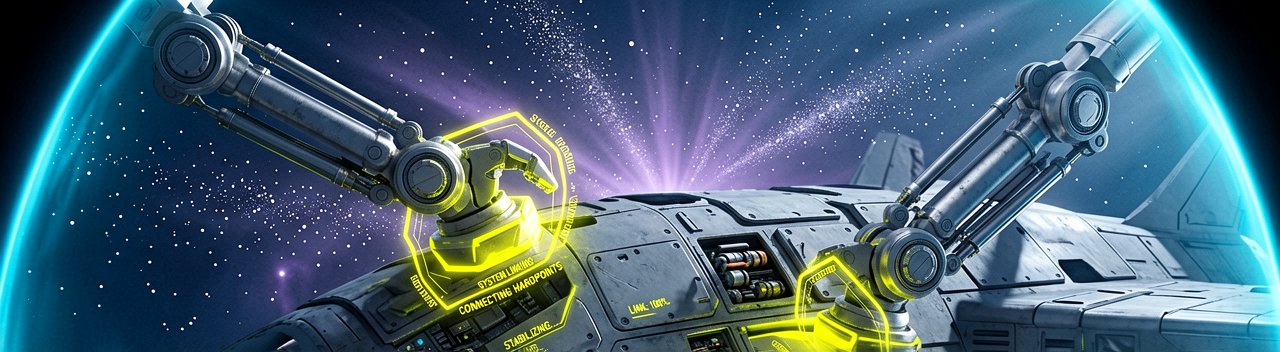
The upcoming rendezvous is a masterclass in technological improvisation because Swift was never designed to be captured or serviced. Over the next several weeks, LINK must autonomously navigate to the falling observatory, match its spin, and extend three mechanical arms to grab onto structural hardpoints that engineers have only ever seen in old blueprints. Once safely docked, the robotic rescuer will fire its own thrusters to push the telescope roughly 186 miles higher, safely back to an altitude of 373 miles. The entire repositioning maneuver is projected to last at least a month, and mission officials peg the odds of success at a coin-flip 50-50.
A Blueprint for the Future of Aging Cosmic Assets
If LINK pulls this off, it won't just buy Swift another decade of operational life; it will mark the first time a commercial vehicle has successfully captured an unprepared government satellite. This could fundamentally alter how agencies manage multi-million-dollar hardware investments. Instead of declaring a mission dead when its orbit decays or its fuel tanks run dry, an emergent industry of autonomous space mechanics could simply refuel, repair, or boost these platforms indefinitely. A victory here also serves as a crucial validation phase for a potential life-extending robotic boost targeted for the aging Hubble Space Telescope later this decade.
The Hidden Math of Solar Maximum
What most reports miss is that the true antagonist in this orbital drama isn't a mechanical failure, but the sun itself. Every 11 years, the sun goes through a period of intense magnetic activity known as Solar Maximum. During this cycle, severe solar flares and coronal mass ejections pump massive amounts of energy into Earth's upper atmosphere, causing the thermosphere to heat up and puff outward like a soufflé. The Neil Gehrels Swift Observatory, which has quietly coasted through lower-friction environments for two decades, suddenly found itself swimming through a soup of dense atmospheric particles. This unexpected "space weather" acted as a brake, robbing the telescope of its orbital velocity much faster than NASA’s long-term models had predicted.
This rapid decay caught the astrophysics community off guard, forcing NASA into a logistical corner. Under normal circumstances, planning a satellite servicing mission takes best part of a decade and hundreds of millions of dollars. However, the agency’s science mission directorate had to bypass conventional, bureaucratic procurement channels to find a solution that could be built, tested, and launched in under twelve months. By turning to a smaller commercial partner, NASA essentially embraced a Silicon Valley "fail fast" mentality—a massive culture shift for an agency that historically prefers years of redundant safety reviews before approaching a multi-million-dollar asset.
The Shadow of Hubble’s Uncertain Future
Behind closed doors, the engineering teams at the Marshall Space Flight Center are treating the Swift rescue as a high-stakes dress rehearsal for an even bigger prize. For years, the astronomical community has quietly panicked over the fate of the Hubble Space Telescope, which is also experiencing a decaying orbit and failing gyroscopes. Because NASA retired the Space Shuttle fleet in 2011, there is no longer a human-rated vehicle capable of visiting Hubble for repairs. If autonomous robotic arms can successfully grapple and boost Swift without human intervention, it proves that the technology is mature enough to save Hubble later this decade, potentially preserving humanity's most iconic space observatory for another generation.
The stakes are just as high for the commercial space industry. Startup companies looking to secure lucrative military and intelligence contracts for satellite refueling and space debris removal are watching this mission with intense scrutiny. If a relatively low-cost startup can pull off an autonomous docking with a non-cooperative, tumbling satellite, it will disrupt the traditional aerospace hierarchy. It signals to investors that the era of disposable space architecture is drawing to a close, replaced by a dynamic orbital economy focused on maintenance, longevity, and sustainable logistics.
The Fine Line Between Ingenuity and Desperation
Reading between the lines, this mission exposes a glaring vulnerability in how we fund and manage humanity’s premier scientific instruments. For decades, the space sector has operated under a "build, launch, and forget" paradigm, dedicating billions to cutting-edge development while chronically underfunding the mundane logistics of long-term orbital maintenance. The scramble to save the Neil Gehrels Swift Observatory reveals that NASA's current strategy for aging assets is less of a calculated master plan and more of a reactive game of cosmic whack-a-mole, dictated by unpredictable solar cycles rather than proactive stewardship.
There is also an uncomfortable irony in relying on an unproven commercial startup to rescue a mature, highly reliable $250 million science platform. By outsourcing this critical intervention to the private sector on such a compressed timeline, NASA is essentially playing a high-stakes game of poker with twenty years of irreplaceable astronomical data. If the autonomous vehicle suffers a software glitch or a thruster anomaly during the docking phase, it could inadvertently collide with Swift, turning a slowly decaying telescope into a sudden cloud of uncontrollable space shrapnel that threatens the entire orbital regime.
Furthermore, the heavily hyped economic narrative of the "orbital towing industry" deserves a healthy dose of skepticism. While industry proponents paint a utopian picture of infinite satellite life cycles, the financial reality remains murky at best. Space agencies and private telecommunication giants may find that paying tens of millions of dollars for emergency robotic boosts is an expensive band-aid that merely delays the inevitable. In many cases, it may still prove more cost-effective to let older hardware burn up and replace it with next-generation platforms boasting superior sensors, faster processors, and modern internal propulsion systems.
Ultimately, this mission forces a fundamental reckoning regarding the true cost of doing science beyond Earth's atmosphere. If autonomous rescues become the new normal, it will inevitably cannibalize budgets originally earmarked for upcoming, groundbreaking exploratory missions. The scientific community may soon find itself trapped in an expensive cycle of keeping yesterday's technology on life support at the direct expense of tomorrow's discoveries, altering our trajectory of cosmic exploration for decades to come.
It turns out that building a telescope capable of peerless deep-space discovery is only half the battle; the real challenge is surviving the hazardous combination of an angry sun, a chaotic low Earth orbit, and a human budget cycle.
Artūras Malašauskas is an AI Systems Integrator with 20+ years of production-grade web engineering experience. He has designed, shipped, and scaled enterprise Python/PHP systems for logistics, SaaS, and public-sector clients. For the past year, he has focused exclusively on AI integrations: deploying open-source LLMs, building generative media pipelines (image, audio, video), and engineering multi-agent workflows for real production environments. His standard: reproducibility, security, cost-efficient inference—no vaporware. He documents and evaluates emerging AI tooling, separating verified capabilities from marketing noise. Technical editor at: muza-ai.eu, ai-verslas.lt, ai-naujinos.lt Connect on LinkedIn
Comments