Microsoft's $2.5 Billion AI Frontier: Redefining Enterprise Tech Adoption
Microsoft has launched a dedicated subsidiary called Microsoft Frontier Co. to radically accelerate how modern enterprises implement artificial intelligence. Backed by an aggressive $2.5 billion investment, the tech giant is mobilizing 6,000 employees to solve the complex technical and strategic challenges businesses face during deployment. This shift signals that the era of simply selling cloud-based software licenses is giving way to high-touch, embedded execution models.
The market is witnessing a fundamental change in how vendors approach enterprise software delivery. Traditionally, software giants delegated lower-margin deployment and integration work to external consulting firms. However, as documented by CNBC, companies now require deeply specialized expertise to realize returns on advanced machine learning algorithms. By establishing this dedicated firm, Microsoft intends to build closer loops with clients while concurrently refining its core product development.
Disrupting the Enterprise Consulting Model
The creation of Microsoft Frontier Co. directly addresses a major bottleneck in the current technology cycle: the implementation gap. Many corporations have purchased AI capabilities but struggle with internal infrastructure, data privacy, and workforce training. Microsoft’s new division directly addresses this by embedding engineers, corporate trainers, and managers into client organizations. This boots-on-the-ground playbook mirrors models popularized by data analytics innovators and underscores a broader structural trend across the tech industry.
The Hyper-Competitive Race for AI Dominance
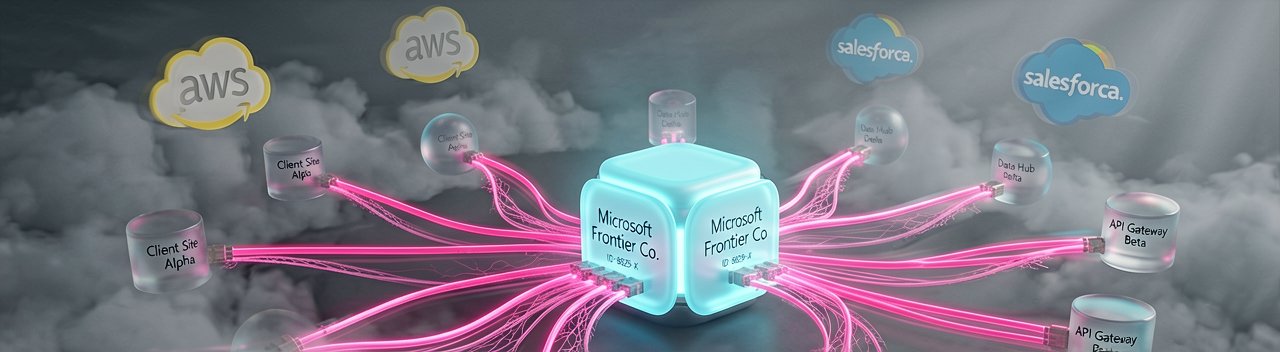
According to reports from Bloomberg , Microsoft is not acting alone in this operational pivot. Competitors like Amazon's cloud division, Salesforce, and OpenAI have launched similar hands-on implementation initiatives. This collective movement highlights an industry-wide realization that software utility is tied directly to customer execution. As infrastructure costs mount, vendors must ensure client satisfaction to maintain their market positions and prevent churn.
Resource Realignment and Long-Term Outlook
This massive deployment of 6,000 workers occurs alongside a broader, strategic rebalancing of corporate resources. Tech media analysis from Investing.com indicates that while hyperscalers are reducing overhead in legacy sales and traditional business units, they are aggressively reallocating capital into applied engineering. This transition underscores a major industry evolution. Future market dominance will not belong to those who build the largest models, but to the platforms that integrate them deepest into corporate operations.
The Hidden Architecture of Microsoft’s Operational Pivot
Behind the Scenes: The scale of Microsoft Frontier Co. reveals a critical, unpublicized reality within Redmond—software sales teams are facing immense pushback from corporate Chief Information Officers who are exhausted by tech-hype cycles. For the past two years, enterprise clients bought into the promise of productivity gains, yet many found that off-the-shelf generative models failed to understand specialized corporate data structures. By reallocating 6,000 internal personnel into an elite implementation army, Microsoft is effectively transitioning from a software vendor into a highly integrated operations partner, acknowledging that the standard software-as-a-service distribution pipeline is broken for next-generation intelligence.
This tactical maneuver mirrors historical inflection points in the technology sector, most notably IBM’s massive pivot toward technology services in the early 1990s. When hardware and software became commoditized, survival dictated a shift toward high-touch corporate problem-solving. Today, as open-source models rapidly close the capability gap with proprietary systems, Microsoft recognizes that raw algorithmic power is becoming a commodity. The true differentiator is now proprietary workflow integration, and deploying specialized engineers directly into client environments prevents competitors from poaching valuable ecosystem accounts.
Internal stakeholders indicate that this structural reorganization has caused significant friction across legacy sales divisions. Traditional account executives, accustomed to closing high-margin software licenses with minimal post-sale involvement, must now coordinate with technical deployment teams who measure success by monthly active usage rather than total contract value. This structural evolution forces a cultural shift within Microsoft itself, tying employee compensation closer to tangible customer outcomes and actual compute consumption rather than upfront multi-year commitments.

Furthermore, this strategy creates an aggressive defensive moat against agile startups and traditional consulting giants alike. Firms like Accenture, Deloitte, and McKinsey have historically captured billions in revenue by managing corporate IT transformations. By building its own massive deployment arm, Microsoft is capturing both the software spend and the lucrative integration budgets. This dual-revenue capture model fundamentally alters the enterprise ecosystem, forcing traditional systems integrators to either deepen their technical capabilities or risk being sidelined by the very platform providers they rely on.
The Hidden Risks of the Capital-Intensive AI Playbook
Reading Between the Lines: Microsoft’s massive financial and human reallocation exposes a glaring paradox at the heart of the current artificial intelligence boom. For years, Silicon Valley evangelized generative AI as a frictionless, infinitely scalable software solution that would yield near-instantaneous efficiency gains. Yet, deploying a 6,000-person task force to manually hardwire these tools into corporate architecture proves the exact opposite. This shift reveals that advanced AI is actually a highly bespoke, resource-heavy technology that demands an old-school, labor-intensive consulting framework to function effectively at scale.
This operational pivot also raises serious questions regarding long-term profit margins and corporate efficiency metrics. Wall Street heavily values software companies for their massive gross margins, which typically hover around eighty percent because code can be replicated infinitely at almost zero marginal cost. By transforming itself into a hybrid services agency, Microsoft risks diluting its premium software margins with the lower-margin, labor-intensive realities of IT consulting. Investors who bought into the narrative of exponential, automated software growth may soon find themselves holding equity in a company that looks increasingly like a traditional system integrator.
Furthermore, this aggressive strategy creates an intense pressure cooker for actual corporate adoption metrics, which have historically been kept vague in quarterly earnings reports. Up until now, tech vendors could mask low engagement by pointing to massive enterprise licensing agreements and initial seat purchases. Now, with billions in capital and thousands of specialized engineers embedded on the ground, Microsoft will no longer be able to hide behind hollow deployment stats. If these teams fail to deliver measurable return on investment for cynical Chief Financial Officers within the next eighteen months, the industry may face a sharp capital contraction.
"In its quest to automate the future of human labor, the tech industry has paradoxically arrived at a place where it must hire armies of actual humans just to explain to corporations how the software works."
Artūras Malašauskas is an AI Systems Integrator with 20+ years of production-grade web engineering experience. He has designed, shipped, and scaled enterprise Python/PHP systems for logistics, SaaS, and public-sector clients. For the past year, he has focused exclusively on AI integrations: deploying open-source LLMs, building generative media pipelines (image, audio, video), and engineering multi-agent workflows for real production environments. His standard: reproducibility, security, cost-efficient inference—no vaporware. He documents and evaluates emerging AI tooling, separating verified capabilities from marketing noise. Technical editor at: muza-ai.eu, ai-verslas.lt, ai-naujinos.lt Connect on LinkedIn
Comments