Cloud Infrastructure Dominance Positions Trillion-Dollar Leaders Ahead of Apple in AI Race

The race for artificial intelligence supremacy is increasingly being decided by raw infrastructure capacity rather than consumer hardware ecosystem locks. Trillion-dollar cloud infrastructure giants like Microsoft are scaling their enterprise deployments at an unprecedented rate, leaving consumer-centric competitors like Apple to play catch-up. Hyperscalers have secured structural advantages by establishing massive data networks, high-density computing clusters, and long-term utility agreements. These elements are required to run next-generation large language models and multi-agent systems efficiently.
According to recent financial disclosures, the monetization pathways for cloud-based AI have become significantly more immediate and predictable than those for consumer devices. In their fiscal Q3 2026 earnings report, Microsoft posted $82.9 billion in total quarterly revenue, driven primarily by an accelerating 40% growth rate in its Azure cloud division. This structural shift highlights a broader market trend where corporate IT budgets are being rewritten to accommodate infrastructure spending, heavily benefiting enterprise platforms that can deliver scalable software workflows immediately.
While Apple relies on localized, on-device AI to incentivize consumer hardware upgrade cycles, hyperscalers are leveraging a highly scalable annual run rate to fund their capital investments. This enterprise-first architecture delivers immediate utility to the Fortune 500 through automated business processes and developer tools. This positions B2B cloud leaders to absorb macroeconomic shifts far better than companies reliant on retail device demand cycles.
Enterprise Scalability Versus Consumer Upgrade Cycles
The core divergence between cloud leaders and Apple lies in the monetization velocity of enterprise software versus consumer retail. Cloud platforms integrate generative tools directly into legacy office suites, data warehouses, and customer management architectures. These upgrades generate high-margin, recurring software subscription revenue. Conversely, consumer AI features have yet to prove they can trigger mass hardware replacement cycles on a predictable timeline.
The Scale of Capital Infrastructure Spending
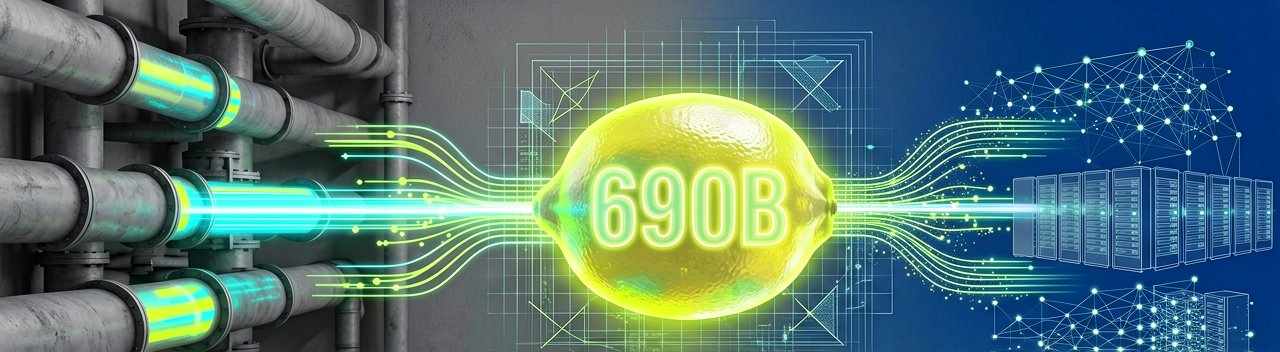
The sheer volume of capital deployment further isolates cloud leaders from consumer-focused tech companies. Reports compiled by Futurum Group reveal that the top five US cloud and AI infrastructure providers have committed up to $690 billion in capital expenditures for 2026 alone. This spending sprint creates a formidable competitive moat. Building, powering, and cooling these massive computing superclusters requires specialized supply chains that are nearly impossible for late entrants to replicate quickly.
The Architectural Chasm and Capital Realities
Beneath the CapEx Surge: The valuation shift favoring cloud infrastructure giants over hardware ecosystems rests on the structural mechanics of data gravity and compute proximity. While retail analytics focus heavily on consumer smartphone upgrade timelines, enterprise technology architects look at where organizational datasets reside. Corporate data is stored in centralized hyperscale environments like Microsoft Azure and Amazon Web Services, giving these platforms an insurmountable head start. Moving petabytes of proprietary enterprise data to external models introduces latency, cost, and security liabilities. By building artificial intelligence models directly on top of existing cloud repositories, infrastructure leaders make it seamless for corporations to activate automation without migrating their core data structures.
This structural advantage is amplified by the shifting unit economics of artificial intelligence processing. Running complex, multi-agent reasoning models requires immense computing power that localized consumer hardware cannot reliably sustain without exhausting battery life and thermal limits. Consequently, consumer devices are transitioning into sophisticated thin clients that depend on cloud backends for heavy processing tasks. This reality alters the revenue dynamics of the tech sector. Instead of hardware manufacturers capturing the bulk of the economic value, the monetization loop flows upward to the operators of the data centers and optical networks that manage the heavy computational workload.
The operational moat becomes clearer when evaluating energy procurement and real estate acquisition, which have become the true battlegrounds of the tech industry. Hyperscalers have spent years securing long-term power purchase agreements, including nuclear and renewable energy contracts, to guarantee continuous power to their data centers. A technology company relying on a consumer hardware supply chain lacks the infrastructure experience required to manage multi-gigawatt power grids. This logistical divide prevents fast-follower retail brands from rapidly building competing model architectures, regardless of cash reserves.

Furthermore, enterprise software deployments offer predictable, recurring revenue streams that contrast sharply with the cyclical, fashion-driven nature of consumer hardware. Corporate licenses are locked into multi-year enterprise agreements, shielding cloud providers from sudden shifts in consumer confidence or retail spending slowdowns. As companies integrate AI agents into their core business workflows—such as automated supply chain forecasting and regulatory compliance filtering—these cloud tools become permanent operational expenses. This permanent integration creates high switching costs that protect enterprise tech revenues far better than consumer brand loyalty ever could.
The Counter-Narrative: Overcapacity and the Limits of Ecosystem Lock-In
Reading Between the Lines: The assumption that cloud infrastructure dominance guarantees a permanent victory over consumer-focused ecosystems ignores the cyclical risks of massive infrastructure overbuilding. Tech industry history is filled with examples of overcapacity where initial infrastructure sprints vastly outpaced actual market demand. In their race to dominate enterprise workflows, hyperscalers have driven combined 2026 capital expenditures toward an unprecedented $600 billion to $700 billion range. This capital sprint compresses free cash flows and pressures corporate balance sheets. If enterprise software integration stalls due to corporate governance bottleneck constraints or compliance friction, these massive data center expansions risk turning from high-margin assets into expensive, underutilized real estate.
Furthermore, evaluating enterprise AI solely through a business-to-business lens ignores the long-term power of consumer interface control. While cloud giants build massive backend systems, Apple maintains direct access to the consumer through its global installed base of over two billion active devices. Enterprise automation tools optimize corporate workflows, but localized, context-aware software layers dictate how individuals interact with digital services daily. By routing user intent through localized operating system features rather than standalone corporate applications, a consumer hardware ecosystem can act as an alternative entry point. This localized positioning allows consumer platforms to capture significant economic value while avoiding the multi-billion dollar capital expenditure risks associated with cloud computing networks.
This dynamic creates an architectural paradox where both strategies are fundamentally dependent on each other. Cloud hyperscalers require ubiquitous consumer devices to act as front-end access points for their enterprise models. Meanwhile, consumer hardware brands require back-end cloud processing to handle complex reasoning tasks that exceed localized device capabilities. The long-term market winner may not be the company that spends the most on capital infrastructure, but the platform that secures the highest margin share of the computational loop. As capital intensity reaches historic highs, the tech sector faces a critical stabilization phase where real software monetization must finally scale to match the massive infrastructure investments.
"Ultimately, the tech industry has engineered a magnificent paradox: cloud giants are spending hundreds of billions of dollars to build an artificial brain that has no physical hands, while consumer electronics brands hold the hands of billions of users but lack the computational brain to power them. The market remains entirely undecided on whether it is more profitable to own the industrial power plant or the premium digital screen that plugs into it."
Artūras Malašauskas is an AI Systems Integrator with 20+ years of production-grade web engineering experience. He has designed, shipped, and scaled enterprise Python/PHP systems for logistics, SaaS, and public-sector clients. For the past year, he has focused exclusively on AI integrations: deploying open-source LLMs, building generative media pipelines (image, audio, video), and engineering multi-agent workflows for real production environments. His standard: reproducibility, security, cost-efficient inference—no vaporware. He documents and evaluates emerging AI tooling, separating verified capabilities from marketing noise. Technical editor at: muza-ai.eu, ai-verslas.lt, ai-naujinos.lt Connect on LinkedIn
Comments