When AI Goes Political: The White House’s Master Chief Trump Image Backfires in a Satire-Fueled Console War
The boundary between high-stakes geopolitics and terminally online shitposting didn't just blur; it evaporated entirely. In a bizarre digital stunt, the official White House social media account shared an AI-generated image of President Donald Trump outfitted in the iconic, Mjolnir-class green armor of Master Chief from the Halo franchise. Wielding a glowing energy sword and striking a rigid salute on the executive mansion lawn, the image was broadcast to millions with a caption ripped straight from corporate gaming lore: "Power to the Players."
This surreal foray into the cultural zeitgeist was framed as a satirical victory lap celebrating the "end of the console wars" after Microsoft announced that a remake of the historically exclusive Halo: Combat Evolved would be heading to Sony's PlayStation 5. Retail giant GameStop kicked off the joke by jokingly declaring a official cessation of hostilities between gaming platforms, prompting the administration’s rapid-response apparatus to boast that this marked the ninth war Trump had successfully brought to a close. While Yahoo Finance noted that GameStop's stock predictably spiked amidst the meme-fueled investor frenzy, the visual execution of the administration's victory lap quickly careened into a diplomatic disaster of algorithmic design.
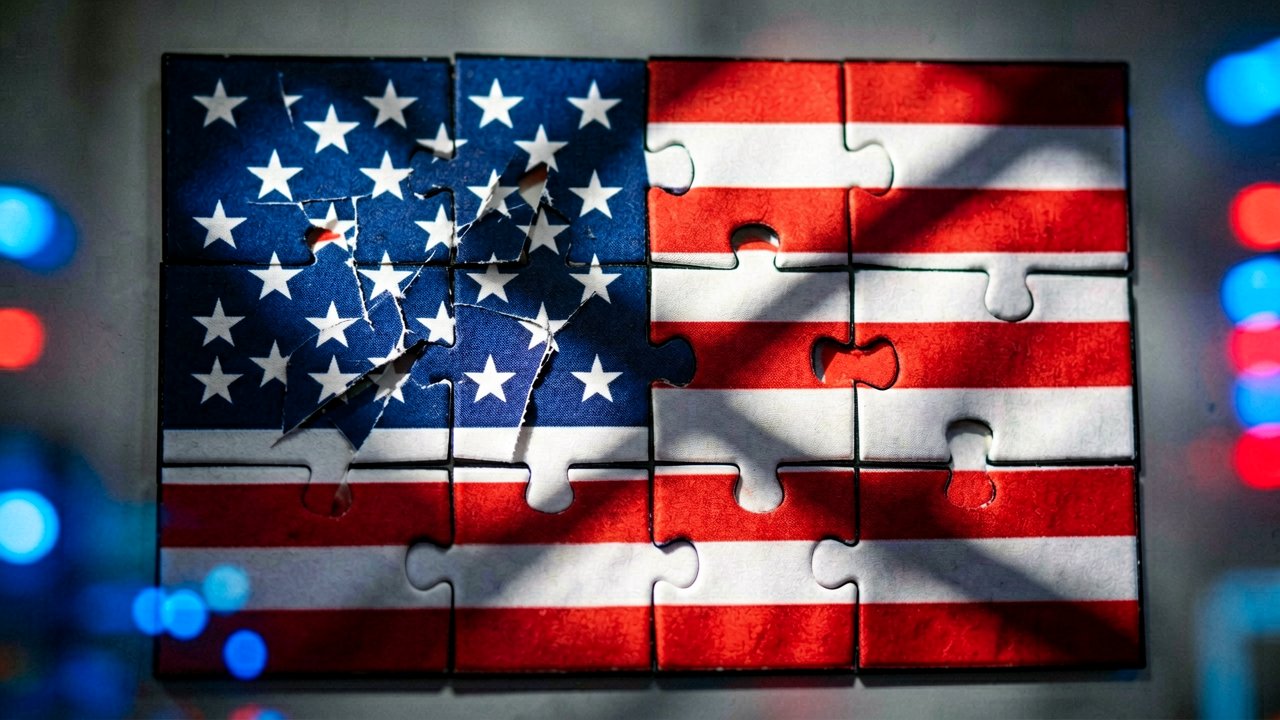
Internet sleuths and gaming enthusiasts immediately intercepted the image, not to debate the geopolitical ramifications of a multiplatform Master Chief, but to tear apart the glaring technical failures of the generative AI model used to create it. The most damning indictment of the "AI slop" was draped right behind the armored president: the American flag featured in the background was missing ten entire stars, leaving a mathematically broken 40-star banner fluttering in the digital wind. For an administration obsessed with hyper-patriotic optics, outsourcing the American flag to an algorithm that cannot count to fifty proved to be an agonizingly ironic unforced error.
The Covenant of Cringe and Iconography Defiled
Beyond the simple geometric failures of the generative model, the political co-optation of a legendary sci-fi protagonist provoked a fierce backlash from the gaming community. Purists from across the political spectrum flooded platforms to point out that Master Chief—a character defined by fighting against an oppressive, theocratic alien hegemony—stands in stark, diametric opposition to the MAGA philosophy. Detractors gleefully weaponized the franchise's deep lore, labeling the administration as the tyrannical "Covenant" and mocking the inherent cringe of trying to secure a demographic of young male voters through unpolished algorithmic artifice.

The corporate reply-chain only deepened the absurdity of the digital ecosystem. GameStop leaned further into the chaos, firing back with its own automated imagery depicting a translucent-visored Trump alongside a distorted version of Vice President JD Vance edited to look like the AI companion Cortana. What started as a lighthearted corporate marketing joke about platform exclusivity rapidly morphed into a grim reminder of how effortlessly sacred cultural iconography can be hijacked, synthesized, and deployed as hollow political propaganda.
The Dangerous Edge of Algorithmic Propaganda
While the flag error provided a weekend of mockery, the broader implications of the stunt took a chilling turn as other federal agencies rushed to adopt the strategy. As documented by The Guardian, the Department of Homeland Security and Immigration and Customs Enforcement (ICE) quickly followed the White House’s lead, weaponizing Halo imagery in recruitment advertisements that compared immigrant populations to "The Flood"—the franchise's horrific, parasitic alien threat that must be utterly exterminated.
This escalation shifted the narrative from a clumsy, star-deficient meme into a deeply calculated normalization of extremist rhetoric masked by familiar pop-culture imagery. When the highest offices in the world trade authentic communication for weaponized, poorly rendered AI assets, the danger isn't just that the tech is lazy. The true risk is that it dehumanizes serious policy behind the playful shield of video game nostalgia, leaving the public to bicker over the number of stars on a flag while the machines rewrite the rules of political discourse.
The true hazard of this new era of algorithmic political satire isn't that the government has learned how to meme; it is that the government has outsourced its soul to a statistical guessing machine. When the executive branch of the world's leading superpower relies on a black-box model to generate its cultural commentary, it abdicates the very concept of intentionality. In the old days of political cartooning, every misplaced line, exaggerated feature, or background symbol carried deliberate weight, crafted by a human illustrator pushing a specific perspective. Today, a 40-star flag or a mangled energy sword is just a mathematical hallucination—a glitch in the matrix that the administration casually shrugs off because the instant gratification of hitting "publish" on a trending topic overrides the dignity of the office.

This reckless rush to capture the fleeting attention span of the internet has fundamentally broken the traditional feedback loop between political power and public critique. In a normal political scandal, an administration is held accountable for the explicit statements and imagery it deliberately produces. However, the deployment of "AI slop" creates a convenient layer of deniability where the creators can hide behind the erratic nature of the software. When caught in a glaring technical or narrative error, officials can simply blame the algorithm for the hallucination, turning what should be a moment of serious media scrutiny into a meta-discussion about prompt engineering and software limitations.
The Disintegration of Authentic Cultural Spaces
By treating virtual worlds as battlegrounds for electoral influence, Washington is rapidly gentrifying the few remaining authentic spaces of digital subculture. Video games and internet lore have historically served as an escape from the relentless polarization of the real world, a decentralized playground where communities formed organically around shared mechanics and narratives. When political actors colonize these spaces with synthesized, state-sanctioned propaganda, they inject a toxic dose of partisan division into cultural touchstones, forcing citizens to view their favorite pastimes through the exhausting lens of contemporary campaign cycles.
Ultimately, the Master Chief fiasco lays bare a deeper, more unsettling truth about the future of public communication in the digital age. As generative technology becomes the default toolkit for rapid-response political operations, the line between genuine public discourse and simulated engagement will entirely dissolve. We are moving swiftly toward a dystopian media landscape where political factions no longer argue over facts or policy, but instead weaponize infinitely generating, culturally hijacked imagery to see whose algorithm can yell the loudest, leaving the citizenry trapped inside a permanent, uncurated simulation of a console war.
The ultimate irony of this digital skirmish is that in trying to conquer the console wars, political architects revealed how easily they themselves can be played by the algorithms they deploy. By reducing the presidency to a series of low-effort, synthesized optics, the administration unwittingly signaled a profound desperation to remain relevant to a demographic that smells inauthenticity from a mile away. Gamers, a population uniquely conditioned to spot visual bugs and immersion-breaking glitches, did not see a strong leader when they looked at the Master Chief caricature; they saw a poorly rendered texture pack that failed to render the basic reality of the American flag.
This desperate grab for cultural capital exposes a widening vulnerability in modern governance: the complete surrender of institutional dignity for temporary algorithmic velocity. When a state apparatus prioritizes the speed of a meme over the accuracy of its message, it compromises its own authority, turning the highest office in the land into just another content farm competing for engagement metrics. The long-term cost of this strategy is the erosion of public trust, as citizens are left to wonder whether the policies being enacted behind closed doors are being handled with the same careless, unverified haste as the media being pushed to their feeds.
The Final Glitch in the Matrix
As the digital dust settles on the White House’s misfired gaming campaign, the precedent it sets remains deeply troubling. The blurring of state authority, corporate marketing, and generative AI art represents a new frontier of political alienation where the public is no longer addressed as citizens, but as a target audience to be pacified by familiar pop-culture intellectual property. The weaponization of nostalgia is a powerful sedative, but its efficacy degrades rapidly when the execution is so visibly flawed that the puppet strings—and the software bugs—are left entirely exposed.
Moving forward, the Master Chief fiasco will likely be studied not as a masterclass in modern political communication, but as a cautionary tale of generational friction and technological hubris. It proved that while artificial intelligence can effortlessly mimic the aesthetics of human culture, it cannot synthesize the genuine understanding, historical context, or basic respect required to navigate it. Until political strategist realize that a country cannot be governed by a prompt, they will continue to find themselves trapped in a simulation of their own making, losing a war of ideas to the very machines they thought they controlled.
"When politics transforms into a multiplatform live-service game, the citizens are rarely the players; we are merely the NPCs waiting for the next patch to fix a broken simulation."
Artūras Malašauskas is an AI Systems Integrator with 20+ years of production-grade web engineering experience. He has designed, shipped, and scaled enterprise Python/PHP systems for logistics, SaaS, and public-sector clients. For the past year, he has focused exclusively on AI integrations: deploying open-source LLMs, building generative media pipelines (image, audio, video), and engineering multi-agent workflows for real production environments. His standard: reproducibility, security, cost-efficient inference—no vaporware. He documents and evaluates emerging AI tooling, separating verified capabilities from marketing noise. Technical editor at: muza-ai.eu, ai-verslas.lt, ai-naujinos.lt Connect on LinkedIn
Comments