Ridge Security Unleashes RidgeBot 7.0: Giving Active Directory the Automated Pentesting Treatment

Enterprise defenders have been playing a perpetual game of whack-a-mole with system vulnerabilities, but the pressure just got a lot more intense for corporate IT networks. On June 8, 2026, offensive cybersecurity pioneer Ridge Security announced the rollout of RidgeBot 7.0, an upgraded iteration of its flagship security validation platform. This major update squarely targets Microsoft Active Directory (AD)—the sprawling identity management engine that holds the keys to the castle for most mid-to-large enterprises, making it a favorite sandbox for malicious hackers looking to hijack corporate domains.
What makes this release particularly notable for modern security operations centers is its focus on autonomous, end-to-end domain compromise simulations. Instead of simply generating a list of theoretical weaknesses that leaves security analysts scratching their heads, RidgeBot 7.0 relies on agentic AI algorithms to simulate real-world adversarial behavior. The software crawls corporate infrastructures, extracts credentials, maps out complex lateral movement paths, and tests actual Domain Admin escalation vectors to deliver deterministic proof of what an attacker could realistically achieve.
A Shift From Noise to Certainty
By mapping its attack sequences directly to the globally recognized MITRE ATT&CK framework, the automated pentesting tool aims to clear out the alert fatigue that plagues modern IT departments. According to Lydia Zhang, president and co-founder of Ridge Security, security teams are routinely overwhelmed by the sheer volume of vulnerability reports; they do not need more alarms, they need concrete validation. This automated approach aims to replace costly, intermittent manual penetration tests with continuous validation, giving administrators a clearer picture of their network defenses before malicious actors can find a way in.
Anatomy of the Active Directory Target
Behind the Infrastructure Threat: Active Directory has long been the soft underbelly of the modern enterprise, structurally designed for convenience but notoriously difficult to secure at scale. For decades, it has served as the central phone book and gatekeeper for user identities, file shares, and system privileges. However, its legacy architecture means that a single misconfiguration—such as an overly permissive service account or a forgotten group policy object—can allow an attacker to pivot from an entry-level workstation straight to the domain controller, granting them total control over the organization's entire digital footprint.
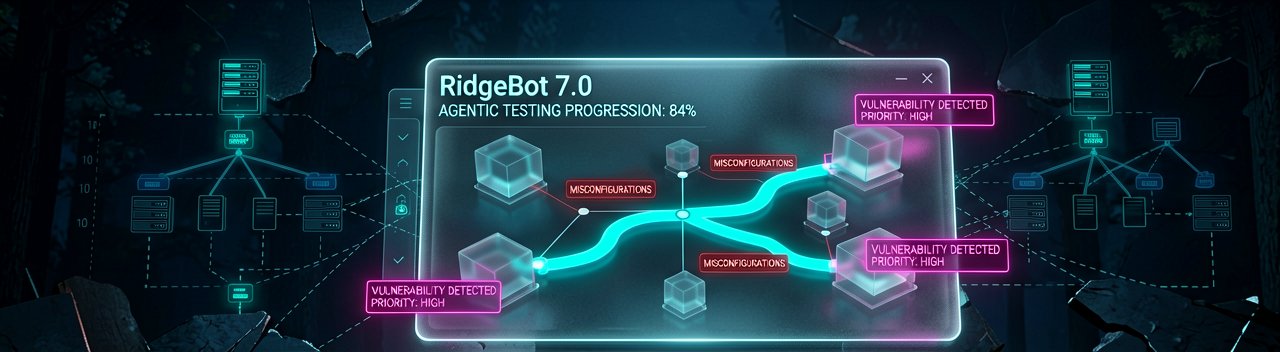
Historically, identifying these complex, multi-stage attack paths required highly skilled human penetration testers executing manual scripts over the course of several weeks. This created an operational bottleneck, as networks change by the hour, but security audits often happen only once a year. Ridge Security is positioning RidgeBot 7.0 as a bridge for this persistent visibility gap, turning what used to be a specialized, artisanal process into an on-demand, algorithmic diagnostic tool that runs continuously in the background.
The Realities of Automated Exploitation
While the promise of fully automated penetration testing is highly appealing to resource-constrained security operations teams, it also highlights an ongoing debate within the cybersecurity community regarding the boundaries of autonomous software. Traditional vulnerability scanners simply look for missing software patches and flag them as potential risks, often generating a high volume of false positives. In contrast, agentic AI platforms actually execute benign versions of exploits, actively attempting to harvest credentials and traverse networks to prove a vulnerability is truly weaponizable.
This shift from theoretical scanning to active validation provides engineering teams with the deterministic data they need to prioritize remediation efforts. Security administrators no longer have to guess which patch matters most; they can visually track the exact chain of execution the AI used to compromise a system. This practical evidence helps eliminate friction between security teams and IT operations, streamlining the process of closing critical security gaps before external adversaries can exploit them.
Balancing Defense with Operational Risks
Deploying an automated system capable of simulating domain-wide compromises requires a delicate balance between aggressive testing and corporate operational stability. Active Directory is a highly sensitive component of corporate networks, and poorly executed automated queries can inadvertently lock out legitimate users, disrupt authentication services, or trigger system instability. Developers in this space face the ongoing challenge of engineering AI agents that can thoroughly pressure-test security controls while maintaining strict guardrails to prevent accidental downtime.

As organizations integrate these automated testing capabilities into their defensive strategies, the role of the human security analyst is shifting from manual exploration to strategic oversight. The continuous data streams generated by platforms like RidgeBot 7.0 allow defenders to move away from reactive firefighting and focus on building more resilient architecture. In a threat environment where attackers increasingly rely on automated tools to discover network vulnerabilities, deploying automated defenses is becoming an operational necessity for safeguarding enterprise identities.
The Double-Edged Sword of Autonomous Offense
Reading Between the Lines: The cybersecurity industry has a long-standing infatuation with the word "automation," often pitching it as a magic bullet for systemic staffing shortages and human error. In theory, handing the keys of offensive testing over to an AI agent like RidgeBot 7.0 levels the playing field against highly automated ransomware syndicates. Yet, a fundamental contradiction remains at the heart of this approach: by lowering the technical barrier to execute sophisticated Active Directory attacks, vendors are inadvertently perfecting blueprints that could easily be reverse-engineered or abused if the testing platform itself is compromised.
There is also a measure of skepticism to be maintained regarding how "autonomous" these systems truly are when confronting bespoke, highly customized enterprise environments. While standard Active Directory deployments follow predictable structures, large corporations usually run on a messy patchwork of legacy upgrades, multi-forest trusts, and fragile third-party integrations. An AI trained on standardized attack vectors may excel at finding common misconfigurations, but it risks overlooking the bizarre, non-standard workarounds that human hackers routinely exploit—or worse, it might misinterpret a delicate legacy configuration and inadvertently trigger a localized network outage.
The Compliance Trap vs. Actual Security
Furthermore, the rise of continuous automated testing threatens to distort how corporate boards measure risk management. Because these tools can generate clean, structured reports at the push of a button, organizations run the risk of treating penetration testing as a check-the-box compliance metric rather than a rigorous defensive exercise. A green dashboard from an automated tool can create a false sense of security, masking the deeper architectural flaws that no automated script can patch, such as poor employee security culture or systemic supply chain vulnerabilities.
Ultimately, the true value of RidgeBot 7.0 and its contemporaries will not be measured by how many simulated domain compromises they achieve, but by how effectively organizations can actually ingest and act upon the resulting data flood. If security teams are already drowning in alerts from traditional scanners, simply upgrading to an AI-driven attack engine will only deliver more sophisticated bad news at a faster rate. Automation is an undeniable force multiplier, but it remains entirely dependent on having a capable human army ready to rebuild the fortresses it safely knocks down.
"We are rapidly approaching a corporate future where AI security agents will spend all day autonomously attacking AI network defenses, leaving human administrators to do what they do best: sign the procurement invoices and hope nobody accidentally unplugs the main server."
Artūras Malašauskas is an AI Systems Integrator with 20+ years of production-grade web engineering experience. He has designed, shipped, and scaled enterprise Python/PHP systems for logistics, SaaS, and public-sector clients. For the past year, he has focused exclusively on AI integrations: deploying open-source LLMs, building generative media pipelines (image, audio, video), and engineering multi-agent workflows for real production environments. His standard: reproducibility, security, cost-efficient inference—no vaporware. He documents and evaluates emerging AI tooling, separating verified capabilities from marketing noise. Technical editor at: muza-ai.eu, ai-verslas.lt, ai-naujinos.lt Connect on LinkedIn
Comments