The Great Aesthetic Flattening: Why Human Friction is the Last Defense Against the Echo Chamber
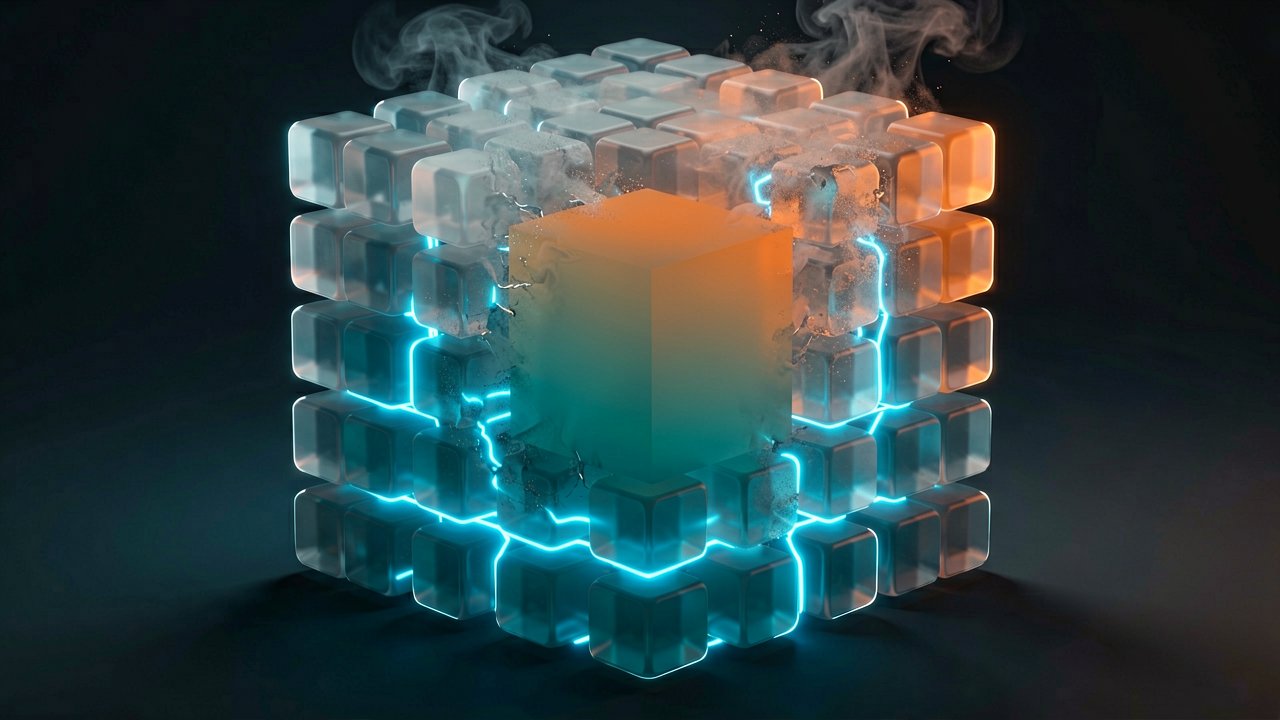
Open any design portfolio, stream a freshly minted indie album, or scroll through a modern branding deck, and you'll likely feel an eerie sense of déjà vu. It's a slick, unblemished familiarity where the corners are perfectly rounded, the copy is impeccably punchy, and the colors fit neatly into predictable, mathematically optimized harmonies. We've officially entered the era of the algorithmic echo chamber. By outsourcing our initial sparks of inspiration to foundational models trained on the exact same subsets of the internet, we've traded the messy, unpredictable chaos of human originality for a hyper-efficient assembly line of creative mediocrity. The terrifying reality is that this cultural stagnation isn't just speculative anymore—it's actively reshaping our world.
Recent empirical research confirms our worst fears about this digital monoculture. A comprehensive systematic review published through the Tilburg University Research Portal reveals that while generative tools dramatically increase individual fluency, they simultaneously trigger an aggressive collapse in collective idea diversity. When multiple creators lean on the same underlying neural networks, their outputs inevitably drift toward a compressed, uniform middle. It's a mathematical inevitability known as mode collapse. The algorithm operates on statistical probability, meaning it's structurally engineered to serve up the most predictable, conventional remix of what already exists. When we ask a machine to dream for us, we don't get a radical leap forward; we get a glossy, automated average.
The Trap of the Path of Least Resistance
The problem isn't just that the machine lacks a soul—it's that it rewards our natural human laziness. Psychologists have long pointed out that human ideation suffers from a cognitive fixation effect, where the mind instinctively takes the path of least resistance. Generative systems capitalize on this vulnerability by presenting instant, high-fidelity mockups that feel like finished thoughts. Creators are abandoning the agonizing, iterative grunt work of sketching, failing, and stumbling into happy accidents. Instead, they're morphing into mere editors, reacting to a closed loop of pre-chewed options. When the act of thinking is fully outsourced to a black box, true literacy and agency vanish, leaving behind an industry of prompt-engineers trapped in a mirror world of their own making.
Reigniting Originality Through Strategic Friction
Breaking free from this cycle requires us to completely upend how we interact with technology. The most visionary creators are beginning to weaponize intentional friction, stepping entirely outside the polished parameters of standard UI design. They're treating these systems not as conceptual architects, but as strict execution assistants—preserving the initial, messy phase of ideation for human minds and real-world observation. True innovation thrives on the edge of the unexpected, the deeply personal, and the deliberately flawed. To outpace the repetitive loop of automated culture, we must stop designing for the smooth, optimized center and start building for the jagged, beautiful contradictions that make human expression inherently unrepeatable.
The human creative process was never meant to be clean. It's forged in the unpredictable trenches of self-doubt, sudden left turns, and spontaneous, unrepeatable bursts of insight. When we trace the genealogy of our finest cultural milestones, we don't find a sterile optimization loop. We find a history of magnificent accidents—the jagged guitar feedback that birthed a rock revolution, or the stray ink smudge that completely reframed a modernist canvas. By over-relying on predictive text and homogenized design frameworks, we risk engineering a world entirely devoid of these vital anomalies. We are trading the agonizing thrill of the unknown for the lukewarm comfort of a pre-calculated safety net.
The Architecture of Manufactured Consensus
This systemic flattening isn't confined to a single medium; it's actively calcifying into a brand-new corporate industrial complex. Across design agencies and content houses, the metrics of engagement have quietly replaced the metrics of taste. A fascinating dive into the mechanics of automated aesthetics by researchers at the Tilburg University Research Portal spotlights how collaborative tools can act as an invisible, leveling gravity. When an entire creative team benchmarks its output against the same baseline suggestions, individual artistic eccentricities are polished away before they ever see the light of day. It's a frictionless slide toward consensus, transforming what should be a vibrant artistic ecosystem into a boardroom-approved mirror maze.
This reliance on synthetic ideation also breeds a subtle, creeping cognitive compliance. Relying on an algorithm to generate the skeleton of an argument or the initial palette of a brand identity bypasses the deep, analytical processing required for genuine mastery. The human mind builds creative muscles by wrestling directly with raw material, sitting in the discomfort of a blank page, and fighting through the bad ideas to uncover the exceptional ones. When the machine removes that initial struggle, it leaves behind an industry of passive orchestrators who can instantly spot a flawless layout but can no longer articulate why it deserves to exist in the first place.
Reclaiming the Radical Power of the Flaw
To resist this automated gravity, the next generation of creators will need to develop an active appetite for subversion. The path forward lies in intentional rule-breaking—using tools counter-intuitively, feeding systems contradictory prompts, and stepping away from the screen to embrace real-world chaos. True originality isn't found by playing smoothly within the guardrails; it lives in the friction where the system breaks down. By reclaiming our right to be messy, inefficient, and wildly inconsistent, we protect the very spark that makes art a profound human connection rather than a highly optimized data point.
The ultimate battlefield for originality isn't the software we deploy, but our willingness to be inefficient. In our mad dash to eliminate the friction of the blank page, we've inadvertently sterilized the soil from which genuine breakthroughs grow. The algorithmic monoculture relies on our compliance, feeding on our desire for speed and predictable outcomes. When efficiency becomes the sole metric of artistic production, human agency is reduced to a simple game of curation, choosing between minor variations of the exact same pre-chewed data.
The Real Danger of the Optimized Mindset
This structural conformity leaves us with a deeper cultural deficit that goes far beyond generic branding or repetitive indie hooks. When we train our minds to think through the narrow lens of mathematical probability, we slowly lose the capacity for radical, paradigm-shifting imagination. The systematic data compiled by institutions like the Tilburg University Research Portal proves that collective human output flattens the moment we let neural networks do the heavy lifting. By allowing machines to define the boundaries of the acceptable, we are constructing a self-reinforcing prison of our own design.
True creative survival requires us to view these automated platforms not as partners in thought, but as hyper-efficient interns. They are brilliant at organizing existing knowledge, summarizing massive datasets, and handling the monotonous logistics of production. However, the conceptual architecture, the emotional gut check, and the deliberate defiance of convention must remain fiercely, uncompromisingly human. We must actively seek out the analog, the un-quantifiable, and the beautifully illogical experiences that cannot be scraped into a training model.
The Last Frontier of Human Originality
Moving forward, the defining signature of great artists will be their unique, un-copyable flaws. The ability to inject personal history, specific trauma, and irrational joy into a project creates an emotional resonance that a statistical average simply cannot simulate. By reclaiming the deliberate, agonizing, and messy process of thinking for ourselves, we build an impenetrable defense against cultural stagnation. The loop of the machine can only copy what we've already done; the future belongs entirely to those who still dare to stumble into the unknown.
The algorithm can predict exactly what the crowd wants to hear next, but it will never understand the profound human brilliance of choosing to play the wrong note on purpose.
Artūras Malašauskas is an AI Systems Integrator with 20+ years of production-grade web engineering experience. He has designed, shipped, and scaled enterprise Python/PHP systems for logistics, SaaS, and public-sector clients. For the past year, he has focused exclusively on AI integrations: deploying open-source LLMs, building generative media pipelines (image, audio, video), and engineering multi-agent workflows for real production environments. His standard: reproducibility, security, cost-efficient inference—no vaporware. He documents and evaluates emerging AI tooling, separating verified capabilities from marketing noise. Technical editor at: muza-ai.eu, ai-verslas.lt, ai-naujinos.lt Connect on LinkedIn
Comments