AI High Schools: The Latest Gimmick in America's Race to Stay Relevant
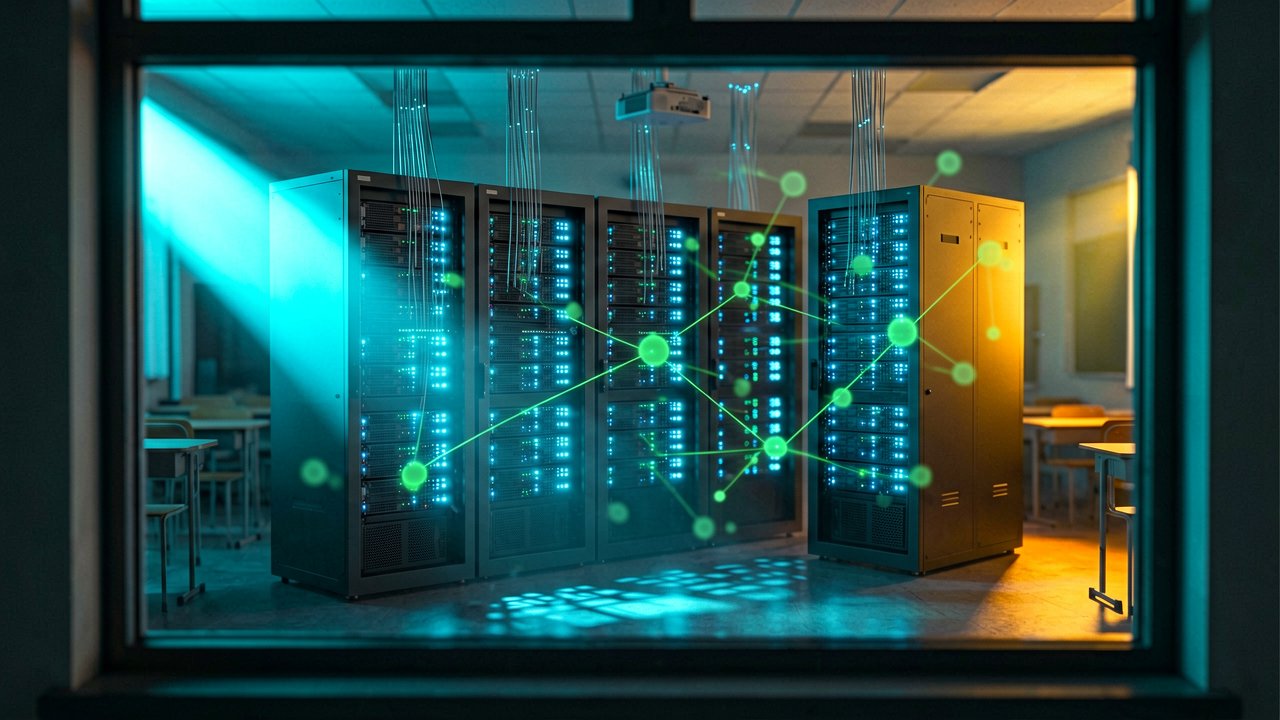
Step into the classrooms of America’s newest public school experiments, and you will not find dusty chalkboards or dog-eared textbooks. Instead, teenagers are greeted by glowing monitors, algorithmic prompts, and a curriculum built entirely around artificial intelligence. From Silicon Valley to the Rust Belt, school districts are suddenly rebranding themselves as "AI academies," promising parents that a heavy dose of machine learning will secure their children a golden ticket into the future workforce. It is a seductive sales pitch, born out of a desperate, long-standing panic that American public education is falling fatally behind the rest of the world.
Yet, stripping away the shiny marketing reveals a familiar, troubling pattern. For decades, US schools have thrown billions at silver-bullet technologies—from iPads to smartboards—only for those tools to collect dust or serve as expensive distractions. This latest craze raises the stakes. By outsourcing critical thinking to large language models before students even master basic algebra, we risk raising a generation that knows how to prompt a machine, but not how to think for themselves. It looks less like an educational revolution and more like a desperate, corporate-backed gimmick to gamify the classroom.
The Real Cost of the Algorithmic Classroom
The push to centralize AI in secondary education is moving at breakneck speed, heavily subsidized by tech giants eager to train their future user base. School boards are eager to sign lucrative contracts, often ignoring warnings from developmental psychologists about shortened attention spans and diminished writing capabilities. When software generates the essays and corrects the code, the friction required to actually learn a skill vanishes. True education requires that cognitive struggle; bypassing it with an automated assistant turns students into passive consumers rather than active creators.
Furthermore, these specialized programs frequently exacerbate the very inequities they claim to solve. While affluent districts use AI as a sophisticated supplement, underfunded schools are tempted to use automated software as a cheap replacement for certified human teachers. As reported by The New York Times, tech integration in classrooms often mirrors existing socioeconomic divides, widening the gap between students who receive premium, human-led mentorship and those left to learn from a screen.

A History of Unfulfilled Tech Promises
We have seen this movie before, and the ending is always the same. In the early 2010s, the mass adoption of laptops was supposed to democratize learning and equalize test scores. Instead, study after study showed that digital-heavy classrooms often led to lower comprehension rates and unprecedented levels of student distraction. America's obsession with being first in technology consistently blinds it to the fundamentals of pedagogy: small class sizes, well-paid teachers, and robust arts and humanities programs that build actual empathy and innovation.
If the race to stay relevant relies entirely on turning high schools into corporate tech incubators, the race is already lost. Coding languages change, software suites update overnight, and the specific AI tools taught to a freshman today will likely be completely obsolete by the time they graduate college. Rather than chasing the latest Silicon Valley trend, American education needs to double down on teaching students how to read deeply, question authority, and understand the historical context of the world they are about to inherit.
Silicon Valley’s new gospel has found its true believers not in corporate boardrooms, but in the principal's office. Across the country, administrators are rushing to pivot from traditional instructional models toward a future entirely shaped by algorithms. The most prominent example is Seckinger High School in Georgia, which brands itself as the nation’s first artificial intelligence-themed public institution. Here, the traditional boundaries of biology, social studies, and art are intentionally infused with an "AI flavor". The district justified this sweeping transformation after reading dire global economic reports predicting massive workforce disruptions. Yet, this institutional rush to satisfy corporate expectations exposes a deeper anxiety about America's educational standing.
While public districts attempt to integrate these tools into existing frameworks, the private sector is taking the experiment to its radical extreme. At the elite, tuition-heavy Alpha School network, traditional human instruction has been entirely dismantled. Students spend just two hours a day interacting with adaptive software that teaches core academic subjects, leaving the rest of the school day for group projects and tech-focused ventures. Human educators are replaced by "guides" who step in only when the technology fails to resolve a student's confusion. This model assumes that human teaching is merely an optimization problem waiting to be solved by a superior computer program.

The Rise of the Invisible Curriculum
This aggressive institutional push ignores a crucial reality: teenagers are already outpacing the system from their smartphones. While administrators debate strict acceptable-use policies and construct rigid specialized pathways, students are quietly developing an unofficial relationship with technology. According to recent educational analyses by Forbes , an "invisible curriculum" has emerged in American classrooms. Students use generative tools to brainstorm, synthesize data, and bypass creative roadblocks entirely outside the view or understanding of their teachers. This creates a massive gap between formal metrics and the actual cognitive habits students rely on to survive academically.
The burden of this rapid technological transition falls squarely on the shoulders of an already exhausted teaching workforce. Public school educators find themselves trapped between top-down administrative mandates to use software and a total lack of practical guidance on how to manage it. Data from U.S. News & World Report indicates that a majority of public school teachers receive zero formal advice or professional training on implementing AI in their daily lessons. This policy vacuum fuels widespread burnout, leaving instructors to act as tech-support monitors rather than intellectual mentors.
Preserving the Human Core of Learning
When education becomes entirely automated, the nature of intellectual discovery changes for the worse. When a machine provides instant feedback and flawless summaries, it robs students of the valuable frustration that accompanies genuine learning. True intellectual maturity does not come from engineering the perfect prompt; it comes from struggling with a complex text, formulating an original thesis, and learning from failure. Reducing education to a seamless user experience risks producing graduates who possess technical compliance but lack deep critical thinking skills.
The ultimate irony of the AI high school trend is that it trains children to mimic machines at the exact moment machines are becoming indistinguishable from humans. If public education is to maintain its relevance, it must stop treating classrooms as corporate labor incubators. Instead of rushing to automate the curriculum, schools should double down on the qualities technology cannot replicate: ethical reasoning, historical context, and the deep mentorship that only a human teacher can provide. True innovation lies not in the software we buy, but in our willingness to protect the human elements of thought from total automation.
The ultimate tragedy of the automated classroom is that we are preparing children for a world that will no longer exist by the time they enter it. Educational policymakers remain trapped in a 20th-century mindset, viewing technology as a static set of tools to be mastered through rote repetition. They fail to see that generative models evolve exponentially faster than any state-approved curriculum can adapt. By the time a high school freshman masters a specific programming environment or prompt-engineering framework, that entire methodology will likely be integrated into the background architecture of consumer software. We are effectively training students for technological compliance in an era that demands radical, creative adaptability.
This obsession with technical training also overlooks the deepening crisis of teenage socialization and mental health. While school boards eagerly fund expensive server rooms and software licenses, they routinely defund arts programs, counselor positions, and physical spaces for unstructured peer interaction. The screen-centric model of learning deepens the isolation that defines modern adolescent life. Forcing a student to spend their formative years negotiating with an optimized software interface rather than navigating the messy, complex social dynamics of a peer group builds a generation with high algorithmic literacy but dangerously low emotional intelligence.
The Illusion of Corporate Readiness
The corporate entities funding this educational pivot are not acting out of altruism. Tech conglomerates view public schools as massive, captured testing grounds for unproven software and as a pipeline to cultivate brand loyalty from an early age. When public institutions reshape their core educational philosophies around corporate demands, they cease to function as places of civic enlightenment and instead become complimentary workforce-training centers. This symbiotic relationship shifts the financial and ethical burden of job training from wealthy private entities onto the public tax base.
True educational resilience in the age of automation does not require more monitors, faster networks, or specialized AI diplomas. It requires a radical recommitment to the humanities, philosophy, and history—the exact disciplines currently being marginalized as impractical. Understanding how to evaluate the bias of information, analyze the ethical implications of automated decision-making, and resist digital manipulation are the true survival skills of the 21st century. These are intellectual habits cultivated through intense, human-led discussion and debate, not through adaptive multiple-choice software.
The great irony of the technological space race in American education is that in our desperate hurry to ensure our children do not fall behind the machines, we are systematically stripping away the exact qualities that make them human.
Artūras Malašauskas is an AI Systems Integrator with 20+ years of production-grade web engineering experience. He has designed, shipped, and scaled enterprise Python/PHP systems for logistics, SaaS, and public-sector clients. For the past year, he has focused exclusively on AI integrations: deploying open-source LLMs, building generative media pipelines (image, audio, video), and engineering multi-agent workflows for real production environments. His standard: reproducibility, security, cost-efficient inference—no vaporware. He documents and evaluates emerging AI tooling, separating verified capabilities from marketing noise. Technical editor at: muza-ai.eu, ai-verslas.lt, ai-naujinos.lt Connect on LinkedIn
Comments