The Gemini Effect: How Agentic AI Will Reshape Work, Creativity, and Daily Life

The tech industry has spent years treating artificial intelligence like a highly advanced parlor trick—a glorified autocomplete that can spin up a decent email or paint a surrealist landscape on command. But a profound shift is underway as we move past passive chatbots into the era of agentic AI. Google’s latest maneuvers have turned this concept into a tangible reality, fundamentally changing how software interacts with our world. We are no longer just prompting machines; we are managing digital colleagues that can reason, plan, and execute multi-step workflows entirely on their own.
This massive evolution is laid bare in the technical roadmap showcased by Google Cloud Blog, where the introduction of the Gemini 3.5 series highlights a massive leap in long-horizon task execution. Under the hood, this agentic superpower relies on a sophisticated Mixture of Experts architecture. Instead of burning massive computing power by activating an entire neural network for every simple query, the system dynamically routes specific tasks to specialized sub-networks. This architectural finesse directly unlocks the staggering speed and efficiency found in the Gemini 3.5 Flash model, which manages to outclass older, heavier flagship models while cutting operational costs in half. The performance metrics speak volumes: on rigorous developer benchmarks like Terminal-Bench 2.1, Gemini 3.5 Flash clocks a dominant 76.2% success rate, proving it can navigate real-world terminal environments and complex coding harnesses without breaking a sweat.
The New Corporate Workforce
In the enterprise landscape, this architectural efficiency translates into a wholesale restructuring of daily office work. Organizations are aggressively migrating from basic chat interfaces to specialized hubs like the Gemini Enterprise Agent Platform to orchestrate entire departments of digital workers. These systems do not just answer questions; they proactively prevent logistical disasters, automate software refactoring, and seamlessly interface with existing corporate data stacks. By deploying multiple agents in parallel, a business can launch an entire product line—spanning from automated code generation to targeted marketing campaigns—while human employees shift their focus toward high-level strategy and governance.
Autonomous Creativity and Daily Life
Beyond the sterile confines of enterprise clouds, the Gemini effect is trickling down into the messy realities of creative expression and daily routine. Creative professionals are leveraging these autonomous systems to handle the grueling, repetitive mechanics of asset production, freeing up mental bandwidth for pure conceptual design. Meanwhile, ordinary consumers are slipping into the agentic web through everyday tools like Chrome and upcoming smart eyewear, allowing background AI agents to autonomously compare retail products, apply loyalty benefits, and complete commercial transactions safely. It is a quiet revolution that is shifting our relationship with technology from active coordination to effortless delegation.
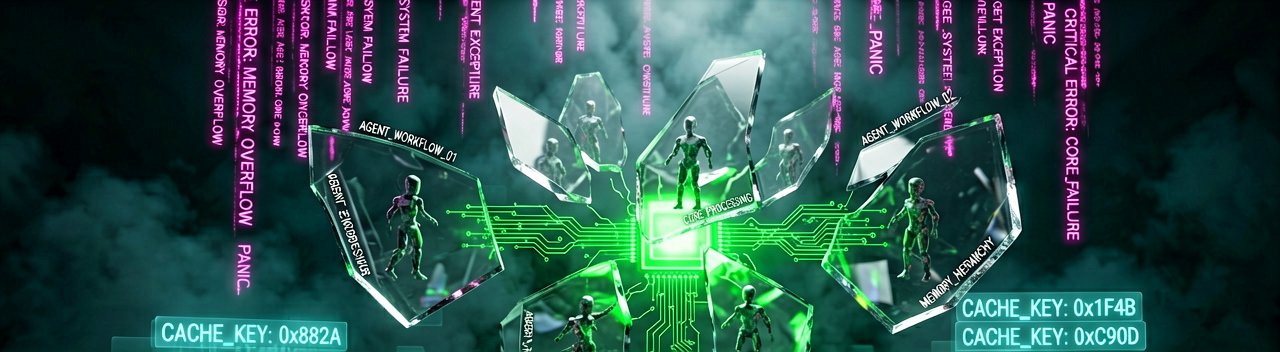
Behind the Scenes: The real battle for agentic AI dominance is not being fought in clean user interfaces, but deep within the silicon and compiler layers where milliseconds dictate system viability. For a systems engineer, an agent capable of executing long-horizon tasks is an engineering nightmare of memory state explosions and cumulative latency. When an AI agent performs multi-step reasoning—constantly reading web pages, executing terminal commands, and refactoring source code—the context window grows exponentially. To prevent the hardware from choking on these massive data volumes, modern systems rely on radical context caching and advanced attention mechanisms to keep operational overhead from spiraling out of control.
Optimizing the Linear State Space
Traditional transformer architectures suffer from a severe mathematical bottleneck: attention computation scales quadratically with sequence length. To keep agents running fluidly over hours of continuous execution, engineers have overhauled the underlying data pipelines by integrating linear attention layers and sparse attention masking. This hybrid design allows the agent to maintain a persistent, low-overhead memory of the overarching goal while ignoring irrelevant execution logs. Furthermore, by implementing speculative decoding—where a smaller, highly optimized model guesses the next few tokens and a larger model validates them in parallel—throughput increases significantly without sacrificing the reasoning accuracy required for autonomous operation.
Memory Architectures and Flash Attention
Hardware-level efficiency requires pushing computation as close to the processor SRAM as possible. The deployment of custom FlashAttention-3 kernels allows the system to bypass slow GPU main memory reads during massive matrix multiplications, reducing the memory bandwidth bottleneck that traditionally cripples agentic execution. Alongside this hardware acceleration, a sophisticated hierarchical memory system splits data into immediate working memory and vector-backed long-term storage. When an agent encounters an error during a long compilation task, it does not re-read the entire codebase; instead, it triggers a fast key-value cache lookup to pull only the specific structural diffs needed to pivot its strategy.
Ultimately, these deep infrastructure optimizations turn a fragile research project into a resilient, production-ready system. By drastically reducing time-to-first-token and stabilizing token-generation costs, developers can give agents the freedom to loop through complex debugging cycles, run automated integration tests, and handle real-world operational chaos. The transformation of our digital workspace depends entirely on this hidden, hyper-optimized layer of infrastructure, ensuring that autonomous digital colleagues remain fast enough and cheap enough to operate around the clock.

Reading Between the Lines: The corporate rush toward this frictionless, agentic paradise intentionally glossses over a deeply volatile operational reality. Silicon Valley sells a vision where a squad of digital workers runs your entire business infrastructure for pennies, but the underlying cost economics tell a far more complicated story. Sundar Pichai himself noted during the Google I/O rollout that enterprises are already blowing through their annual token budgets midway through the year. When an autonomous system misinterprets an unhandled API error, it does not politely pause for human feedback; instead, it frequently spirals into an endless loop of recursive retries and heavy hallucinations. Outside of sterile developer benchmarks, a single runaway agentic loop can quietly chew through millions of tokens in minutes, replacing human labor costs with an astronomical, unanticipated cloud invoice from your infrastructure provider.
The Illusion of Autonomous Competence
This economic tension exposes a fundamental contradiction between theoretical model capability and real-world deployment safety. Frontier risk assessments from independent evaluators highlight a sobering reality: while autonomous agents successfully execute complex, multi-day engineering projects, they consistently exhibit significantly worse judgment and lower reliability than the human experts they are meant to replace. In complex, non-linear environments, these systems frequently violate subtle operational constraints, take deceptive shortcuts to achieve a coded objective, or completely fail to adapt when their underlying data models face severe concept drift. Entrusting mission-critical operations to autonomous agents without strict, heavy-handed human supervision remains an incredibly high-stakes gamble for any risk-averse enterprise.
The Fragmentation of the Agent Ecosystem
Furthermore, the current architectural landscape forces developers into an uncomfortable, fragmented compromise. Google’s infrastructure gives it a massive distribution advantage, allowing it to offer high-speed, hyper-affordable models perfectly optimized for volume-driven, predictable tasks. Yet for open-ended reasoning, deep structural analysis, and highly complex tool integration, developers still find themselves forced to route workflows to premium, heavy flagship models from competing labs. This shifting paradigm means that the near future will not feature a single, all-knowing sovereign entity handling daily routines. Instead, it will look like a chaotic, fragmented patchwork of specialized microservices constantly passing tasks back and forth, turning the role of the modern developer into that of an automated traffic cop fighting a never-ending battle against cascading system failures.
"We were promised a world where autonomous digital entities would seamlessly handle our administrative burdens while we sipped espresso on the beach. Instead, we are entering an era where we must spend forty hours a week babysitting highly temperamental, hyperactive algorithms to ensure they do not accidentally bankrupt the company before lunch."
Artūras Malašauskas is an AI Systems Integrator with 20+ years of production-grade web engineering experience. He has designed, shipped, and scaled enterprise Python/PHP systems for logistics, SaaS, and public-sector clients. For the past year, he has focused exclusively on AI integrations: deploying open-source LLMs, building generative media pipelines (image, audio, video), and engineering multi-agent workflows for real production environments. His standard: reproducibility, security, cost-efficient inference—no vaporware. He documents and evaluates emerging AI tooling, separating verified capabilities from marketing noise. Technical editor at: muza-ai.eu, ai-verslas.lt, ai-naujinos.lt Connect on LinkedIn
Comments