The Digital Drill: Why AI is Big Oil's New $500 Billion Crude
For years, Silicon Valley pitched artificial intelligence as the ultimate tool to disrupt legacy industries, but it turns out the old guard of fossil fuels might just be its most lucrative playground. A definitive market study by Rystad Energy reveals that digitalization and AI are on track to generate a staggered $500 billion in combined value for upstream exploration and production (E&P) companies between now and 2030. It is a staggering sum that reframes the entire tech-energy nexus; we are no longer just talking about algorithms optimizing data centers, but software radically supercharging the extraction of physical molecules from the earth.
This massive half-trillion-dollar windfall isn't coming from hypothetical, far-future tech. It is being pulled directly from concrete, efficiency-driven cost cuts, significantly shorter project development timelines, and boosted production yields through minimized equipment downtime. According to the data, forward-thinking E&P operators utilizing advanced digital architectures will unlock an additional $80 billion in annual value by 2030 compared to their 2025 baselines. Early proof of this financial evolution is already leaking into corporate earnings reports, showing that the industry's heaviest hitters are aggressively scaling their deployments to outpace rivals.
From Code to Crude: Early Adopters Take the Prize
The financial returns of this digital shift are proving to be immediate and highly impactful. State-backed energy giant ADNOC pulled in an extra $500 million solely from its AI initiatives in a single year, subsequently earmarking $1.5 billion in digital capital spending to chase an annual run-rate of $1 billion in technology-derived value. Meanwhile, Norway’s Equinor clawed back roughly $200 million in AI-linked savings over a multi-year period before watching those gains compound sharply to register $130 million in savings for 2025 alone. The math is simple: companies that treat data as a core asset are finding ways to extract oil cheaper, safer, and faster than ever before.
The Widening Execution Gap
However, this transition is exposing a harsh reality for slow-moving legacy operators who view tech integration as a luxury rather than a necessity. The study points out that digital value follows a strictly compounding path; it accelerates what happens inside an already mature organization, but it cannot fix broken, siloed corporate infrastructure. As data and institutional intelligence accumulate, the competitive divide between early tech adopters and laggards will widen into a cavernous gap. To truly capture a piece of that $500 billion pie, energy firms have to stop running isolated pilot programs and start embedding AI systems at the absolute core of their physical operations.
What Most Reports Miss: The Invisible Upstream Architecture
The glossy headlines detailing half-trillion-dollar windfalls inevitably focus on high-profile corporate announcements, yet the true mechanics of this shift live deep inside the engineering stack. For decades, the oil and gas sector operated on fragmented data silos, where reservoir engineers, drilling crews, and logistics teams utilized entirely different software ecosystems. The current AI boom is not actually about introducing flashy new algorithms; it is about building unified data fabrics that allow machine learning models to analyze the entire lifecycle of an oilfield simultaneously. Without this foundational boring work of data harmonization, even the most sophisticated neural networks are entirely useless.
From a stakeholder perspective, this architectural overhaul is radically altering the traditional power dynamic between legacy oil services firms and Silicon Valley tech giants. Large operators are increasingly bypassing traditional oilfield services providers to establish direct joint ventures with cloud computing leaders and specialized AI vendors. This shift has triggered an intense talent war, forcing energy companies to compete directly with Big Tech for data scientists and machine learning engineers. To win these recruits, oil executives are having to offer tech-style compensation packages and completely rebrand their corporate cultures from old-school industrialism to cutting-edge digital development hubs.
Historically, the energy sector has always been a hotbed of computing innovation—seismic imaging, after all, practically birthed modern commercial supercomputing in the late 20th century. However, the industry's historical approach to software was highly cautious, characterized by multi-year testing cycles and a deep aversion to operational risk. The current pressure to integrate AI is forcing a cultural pivot toward agile development, where code is deployed, tested, and iterated upon in real-time. This faster pace introduces unprecedented operational friction, as field engineers accustomed to absolute predictability must now trust algorithmic recommendations for complex tasks like autonomous drilling or predictive pipeline maintenance.
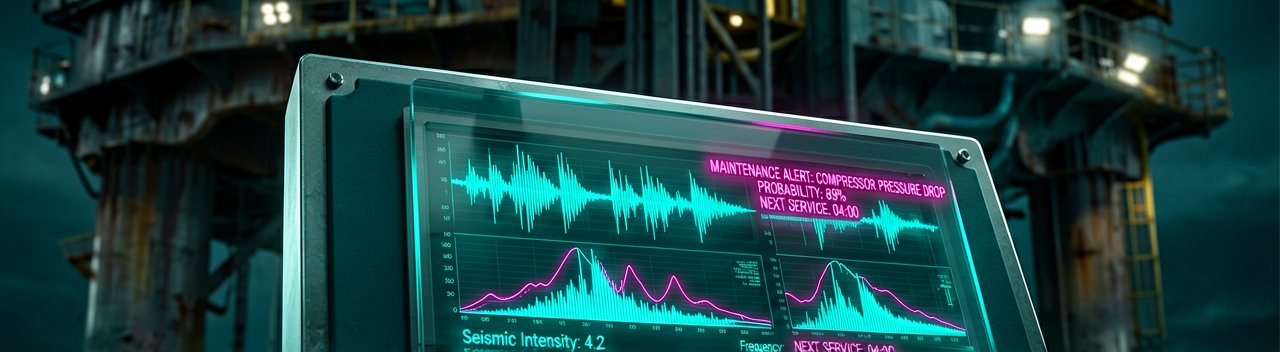
Furthermore, this digital acceleration serves a dual purpose that standard financial reporting often overlooks: compliance and emissions tracking. Under intense regulatory and investor scrutiny to reduce carbon footprints, operators are leveraging machine learning to pinpoint fugitive methane emissions and optimize energy consumption across offshore platforms. By using AI to predict equipment failures before they happen, companies drastically cut down on flaring events and catastrophic leaks. Consequently, the technology is being leveraged not just as a tool for maximizing raw crude extraction, but as a vital survival mechanism for navigating an increasingly strict global regulatory landscape.

Reading Between the Lines: The Cost of Algorithmic Oil
The intoxicating allure of a $500 billion valuation windfall conveniently glosses over a glaring paradox: the immense computing power required to generate these efficiencies is itself an energy hog. Training and deploying the complex neural networks needed for real-time seismic inversion and autonomous drilling requires a massive expansion of data centers. These facilities consume vast amounts of electricity, often pulling from the very grids that fossil fuel companies are under pressure to help decarbonize. This creates a bizarre feedback loop where the industry relies on a heavily carbon-intensive tech infrastructure to optimize its own carbon-extracting operations, complicating any neat narratives about AI-driven sustainability.
There is also a profound skepticism regarding the "black box" nature of advanced AI models when applied to high-stakes, volatile physical environments. In a silicon valley laboratory, an algorithmic hallucination results in a broken webpage; on an offshore drilling rig, a miscalculated pressure prediction can trigger a catastrophic blowout. Many field engineers remain deeply hesitant to cede control to predictive maintenance software that cannot explain its own reasoning. This trust deficit means that despite massive corporate capital expenditure on software licenses, actual on-the-ground adoption often stalls, leaving expensive digital platforms underutilized while crews rely on traditional, time-tested manual overrides.
Furthermore, the projection of immense value assumes a stable regulatory and geopolitical landscape that rarely exists in the energy sector. If AI successfully flattens the cost curve and floods the market with cheap, highly optimized production, standard economic theory suggests a subsequent drop in global crude prices. This potential oversupply could cannibalize the exact financial margins that the technology was deployed to protect in the first place. The industry may find that it has spent billions of dollars on digital transformation simply to stay in the exact same economic position, effectively running faster just to stand still on a shifting geopolitical treadmill.
"Ultimately, Big Oil's grand digital transformation proves that the more things change, the more they stay the same. The industry is spending billions on silicon valley's brightest minds just to figure out how to do what it has always done best: pull stuff out of the ground slightly faster than the guy next door, while praying the market doesn't crash before the next earnings call."
Artūras Malašauskas is an AI Systems Integrator with 20+ years of production-grade web engineering experience. He has designed, shipped, and scaled enterprise Python/PHP systems for logistics, SaaS, and public-sector clients. For the past year, he has focused exclusively on AI integrations: deploying open-source LLMs, building generative media pipelines (image, audio, video), and engineering multi-agent workflows for real production environments. His standard: reproducibility, security, cost-efficient inference—no vaporware. He documents and evaluates emerging AI tooling, separating verified capabilities from marketing noise. Technical editor at: muza-ai.eu, ai-verslas.lt, ai-naujinos.lt Connect on LinkedIn
Comments