Beyond the Prompt: Google Marches Into the Agentic Gemini Era

For years, tech giants have conditioned us to treat artificial intelligence like a highly advanced magic eight-ball. You type a prompt, cross your fingers, and hope the machine spits out something usable. But at this year’s I/O conference, Google made it explicitly clear that the era of passive chatbots is officially dead. Sundar Pichai took the stage to announce what the company calls the "agentic Gemini era"—a fundamental paradigm shift where AI steps away from simple question-and-answer interactions and takes the wheel as an autonomous, proactive assistant capable of handling multi-step workflows entirely in the background.
This isn't just a minor iteration or a clever marketing rebrand. Google is backing this philosophical shift with a massive technological overhaul, releasing specialized models like Gemini 3.5 Flash and Gemini Omni alongside robust infrastructure designed specifically for autonomous action. According to a detailed keynote recap by The Federal, Mountain View is aggressively betting its $190 billion capital expenditure budget that users want software that acts on their behalf rather than just answering their questions. The transition shifts AI from a passive digital assistant into a persistent, round-the-clock partner that handles everything from enterprise software engineering to sorting your personal inbox while you sleep.
Meet Spark: The Always-On Digital Clone
The crown jewel of this consumer agent push is Gemini Spark, a 24/7 personal AI agent designed to quietly orchestrate your digital life. Unlike traditional LLMs that pause execution the moment you close your browser tab, Spark lives entirely in the cloud on dedicated virtual machines. It is engineered to proactively scan your emails, chats, and calendar invites, synthesize massive amounts of data, and generate actionable items—such as building a live RSVP tracker directly in Google Sheets—without requiring an initial prompt. To soothe growing privacy and safety anxieties, Google built Spark to automatically pause and request explicit user permission before executing high-stakes actions like making a purchase or hitting send on a critical email. The tool is currently rolling out in beta to U.S. subscribers on the Google AI Ultra plan, with a full Google Chrome integration slated for later this summer.
The High-Speed Engines and "Vibe Coding" Infrastructure
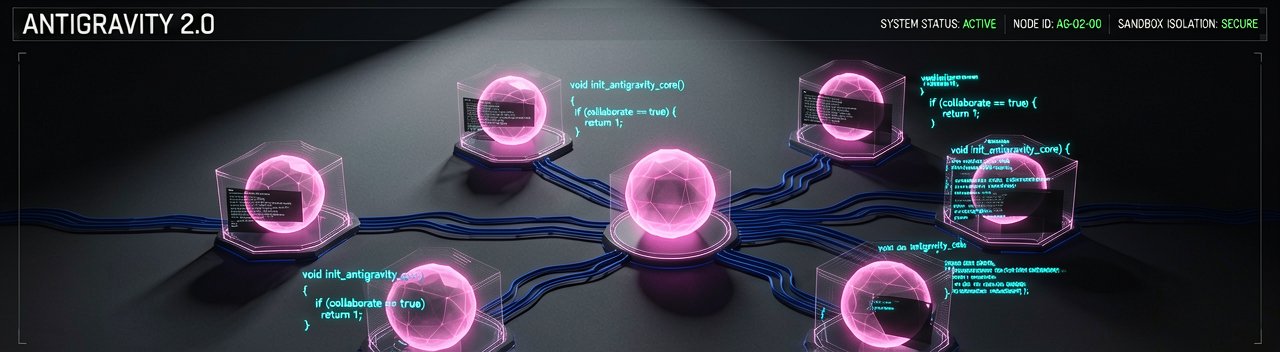
Powering these complex, multi-day background workflows requires a completely different breed of silicon and software, which is exactly why Google unveiled its eighth-generation Tensor Processing Units (TPUs) alongside Gemini 3.5 Flash. This new model is optimized strictly for speed and long-horizon autonomy, clocking in at four times the speed of comparable frontier models while handily outperforming older versions on coding benchmarks. Developers aren't just getting a raw API, either; Google launched Antigravity 2.0, a standalone desktop development platform where engineering teams can orchestrate dozens of specialized subagents to build software simultaneously. In an era where "vibe coding"—creating entire applications simply by describing them to an agent—is becoming reality, Google's new tech stack aims to eliminate the traditional friction of debugging, compiling, and testing by letting the AI validate its own code in isolated Linux sandboxes.
A Total Overhaul of the Iconic Search Box
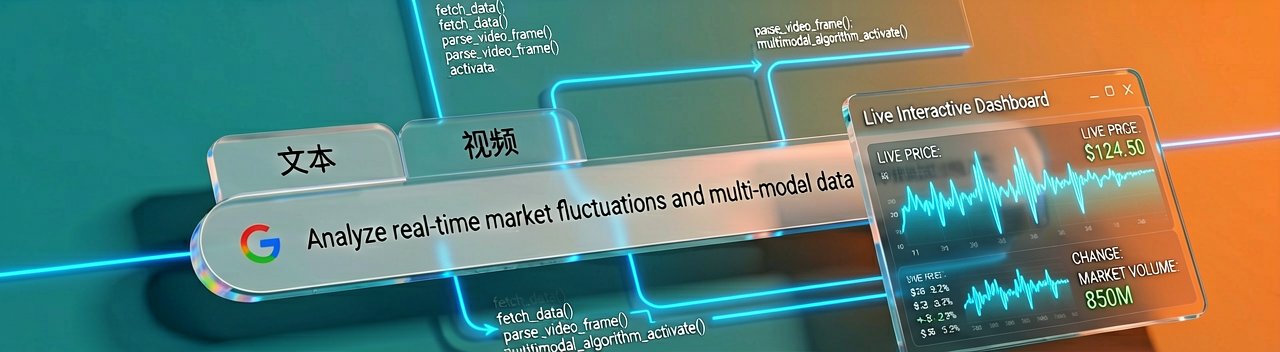
Perhaps the most immediate impact for everyday internet users will be felt in Google Search, which received its most radical facelift in over a quarter of a century. The iconic search box is transforming into an intelligent interface that abandons rigid autocomplete suggestions in favor of complex, multi-modal inputs, allowing you to throw text, videos, and active Chrome tabs into a single query. Powered by Gemini 3.5 Flash and the Antigravity platform, Search will soon be able to write and execute code on the fly to build entirely custom, dynamic layouts, interactive widgets, and personal dashboards tailored precisely to your question. Combined with a cross-merchant "Universal Cart" that monitors price drops and histories across YouTube, Gmail, and Search, Google is transforming the web from a directory of links into a highly personalized ecosystem of bespoke, mini-applications generated instantly for the individual user.
Behind the Scenes: The High-Stakes Architecture of Autonomous AI
While the glittering consumer-facing demos at I/O captured the headlines, the real battle for the agentic era is being fought in the unglamorous trenches of cloud infrastructure and system orchestration. Transitioning from a stateful, single-prompt chatbot to a stateless, long-running agent requires a complete reimagining of the computing stack. When an agent like Gemini Spark runs 24/7 in the background, it cannot simply hold an open connection to a monolithic server cluster. Instead, engineers are utilizing hyper-efficient micro-containers that spin up instantly to process an event—such as a new email receipt—and spin down just as fast, preserving precious GPU and TPU cycles. This orchestration layer represents a massive engineering hurdle that Google has quietly been solving while competitors remain largely focused on raw parameter counts.
Industry insiders point out that this architectural shift transforms how we must think about data privacy and context windows. For an AI agent to reliably automate multi-step workflows like planning an entire corporate retreat, it needs to maintain a persistent memory of past preferences, corporate compliance policies, and real-time budgeting constraints. Google’s advantage here lies in its existing workspace ecosystem, but merging that data safely with autonomous agents requires a zero-trust security framework. Silicon Valley analysts note that the tech giant is effectively building a digital firewall around each user's agent, ensuring that while the AI can scan external APIs to find the best flight deals, the user's private financial data never leaks back into the foundational training set.
From a stakeholder perspective, the enterprise reaction to the agentic era is a mix of intense euphoria and deep systemic anxiety. On one hand, Chief Information Officers are eager to deploy Gemini 3.5 Flash and the Antigravity platform to automate repetitive DevOps pipelines, potentially compressing software development cycles from weeks to minutes. On the other hand, labor economists and legal teams are raises red flags over accountability. If an autonomous agent executing code in an isolated Linux sandbox accidentally brings down a client's live database, determining liability becomes a legal nightmare. Google’s inclusion of explicit human-in-the-loop checkpoints for high-stakes actions is a direct concession to these corporate fears, signaling that complete autonomy is still a distant, heavily regulated goal.
Looking back historically, this moment closely mirrors the early days of mobile operating systems, where the industry shifted from basic web browsing to a rich ecosystem of background-syncing apps. Just as smartphones required new chips to handle background push notifications without destroying battery life, the agentic era demands specialized hardware like Google's eighth-generation TPUs to handle continuous asynchronous inference without bankrupting the cloud provider. The company that successfully standardizes this agent-to-agent communication protocol will effectively control the operating system of the future web. By open-sourcing key elements of the Antigravity framework, Mountain View is clearly attempting to establish its architecture as the default blueprint before rivals can lock down their own proprietary standards.
Reading Between the Lines: The Cost and Friction of Total Autonomy
The tech industry has a well-documented habit of mistaking an impressive demo for a friction-free reality, and the "agentic era" is ripe for a healthy dose of skepticism. Google promises a frictionless world where Gemini Spark handles our lives in the background, but this vision rests on a shaky assumption: that the web is a cooperative playground. In reality, the modern internet is a battlefield of anti-bot defenses, paywalls, and captchas designed precisely to keep automated scripts out. If Gemini 3.5 Flash attempts to scrape data or book a service on a platform that aggressively blocks non-human traffic, the seamless workflow grinds to a halt. Google may control its own ecosystem, but it cannot force the rest of the fractured web to play nice with its autonomous agents.
There is also a glaring contradiction between Google’s environmental sustainability goals and the sheer computational gluttony required to run millions of always-on digital clones. Processing a single traditional search query already requires measurable electrical power; scaling that up to persistent, 24/7 subagents that continuously analyze data, run code in sandboxes, and monitor the web represents an exponential leap in energy consumption. Even with the hyper-efficiency of eighth-generation TPUs, the carbon footprint of keeping a personal AI agent alive in perpetuity threatens to collide head-on with corporate net-zero pledges. Mountain View is pitching a future of effortless convenience, but the hidden environmental and infrastructural invoice for this continuous computing cycle has yet to be fully calculated.
Furthermore, the shift from a proactive prompt to a passive oversight role changes human psychology in ways we are not prepared for. When software acts on our behalf, we exchange the friction of doing work for the cognitive fatigue of auditing work. Checking a spreadsheet generated by Gemini Spark to ensure it didn't confidently hallucinate a vendors' pricing structure requires a tedious level of vigilance. If users must meticulously double-check every automated email, purchase, and code deployment to avoid catastrophic errors, the promised time savings evaporate. The agentic era risks replacing the active creativity of building things with the bureaucratic exhaustion of managing an erratic digital workforce.
"We are rapidly moving toward a world where your AI agent will spend all day negotiating with my AI agent to schedule a meeting that neither of us actually has the energy to attend."
Artūras Malašauskas is an AI Systems Integrator with 20+ years of production-grade web engineering experience. He has designed, shipped, and scaled enterprise Python/PHP systems for logistics, SaaS, and public-sector clients. For the past year, he has focused exclusively on AI integrations: deploying open-source LLMs, building generative media pipelines (image, audio, video), and engineering multi-agent workflows for real production environments. His standard: reproducibility, security, cost-efficient inference—no vaporware. He documents and evaluates emerging AI tooling, separating verified capabilities from marketing noise. Technical editor at: muza-ai.eu, ai-verslas.lt, ai-naujinos.lt Connect on LinkedIn
Comments