South Korea’s Multi-Core Gamble: Decentering Deep-Tech From Seoul

South Korea’s obsession with its capital region is no secret, especially when it comes to the nation's burgeoning startup landscape. For years, Seoul has swallowed up nearly sixty percent of the country’s startup infrastructure, turning the capital into a hyper-concentrated powerhouse while leaving outer provinces searching for crumbs. But the tide is finally turning as the government moves to engineer a multi-hub ecosystem designed to anchor talent exactly where it studies. The Ministry of SMEs and Startups (MSS) is officially kicking off its regional "startup city" initiative, partnering with four major metropolitan cities to decentralized the nation’s deepest tech pipelines.
According to a report by CHOSUNBIZ, the newly designated regional tech hubs—Daegu, Gwangju, Daejeon, and Ulsan—are joining forces with the country's elite scientific institutions. By tethering local industrial infrastructure directly to academic giants like KAIST, DGIST, GIST, and UNIST, the government hopes to ease the hyper-concentration of venture capital in the capital city. It is a calculated gamble to turn regional brains into regional businesses before they pack their bags for Seoul. The ultimate roadmap is incredibly ambitious: the ministry aims to establish ten of these dedicated startup cities nationwide, with the explicit goal of pushing at least five of them into the global top 100 startup ecosystem rankings by 2030.
Breaking the Seoul Monopoly
It's an aggressive pivot from mass funding to precision, region-specific scaling. Under the plan outlined by the The Asia Business Daily, the MSS will significantly relax stringent regulations and academic policies that have historically crippled faculty and student entrepreneurship. Universities will no longer just be centers of theoretical research; they will transform into actual corporate launchpads. Selected regions are slated to receive intense localized support, including direct access to public institution data, robust test-bed infrastructure, and specialized regional venture funds to bridge the metropolitan capital gap. By focusing on specialized local industries—whether it's advanced materials in Ulsan or AI in Gwangju—Korea is trying to build a multi-core tech engine that can weather global economic shifts.
What Most Reports Miss: The Cultural Inertia of the Han River
The real battlefield for the Ministry of SMEs and Startups isn’t regulatory red tape or venture capital allocation; it is the deeply ingrained cultural prestige of Seoul. Decades of economic concentration have conditioned South Korea’s brightest minds to view leaving the capital region as a professional downgrade. For a KAIST graduate in Daejeon or a UNIST researcher in Ulsan, the pull of Seoul’s lifestyle, networking circles, and perceived career safety net remains incredibly potent. Building the physical infrastructure for these regional startup cities is the easy part, but convincing a 26-year-old AI engineer that Gwangju offers the same prestige as Gangnam is an entirely different hill to climb.

Furthermore, local government capabilities vary wildly across the four designated hubs. While Daejeon sits comfortably on decades of federal research and development history via Daedeok Innopolis, cities like Ulsan are traditionally hard-hat industrial towns trying to pivot from heavy manufacturing to software and advanced materials. This disparity means the MSS cannot rely on a one-size-fits-all playbook. Seasoned industry insiders point out that municipal bureaucrats often lack the agility required to manage high-risk, deep-tech portfolios, which could lead to friction when local administrative habits clash with the fast-paced demands of venture-backed startups.
The success of this decentralized multi-core engine ultimately hinges on corporate buy-in from the private sector. Tech giants like Samsung, Hyundai, and SK have historically concentrated their research facilities around the capital to attract top-tier talent, creating a self-fulfilling loop. If these conglomerates refuse to establish regional satellite offices or acquire local deep-tech spin-offs, the provincial hubs risk becoming high-tech holding pens. The government's promised tax incentives and relaxed academic policies are a solid start, but true sustainability will only be achieved when the private sector sees these regional universities not just as talent pipelines, but as essential centers for commercial innovation.
Reading Between the Lines: The Mirage of the Regional Miracle
The core assumption underlying the MSS strategy is that proximity to elite technical universities automatically translates into local economic vitality. However, history suggests this is rarely a linear equation. While institutions like KAIST and UNIST churn out world-class engineering talent, universities are inherently transient spaces; students move where the capital is, not where the campus was. Simply easing regulations on faculty entrepreneurship does little to solve the acute shortage of seasoned, growth-stage executives willing to live and work outside the capital region. Without senior operational talent to scale these deep-tech spin-offs, regional hubs run the risk of becoming mere incubators that breed early-stage ideas, only for those companies to migrate to Seoul the moment they require a Series A funding round.
A glaring contradiction also exists within the government’s timeline. Pushing five regional ecosystems into the global top 100 by 2030 requires a level of velocity that deep-tech inherently resists. Unlike consumer software or fintech, deep-tech sectors like quantum computing, advanced robotics, and biotech demand decade-long horizons and immense capital expenditure before reaching commercial viability. By forcing these fledgling regional hubs to chase arbitrary international rankings on a tight five-year schedule, the ministry risks incentivizing superficial metrics—such as the sheer volume of newly registered entities—over genuine, long-term market disruption. It is a classic bureaucratic trap: prioritizing immediate, politically digestible results over the slow, agonizing burn of true scientific commercialization.
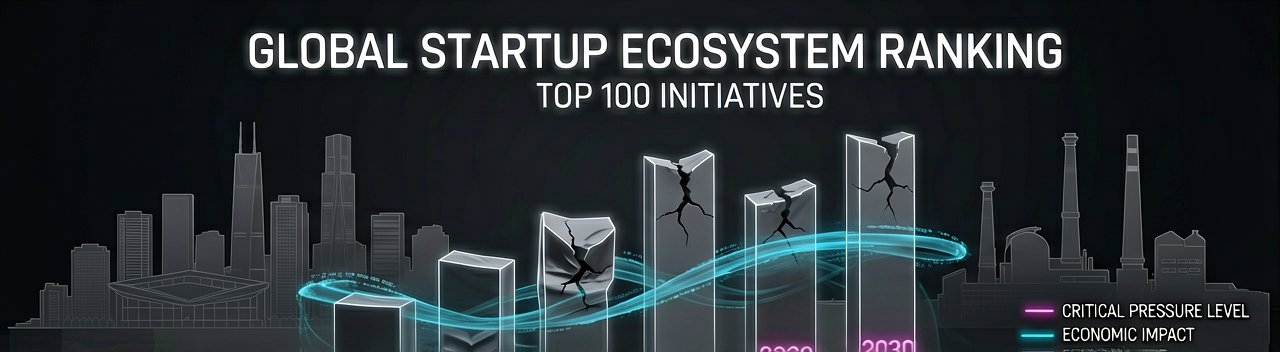
Ultimately, this regional push might inadvertently trigger a zero-sum competition for limited resources among the provinces themselves. Rather than collaborating to build a unified national ecosystem, Daegu, Gwangju, Daejeon, and Ulsan will inevitably find themselves cannibalizing the same finite pool of domestic venture capital and specialized tech talent. If every designated city attempts to build its own independent AI or robotics hub to satisfy local political stakeholders, the result will not be a multi-core powerhouse, but a fragmented landscape of underfunded, understaffed duplicates. True decentralization requires a ruthless degree of national prioritization that political realities seldom permit.
South Korea is discovering that while you can easily mandate a new high-tech zone from a boardroom in Sejong, convincing venture capitalists to spend four hours on a train for a pitch meeting is another matter entirely; in the end, the gravity of Seoul’s espresso bars and networking lounges might just prove stronger than any government tax break.
Artūras Malašauskas is an AI Systems Integrator with 20+ years of production-grade web engineering experience. He has designed, shipped, and scaled enterprise Python/PHP systems for logistics, SaaS, and public-sector clients. For the past year, he has focused exclusively on AI integrations: deploying open-source LLMs, building generative media pipelines (image, audio, video), and engineering multi-agent workflows for real production environments. His standard: reproducibility, security, cost-efficient inference—no vaporware. He documents and evaluates emerging AI tooling, separating verified capabilities from marketing noise. Technical editor at: muza-ai.eu, ai-verslas.lt, ai-naujinos.lt Connect on LinkedIn
Comments