The Code and the C-Suite: HSBC and the Real Cost of Banking Automation

When a chief executive tells staff not to fight the machines, it is time to look closely at the payroll ledger. Speaking at a high-profile investor event, HSBC Chief Executive Georges Elhedery starkly laid out the financial sector's immediate future, explicitly acknowledging that generative artificial intelligence will both destroy and create banking jobs. The bank's leadership is framing this paradigm shift as an evolutionary journey of personal upskilling rather than a cold exercise in cost reduction. Yet, coming just a day after rival Standard Chartered made headlines by announcing plans to slash 15% of its corporate functions—equivalent to roughly 8,000 jobs by 2030—the message from the upper echelons of global banking is undeniably clear: automation is no longer a pilot project, but a core architectural pillar of the balance sheet, as reported by Reuters.
The Realities of the Back-Office Cull
What Most Reports Miss is that the boardroom rhetoric about "higher-performing versions of ourselves" masks an aggressive structural migration toward autonomous AI agents. While publicly traded lenders prefer to champion employee resilience and massive retraining initiatives, the internal math tells a far more disruptive story. Earlier internal evaluations at HSBC pointed toward a multiyear strategy weighing workforce reductions of up to 20,000 roles, targeting the non-client-facing operational hubs that have historically driven the administrative backbone of multinational finance, as disclosed by Investing.com . By deploying what the industry increasingly calls digital workers, institutions are aggressively automating routine algorithmic trading tasks, data processing, and compliance monitoring, fundamentally changing how risk is measured.
This transformation exposes an operational chasm between corporate communications and executive execution. While peer institutions stumble into public relations crises by dismissing human labor as lower-value human capital, HSBC is opting for a more calculated cultural compromise. The bank has deployed enterprise-wide generative tools alongside specialized coding assistants to thousands of its software developers, effectively demanding that its massive 200,000-strong global workforce rapidly adapt or quietly phase out through natural attrition. By standing up dedicated leadership structures, including the appointment of its first standalone Chief AI Officer earlier this spring, the lender is signaling that tech-driven efficiency is its primary lever to maximize investor returns, according to coverage by Global Banking and Finance Review.
Ultimately, this aggressive digital push across global service centers changes the entire nature of entry-level financial careers. For decades, analytical and administrative back-office roles functioned as the critical training grounds for the next generation of banking executives. As AI agents claim up to 90% of these data-heavy tasks at a fraction of the legacy operating cost, those traditional professional ladders are being dismantled overnight. The banking jobs being created today do not resemble the ones being destroyed; they require immediate, deep technical literacy in data engineering and algorithmic oversight. The global banking elite are successfully using advanced automation to insulate profits against macro pressures, leaving legacy workers with a blunt ultimatum: reinvent their skillset immediately, or watch their roles disappear entirely into the server architecture.

The Upskilling Illusion and Institutional Risk
Reading Between the Lines: The corporate gospel of worker upskilling relies on a fundamental mathematical fallacy that financial journalists rarely challenge. When an institution replaces thousands of legacy data processors with a handful of high-priced machine learning engineers, it is not "evolving" its workforce; it is swapping it out entirely. The romantic notion that a mid-career compliance officer can effortlessly pivot into a prompt engineer or a data model auditor ignores the steep structural barriers of modern software engineering. By framing this systemic labor replacement as an individual responsibility to adapt, global banks conveniently shift the social and economic costs of technological displacement onto the employees themselves.
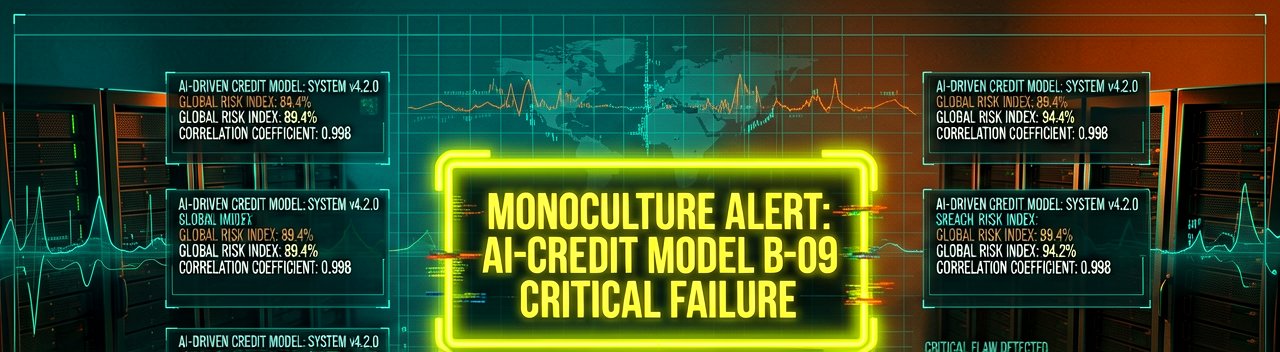
Furthermore, this breakneck migration toward automated decision-making introduces a volatile layer of systemic fragility that risk committees are ill-prepared to manage. While digital workers do not take sick leave or demand bonuses, they are notoriously prone to algorithmic drift and hallucinated data correlations that can quietly corrupt a bank's risk assessment models over time. If a cluster of major financial institutions begins relying on the same underlying proprietary LLMs to evaluate credit worthiness or detect market anomalies, the industry creates a dangerous monoculture. A single unpatched flaw or biased training set across these shared AI architectures could trigger localized flash crashes or massive, coordinated compliance failures before human oversight even detects the anomaly.
This automated efficiency drive also exposes an uncomfortable irony regarding client trust and long-term brand loyalty. While the C-suite celebrates the reduction of operational friction through AI-driven chat interfaces and automated loan approvals, high-net-worth individuals and corporate clients still demand human nuance, discretion, and accountability when markets turn turbulent. By aggressively stripping away the human touchpoints from their operational ecosystems, banks risk turning their services into commoditized software utilities. When every lender utilizes identical algorithmic backdrops to price products and manage customer interactions, the only remaining differentiator will be price, ultimately eroding the very profit margins that automation was deployed to protect.
"In the end, Wall Street's grand experiment with digital workers may prove that while computers are brilliant at managing predictable spreadsheets, they remain blissfully incompetent at taking the blame when a portfolio collapses—meaning the most secure job left in global banking is likely the executive tasked with apologizing to the regulators."
Artūras Malašauskas is an AI Systems Integrator with 20+ years of production-grade web engineering experience. He has designed, shipped, and scaled enterprise Python/PHP systems for logistics, SaaS, and public-sector clients. For the past year, he has focused exclusively on AI integrations: deploying open-source LLMs, building generative media pipelines (image, audio, video), and engineering multi-agent workflows for real production environments. His standard: reproducibility, security, cost-efficient inference—no vaporware. He documents and evaluates emerging AI tooling, separating verified capabilities from marketing noise. Technical editor at: muza-ai.eu, ai-verslas.lt, ai-naujinos.lt Connect on LinkedIn
Comments