Singapore’s Audacious Bet: Forcing Banks to Turn the AI Chopping Block Into a Job Engine

Singapore has never been a country to sit back and let global economic shifts dictate its future, and the current artificial intelligence revolution is no exception. While global banking giants see AI as a golden ticket to slash headcounts and beef up margins, the city-state is boldly rewriting the script. Instead of using automation to trim the fat, Singapore is demanding its financial sector do something far more complex: use AI to create better, high-value jobs for humans.
The timing for this government push is anything but accidental. The directive landed right as global financial giants sent shockwaves through the industry with massive automation-driven restructuring plans. Standard Chartered recently triggered widespread anxiety by announcing a cut of over 7,000 jobs worldwide as part of an aggressive AI adoption strategy. Meanwhile, HSBC’s leadership openly admitted that while generative AI will destroy certain roles, workers must simply embrace the inevitable tide of change. It is a familiar, cold corporate narrative, but Singapore’s regulators are actively building a shield against it.
Rather than letting local workers become collateral damage, Singaporean officials are making it clear that cost-cutting cannot be the sole metric of technological success. Speaking at a recent industry event, Deputy Prime Minister Gan Kim Yong noted that slowing down AI adoption would only cripple the nation's competitive edge and ultimately harm citizens. As reported by Reuters , Gan insists that when financial firms deploy AI, they must look beyond basic cost savings and actively design entirely new professional roles while reskilling their existing workforce to step into them.
The "Great Multiplier" in Action
This vision is already playing out on the ground. DBS, Singapore’s largest local bank, is currently orchestrating a delicate balancing act that could serve as a blueprint for the rest of the world. While the lender expects AI to handle tasks currently occupying thousands of roles over the next three years—primarily affecting temporary and contract positions—it is simultaneously building a massive talent pipeline at the bottom. DBS recently committed to hiring 500 young local talents through dedicated graduate and internship tracks, explicitly stating that internal AI tools like CodeBuddy and DBS-GPT are meant to help fresh hires learn faster and focus immediately on higher-order problem-solving.
According to reports from The Business Times, DBS Group CEO Tan Su Shan describes the technology as a potential "great multiplier" for a country with severe labor constraints. The goal is to offload mundane operations to autonomous agents so that human employees have the bandwidth to tackle strategic, high-value wealth management and advisory tasks. It is an ambitious attempt to reshape the traditional organizational structure, transforming it into what leadership calls a "fat at the bottom" model fueled by a constant influx of tech-augmented graduates.
Institutional Trust Meets Frontier Tech
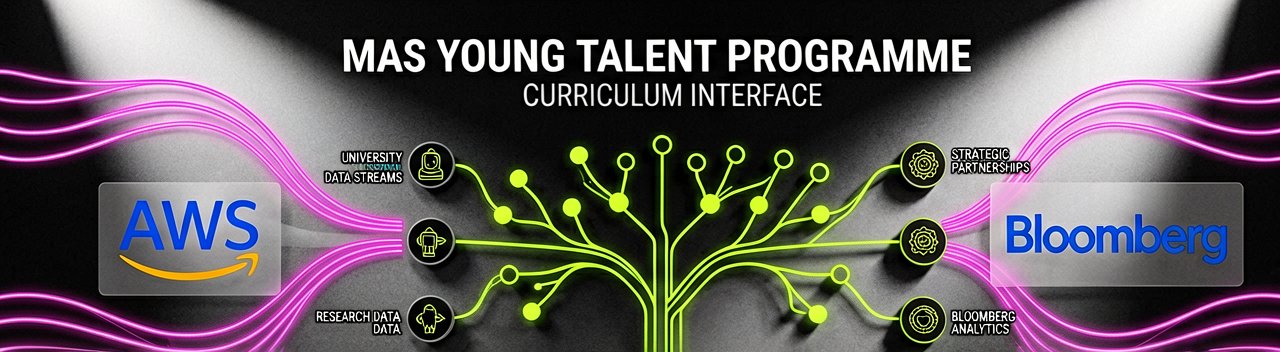
To ensure this transition does not stall, the Monetary Authority of Singapore (MAS) and the Institute of Banking and Finance have rolled out the Young Talent Programme for AI in Finance. Backed by heavyweights like Amazon Web Services and Bloomberg, this initiative is injecting structured AI training directly into university curriculums and funding over 1,000 internships. This regulatory infrastructure is exactly why a recent industry report ranked Singapore third globally among financial AI hubs, trailing only New York and San Francisco, while highlighting the city-state as the open-market hub closest to combining cutting-edge AI capabilities with deep institutional trust.
Ultimately, Singapore is gambling on the fact that human capital remains a bank's most valuable asset, provided it is properly upgraded. By forcing financial institutions to treat AI as an amplifier of human capability rather than a replacement for it, regulators are attempting a high-stakes economic pivot. If it works, the country will secure its status as Asia's premier financial fortress, proving that automation can expand a middle class instead of hollow it out.
Behind the Scenes: The Invisible Friction of Singapore's Upskilling Mandate
While government announcements present a seamless transition from traditional banking to an AI-driven future, the reality inside Singapore’s glass towers is a complex cultural and operational battle. Mid-career professionals, particularly those in risk compliance, back-office operations, and middle management, face the highest hurdles. These veterans spent decades mastering legacy regulatory frameworks and manual audit trails, only to find that generative AI can parse thousands of pages of legal text in seconds. The pressure to adapt is immense, as the government's push means that simply being efficient at a old job is no longer a guarantee of employment security.
Human resource executives within the local banking ecosystem privately acknowledge that retraining a 45-year-old credit analyst to become an AI prompt engineer or a data-validation specialist is not as simple as enrolling them in a weekend boot camp. It requires dismantling deeply ingrained professional identities. The Institute of Banking and Finance has had to heavily subsidize these transitions, yet a distinct gap remains between older workers trying to catch up and digital-native graduates who inherently understand how to leverage autonomous agents. This internal friction is the unspoken risk of the city-state's rapid tech pivot, creating a quiet anxiety among the existing workforce.
From the perspective of multinational banks operating in Singapore, compliance with these local workforce development mandates requires a delicate geopolitical dance. Global institutions like Citi, Standard Chartered, and HSBC operate on global efficiency metrics dictated by boards in New York and London, where the primary objective is often immediate cost reduction to appease shareholders. When Singapore's regulators demand that these banks reinvest their AI cost savings back into local talent development and graduate programs, it creates a unique regional exception to global corporate strategies. Banks must balance their desire for lean global operations with the strict requirements needed to maintain their lucrative licenses in Asia’s premier financial hub.
Historically, Singapore has successfully executed similar economic shifts, moving from low-cost manufacturing to high-tech electronics, and later to global wealth management. Each transition relied on the same playbook: aggressive state intervention, heavy subsidies for corporate training, and an unyielding focus on educational alignment with industry needs. However, the sheer velocity of the generative AI curve compressed a transformation that would normally take a decade into a matter of eighteen months. This unprecedented speed leaves little margin for error for policy architects trying to sync educational output with fast-evolving bank architectures.
The success of this grand experiment ultimately hinges on whether the financial sector can genuinely invent enough high-value roles to absorb the displaced talent. If the newly created positions in algorithmic risk management, AI governance, and hyper-personalized wealth advisory match the volume of automated roles, Singapore will have successfully created a template for the modern digital economy. If the math fails to add up, the city-state faces the prospect of a highly educated, tech-literate underemployed class, proving just how high the stakes are for this regulatory gamble.
Reading Between the Lines: The Paradox of AI Job Creation
The core philosophy of Singapore’s strategy relies on a comforting economic theory: that technological disruption always destroys old jobs only to birth a surplus of better ones. While this pattern held true during the transition from paper ledgers to databases, the generative AI era challenges the very foundation of this optimism. Previous tech waves automated routine manual tasks, pushing human workers up the intellectual value chain into cognitive roles. Generative AI, however, targets that exact cognitive tier, automating the very analytical, creative, and logic-based tasks that Singapore has spent decades preparing its workforce to perform.
This reality introduces an uncomfortable contradiction into the state's master plan. Financial institutions are being urged to hire fresh graduates to work alongside AI "co-pilots" to accelerate their learning curves. Yet, the traditional way junior bankers develop deep, intuitive expertise is precisely through the repetitive, grueling grunt work—like drafting spreadsheets and reviewing basic contracts—that is now being outsourced to algorithms. By removing the bottom rungs of the professional ladder, banks risk creating a future talent deficit where mid-level managers lack the foundational experience required to audit and correct the work of autonomous systems.
Furthermore, the fiscal reality of keeping multinational banks anchored in Singapore may eventually collide with the government’s social contract. If neighboring regional hubs offer a lighter regulatory touch that allows banks to fully harvest the cost-cutting power of AI without the burden of mandatory retraining quotas, the city-state's competitive edge could erode. Regulators are essentially asking public corporations to prioritize long-term local societal stability over immediate quarterly returns for global investors, an idealistic demand that tests the limits of state leverage over private capital.
If this ambitious policy stumbles, the implications will ripple far beyond the borders of Southeast Asia. Singapore is acting as the world's petri dish for state-directed technological adoption, and a failure to generate a net-positive job count would signal that AI-driven labor displacement is an inevitability that even the most organized governments cannot prevent. Conversely, if Singapore pulls this off, it will expose the lack of vision in Western financial capitals, where labor forces are often left to navigate massive technological disruption with little structural support.
"We are witnessing a fascinating corporate paradox: banks are spending billions on artificial intelligence to eliminate human error, while simultaneously spending millions to train humans to catch the errors made by the artificial intelligence. In the end, the ultimate job security in modern banking might just be babysitting an incredibly expensive, highly sensitive piece of software."
Artūras Malašauskas is an AI Systems Integrator with 20+ years of production-grade web engineering experience. He has designed, shipped, and scaled enterprise Python/PHP systems for logistics, SaaS, and public-sector clients. For the past year, he has focused exclusively on AI integrations: deploying open-source LLMs, building generative media pipelines (image, audio, video), and engineering multi-agent workflows for real production environments. His standard: reproducibility, security, cost-efficient inference—no vaporware. He documents and evaluates emerging AI tooling, separating verified capabilities from marketing noise. Technical editor at: muza-ai.eu, ai-verslas.lt, ai-naujinos.lt Connect on LinkedIn
Comments