The Electron Moat: Why China’s AI Ambitions Live or Die on the Grid
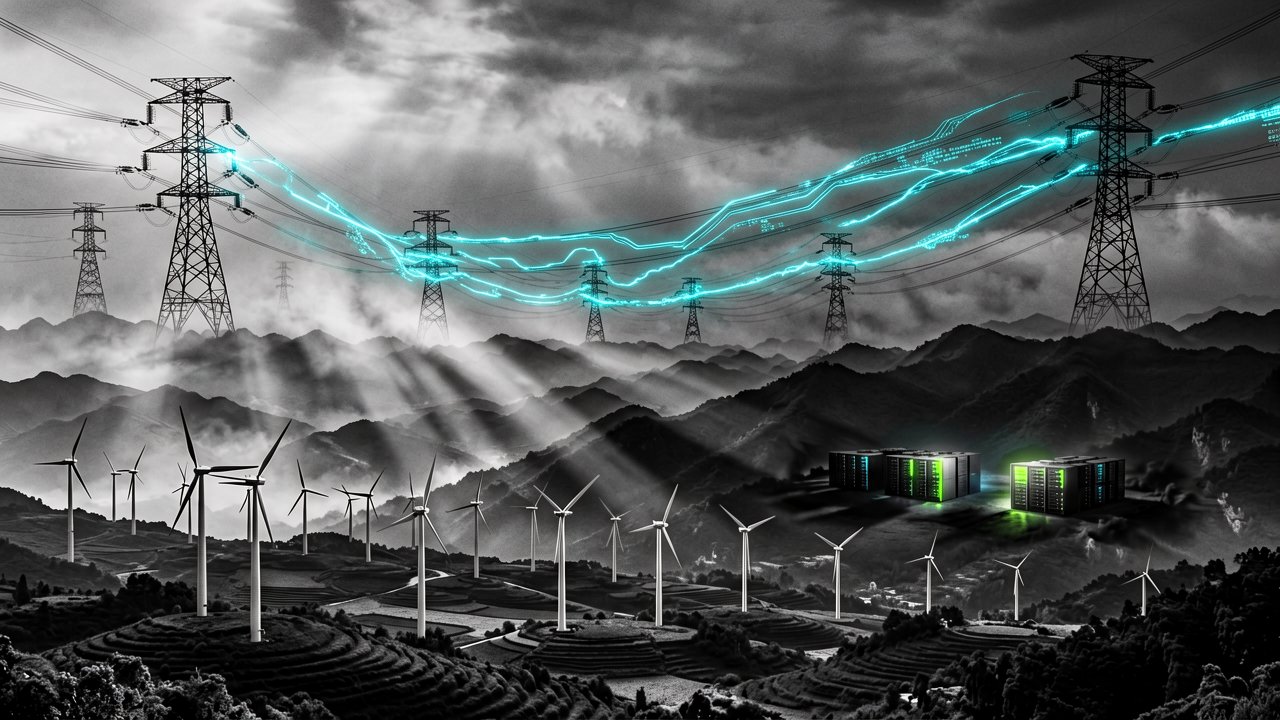
For the past few years, the narrative surrounding the geopolitical tussle for artificial intelligence supremacy has focused almost entirely on the silicon layer. Washington has tightened export controls on advanced graphics processing units (GPUs) while Beijing has scrambled to build its own domestic chip alternatives. But focusing purely on semiconductors misses the broader architectural reality of modern AI. Training large language models and operating sprawling inference networks require staggering amounts of energy, making raw electrical capacity the foundational layer of the entire technological stack. While the United States continues to lead in breakthrough algorithmic research and high-end chip design, China is aggressively leaning into its massive infrastructural advantage: the largest, most heavily subsidized power grid on the planet.
This structural disparity, often dubbed the "electron gap," has quietly shifted the unit economics of AI training in Beijing's favor. As reporting from The Economist outlines, the massive computational demand of next-generation models means that data centers are no longer just software hubs; they are industrial-scale energy consumers. While American hyperscalers are running into bureaucratic hurdles, fragmented local jurisdictions, and an aging domestic grid that struggles to hook up new generators quickly, China is moving via state-directed mandate. The Chinese state council tightly aligns priorities across national agencies, allowing for the rapid deployment of massive power transmission projects explicitly designed to feed compute-hungry clusters.
The Realities of the East Data, West Computing Strategy
Central to China's energy-compute flywheel is its ambitious national layout strategy. The country has spent years building out colossal ultra-high-voltage (UHV) transmission lines that connect remote, resource-rich western provinces to the economically dense coastal hubs. In provinces like Guizhou, Inner Mongolia, and Gansu, data centers are built directly adjacent to massive wind farms, hydroelectric dams, and coal-fired plants. According to coverage by The Wall Street Journal, some Chinese data centers are paying less than half of what their American counterparts do for electricity. This massive energy cushion allows domestic tech champions to run brute-force training cycles that would otherwise be cost-prohibitive in Western markets, effectively offsetting their lack of access to cutting-edge U.S. chips by simply running massive clusters of older-generation silicon continuously.
Why Raw Electrons Do Not Equal Instant Victory
However, having access to cheap electricity does not automatically guarantee global AI dominance. The true picture is far more complex than just calculating gigawatts. Analysis from the ASPI Strategist reveals that China’s rapidly expanded computing infrastructure frequently suffers from severe underutilization. Building massive data center structures in remote regions is one thing, but establishing the advanced networking fabric, low-latency data pipelines, and software ecosystems required to make those facilities efficient is an entirely different bottleneck. Furthermore, China's rigid power grid can occasionally lack the operational flexibility needed to integrate volatile renewable energy smoothly, meaning that many facilities still lean heavily on traditional baseload coal power to maintain uninterrupted uptimes.
A Shift Toward Virtual Power Plants
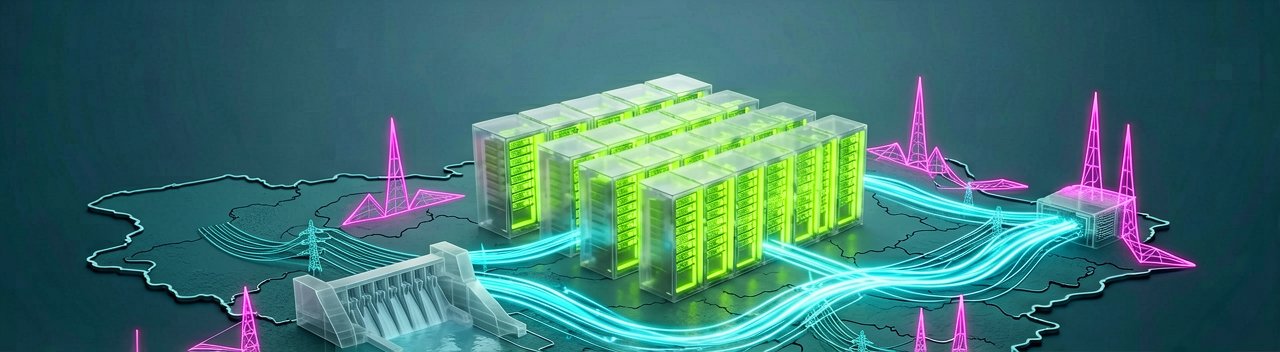
To overcome these efficiency hurdles, Chinese operators are pioneering dynamic new operational models that treat data centers as active grid participants rather than passive energy sinks. Major computing hubs are increasingly entering spot electricity trading markets, functioning effectively as "virtual power plants" that scale their computational workloads up or down depending on real-time grid conditions and fluctuating electricity prices. When green energy production spikes and tariffs plummet, these facilities ramp up heavy training pipelines; when the grid faces stress, they throttle back or shift non-urgent workloads across provinces. Cheap, centralized energy has given China a formidable moat that alleviates the immediate infrastructure anxieties plaguing Western tech hubs, but ultimate AI supremacy will ultimately depend on whether Beijing can match its structural energy abundance with the high-end silicon and architectural efficiency required to turn those electrons into intelligence.
Behind the Scenes: The Hard Engineering of the Silicon-Electron Tradeoff
The tech industry has long suffered from a form of silicon myopia, assuming that the race for AI supremacy would be won or lost solely in the cleanrooms of advanced semiconductor foundries. But the reality on the ground resembles a gritty, industrial-scale logistics problem where power generation is the ultimate rate-limiting factor. While American labs are forced to spend billions of dollars optimizing every single line of code to save precious watt-hours on scarce NVIDIA hardware, Chinese engineers are executing a different playbook. They are treating energy as a cheap, abundant substrate, essentially using a massive surplus of electricity to compensate for the architectural inefficiencies of using older or domestic-grade silicon clusters.
This dynamic has forced Chinese cloud giants to become pioneers in specialized data center topology. Because Washington's export controls restrict the bandwidth of chips moving into the country, Chinese engineers cannot easily build the hyper-dense, low-latency clusters favored by Silicon Valley. Instead, they are distributing workloads across vast, decentralized networks that rely heavily on the state's ultra-high-voltage grid infrastructure. Historical precedents from the traditional industrial sector show that Beijing excels at this type of brute-force infrastructure scaling, using state-backed mandates to build out supply chains long before commercial demand fully catches up.
Yet, this state-directed approach has created unique friction points between local bureaucrats and central planners. In provinces like Inner Mongolia and Ningxia, local grid operators frequently complain about the erratic, high-amplitude power spikes generated when massive language models initiate training runs. These computational spikes can disrupt regional grid stability, forcing data centers to negotiate complex power-purchase agreements that mandate the use of dedicated, coal-fired backup plants. Consequently, while the Western tech sector strives toward aggressive net-zero goals, China's AI ambitions remain deeply intertwined with its traditional, carbon-heavy industrial base.

Furthermore, the internal consensus among top-tier Chinese AI researchers suggests that cheap energy is an organizational cushion rather than a silver bullet. Leading software engineers in Beijing and Shenzhen openly acknowledge that access to cheap gigawatts cannot entirely bridge the software ecosystem gap, particularly the global dominance of NVIDIA’s proprietary software platform. The massive power pools in the western provinces allow these firms to stay in the race by running thousands of lower-tier chips simultaneously, but it also creates a massive engineering overhead in managing cluster synchronization and heat dissipation at an unprecedented scale.
Reading Between the Lines: The Illusion of Computational Abundance
The prevailing geopolitical assumption is that unlimited energy acts as a direct multiplier for AI capability, but this perspective overlooks the law of diminishing returns inherent to distributed computing. Flooding an AI cluster with cheap electricity does not automatically result in a smarter model if the underlying silicon cannot communicate efficiently. When Chinese data centers link together massive arrays of lower-tier, domestic semiconductors to replicate the raw computing power of restricted Western chips, they encounter a severe communication bottleneck. The energy spent merely moving data between scattered nodes and managing thermal loads often eclipses the energy used for actual mathematical computation, turning a cheap power advantage into an incredibly expensive exercise in structural inefficiency.
This reality exposes a glaring contradiction in China's state-directed strategy. Beijing has spent years forcing a geographic decoupling of data centers from economic centers under its "East Data, West Computing" initiative to exploit cheap rural energy. However, the most cutting-edge AI applications, particularly real-time financial algorithms, autonomous industrial systems, and interactive consumer platforms, require ultra-low latency. Training a model next to a remote hydroelectric dam is useful, but deploying that model to serve millions of users in Shanghai or Shenzhen across thousands of miles of fiber-optic cables introduces physical delays that negate the benefits of cheap initial training. The state can mandate where the infrastructure is built, but it cannot legislate away the speed of light.
Furthermore, the long-term economic sustainability of subsidizing energy for AI remains highly questionable. Local provincial governments across China’s western rustbelt are already saddled with immense debt, yet they are expected to guarantee rock-bottom electricity tariffs to wealthy tech conglomerates. This creates a bizarre wealth transfer from struggling, coal-dependent rural municipalities to hyper-capitalized technology firms based in the coastal megacities. If central planners eventually force these provincial grids to prioritize fiscal self-sufficiency over tech-sector subsidies, China's artificial energy moat could evaporate almost overnight, exposing the domestic AI ecosystem to the same market-driven energy anxieties facing the rest of the world.
Ultimately, the belief that raw energy abundance will hand China the keys to AI supremacy confuses the fuel with the engine. A rocket ship with a poorly designed propulsion system will not reach orbit any faster just because you fill its tank with cheap propellant. While the West frantically scrambles to untangle its bureaucratic gridlock and build more power plants, China faces the opposite problem: it has built a sprawling, power-hungry industrial empire that must now frantically innovate its way out of a silicon deficit before the immense cost of keeping the lights on catches up with the treasury.
Geopoliticians love to argue over whether the future will be won by the nation with the smartest algorithms or the one with the most silicon, but the power engineers already know the truth: at the end of the day, even the most revolutionary artificial superintelligence is just a highly sophisticated way of turning a massive pile of burning coal into lukewarm water.
Artūras Malašauskas is an AI Systems Integrator with 20+ years of production-grade web engineering experience. He has designed, shipped, and scaled enterprise Python/PHP systems for logistics, SaaS, and public-sector clients. For the past year, he has focused exclusively on AI integrations: deploying open-source LLMs, building generative media pipelines (image, audio, video), and engineering multi-agent workflows for real production environments. His standard: reproducibility, security, cost-efficient inference—no vaporware. He documents and evaluates emerging AI tooling, separating verified capabilities from marketing noise. Technical editor at: muza-ai.eu, ai-verslas.lt, ai-naujinos.lt Connect on LinkedIn
Comments