The Death of the Click: How Akamai is Saving Brands from AI Invisibility

For the past two decades, the playbook for corporate digital strategy has been dead simple: build a website, optimize it for Google, and wait for human eyeballs to click through. But that classic marketing funnel is crumbling before our eyes. We have entered the era of machine-mediated discovery, where large language models (LLMs) and autonomous AI agents act as the new front doors to corporate brands. When a user asks an AI chatbot for a product recommendation or an operational fact, the AI synthesizes the answer itself, frequently swallowing the referral traffic entirely. To combat this quiet digital erasure, edge-delivery giant Akamai launched its new AI Brand Presence suite, a tool designed to ensure businesses stay relevant, accurately cited, and fundamentally visible to the bots currently rewriting the internet.
The numbers back up this massive behavioral shift. Akamai recently observed a staggering 300% year-over-year surge in AI bot traffic across its massive global network. Compounding that stat is the uncomfortable reality that nearly 60% of modern online searches now end without a single click-through to an external link. If a business isn't directly feeding structured, machine-readable data to these visiting crawlers, it risks being completely omitted from AI-generated responses. Realizing that companies face an existential threat of digital invisibility, Akamai built this edge solution to automatically translate standard website information into optimized, LLM-friendly context. The magic here happens entirely at the network edge, meaning businesses can finally cater to AI agents without wrecking their website’s performance or making complex, costly updates to their underlying content management systems.
Feeding the Bots Without Breaking the Site
The engineering logic behind Akamai's new tool split-routes the digital experience. When a human visits a webpage, they see the standard, beautifully designed user interface. But when an AI scraper or an autonomous agent is detected in real time at the edge, Akamai dynamically serves a structured, machine-readable version of that exact same content. During its internal pilot phase, Akamai functioned as its own first customer, and the data was eye-opening. By feeding AI bots tailored data, Akamai saw an 85% spike in its own citations and a massive 364% boost in overall brand presence across conversational AI platforms, according to the official release distributed via GlobeNewswire.
A Dashboard for the Agentic Era
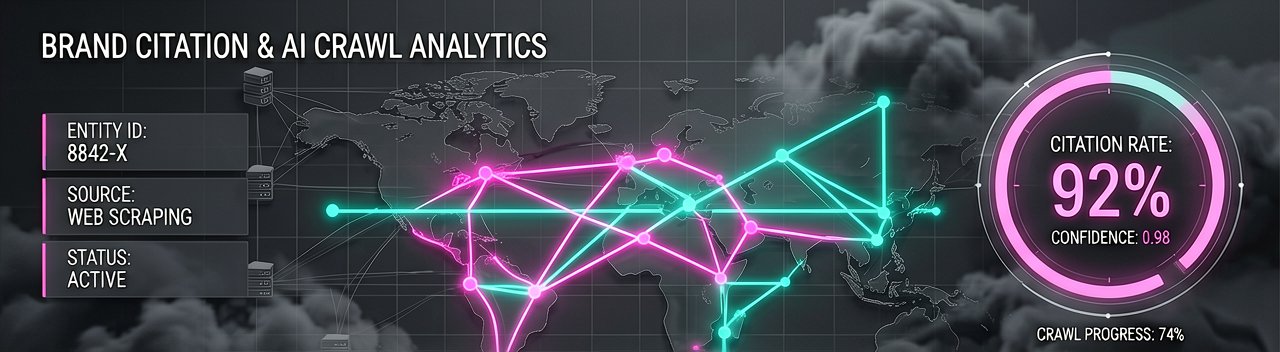
Beyond raw optimization, the platform addresses a massive blind spot for modern enterprise CIOs: transparency. A unified analytics dashboard shows precisely which AI models are crawling a company's web estate, what specific content they are digesting, and how those automated interactions ultimately translate into brand citations or downstream user engagement. It also measures a company's "AI share of voice," benchmarking their visibility against direct industry competitors. For businesses that have spent millions optimizing for traditional search engine algorithms, the tool offers a vital bridge to the next generation of web discovery, ensuring they remain the primary source of truth for the AI models their customers trust.
Behind the Scenes: The Invisible Tug-of-War for Web Control
The enterprise rush to optimize for AI agents reveals a deeper, more structural anxiety simmering within the tech sector. For decades, the relationship between content creators and web crawlers was governed by an unspoken social contract: publishers allowed search engine bots to scrape their data in exchange for referral traffic. That foundational bargain is now dead. Today's LLMs consume proprietary data not to index it for later discovery, but to train models that actively replace the need to visit the original source. By launching its AI Brand Presence suite at the network edge, Akamai isn't just offering a standard software update; it is positioning itself as a strategic mediator in an increasingly tense digital arms race between corporate intellectual property owners and aggressive AI data harvesters.
This dynamic has forced Chief Information Officers into a deeply uncomfortable defensive posture. Over the past year, many enterprise IT teams resorted to blunt-force trauma tactics, using robots.txt files or firewall rules to completely block AI scrapers. While blocking bots preserves data sovereignty in the short term, it inadvertently deletes the company from the training datasets and agentic search results used by millions of customers. Industry insiders refer to this dilemma as the "invisibility paradox." Akamai's edge-based approach attempts to solve this by replacing unconditional blocking with granular, conditional negotiation. Instead of locking the door entirely, companies can now curate precisely what the machine sees, ensuring their latest product specs or corporate compliance facts are perfectly ingested while hiding sensitive IP.
The technical shift from traditional Search Engine Optimization (SEO) to GenAI Optimization (GEO) requires an entirely different engineering philosophy. Standard SEO relies on keywords, meta tags, and backlink authority to climb an index. In contrast, AI agents demand highly structured data schemas, semantic clarity, and absolute factual consistency. Because LLMs are prone to hallucinations, a single formatting ambiguity on a corporate website can cause an AI model to misrepresent a company's pricing or service capabilities to a potential B2B buyer. By standardizing web content into hyper-efficient JSON-LD payloads and machine-optimized text chunks directly at the edge layer, Akamai essentially eliminates the interpretation errors that lead to brand damaging hallucinations in conversational search interfaces.
Looking at the broader historical trajectory, we are witnessing the birth of a dual-layer internet. For the foreseeable future, enterprises must maintain two distinct front ends: a visually rich, emotionally resonant experience designed to convert human visitors, and a lean, hyper-efficient API-style layer designed to feed autonomous machines. This evolution mirrors the early days of mobile web adoption, but the stakes this time around are significantly higher. As autonomous AI agents begin executing actual financial transactions on behalf of users, the businesses that fail to optimize their edge delivery for machine discovery will find themselves entirely locked out of the future economy.

Reading Between the Lines: The Illusion of Control in a Bot-Dominated Web
While Akamai’s early metrics—such as that eye-popping 364% surge in brand presence—sound like an absolute triumph for corporate marketing teams, a deeper analysis reveals a stark structural contradiction. The core promise of GenAI Optimization (GEO) is to help companies remain visible inside conversational search results. Yet, the very mechanism of this visibility accelerates the destruction of direct web traffic. By feeding perfectly manicured, hyper-efficient datasets directly to LLM crawlers at the network edge, enterprises are effectively building the high-quality infrastructure that allows AI providers to keep users trapped inside their own walled gardens. Businesses are essentially funding and optimizing the exact tools that isolate them from their end customers.
This reality forces a re-evaluation of what a "citation" is actually worth in the agentic era. In traditional search, a high ranking meant an immediate influx of monetizable human traffic. In an AI-mediated ecosystem, a citation is frequently nothing more than a tiny, low-contrast footnote trailing a block of synthesized text. The critical flaw in current corporate strategy is the assumption that an AI chatbot accurately citing a brand will eventually lead to a downstream transaction. In reality, as autonomous AI agents evolve to handle comparison shopping, booking, and purchasing decisions entirely on behalf of the consumer, the traditional human-to-brand relationship is completely severed. Companies risk becoming invisible utility providers to a machine workforce, rather than recognizable brands with loyal consumer bases.
Furthermore, relying on edge delivery networks to manage brand narrative presents an ongoing cat-and-mouse game with LLM providers. Akamai's solution relies on real-time bot detection to serve optimized content payloads specifically to scrapers. However, AI companies are already engineering their crawlers to mimic human browsing behavior precisely to bypass these filters and scrape authentic, uncurated human web layouts. This creates an inevitable technical conflict. If an enterprise serves a sanitised, heavily optimized dataset to an AI bot while showing a different, more nuanced version to humans, the AI model may eventually flag the discrepancy as a form of cloaking, potentially penalizing the brand's authority score within the model's knowledge graph.
Ultimately, the pivot to AI Brand Presence platforms highlights a broader, pragmatic concession by modern enterprises. The battle to preserve the open, link-driven web has been decisively lost to the convenience of conversational interfaces. For corporate executives, optimization is no longer about driving growth or capturing market share; it has transformed into an expensive form of digital self-defense. Enterprises are left with a binary, unappealing choice: either spoon-feed the very machines that are cannibalizing their web traffic, or refuse to participate and face total digital oblivion inside the primary search tools of the next generation.
"We have officially reached the peak irony of the digital age: corporations are now spending millions of dollars on cutting-edge edge infrastructure just to translate their websites into structured bullet points, all so an AI chatbot can summarize their entire life's work into a single sentence and completely forget to include a clickable link."
Artūras Malašauskas is an AI Systems Integrator with 20+ years of production-grade web engineering experience. He has designed, shipped, and scaled enterprise Python/PHP systems for logistics, SaaS, and public-sector clients. For the past year, he has focused exclusively on AI integrations: deploying open-source LLMs, building generative media pipelines (image, audio, video), and engineering multi-agent workflows for real production environments. His standard: reproducibility, security, cost-efficient inference—no vaporware. He documents and evaluates emerging AI tooling, separating verified capabilities from marketing noise. Technical editor at: muza-ai.eu, ai-verslas.lt, ai-naujinos.lt Connect on LinkedIn
Comments