Beyond the Hype: What Senior Leaders Are Actually Asking About AI

The honeymoon phase with generative artificial intelligence is officially over in the corporate boardroom. Senior executives and board members are no longer satisfied with flashy proof-of-concepts or poetic chatbots that write marketing copy. They've shifted from open experimentation to a much grittier focus on operational integration, governance, and tangible returns. A recent survey from The Conference Board highlights this shift, revealing that AI and technology have surged to the absolute top of executive investment priorities, outpacing traditional product innovation.
This means the corporate conversation has fundamentally matured. Leadership teams are grappling with the reality of scaling these technologies across complex, siloed organizations while trying to maintain stable profit models. They're asking hard questions about infrastructure readiness, workforce displacement, and risk management. For supervisory boards, there's an increasingly urgent need to close the expertise gap to ensure they can oversee this monumental transition without slowing down innovation.
Show Me the Money: The Struggle for AI ROI
The most pressing question echoey chambers of the C-suite face right now is painfully simple: where is the return on investment? Up until now, massive technology spending has been largely driven by hyper-scalers and tech vendors building out infrastructure. According to insights from Gartner, enterprise buyers have been cautious, sticking to incremental, tactical deployments aimed at basic efficiency. This cautious approach is making it incredibly difficult for Chief Information Officers to justify skyrocketing budgets to the board. Executives are tired of hearing about theoretical productivity gains; they want to see metrics that directly impact the bottom line.
The Real Hurdle Isn't Technology—It's People
When you peel back the layers of failed enterprise AI projects, the root cause is rarely a flawed algorithm. Senior leaders are realizing that cultural friction and workforce unpreparedness are the real project killers. Data compiled by underscores that over 93% of leadership survey respondents cite cultural challenges rather than technical limits as their primary roadblock. This problem is worsened by an "enablement illusion," where executives mistake giving employees basic access to AI tools for actual organizational readiness. Without a comprehensive talent strategy that actively re-skills middle management and frontline workers, organizations risk losing their top technical talent to more progressive competitors.
Evolving Profit Models and Autonomous Agents
Looking ahead, CEOs are intensely focused on how autonomous AI agents will disrupt their existing business models. There's a growing anxiety that transactional revenue streams are at risk as smart agents begin bypassing traditional intermediaries to automate purchasing, pricing, and real-time negotiation. Instead of trying to acquire entirely new customer bases, forward-thinking executives are planning to use AI to deepen relationships with existing clients and prepare for the rise of machine customers. To survive this shift, leadership teams know they must overhaul their operational structures and pivot toward recurring, outcome-based revenue models.
What Most Reports Miss: The Ghost in the Executive Machine
The standard corporate narrative suggests that AI adoption is a linear march toward efficiency, guided by capable leadership and clear roadmaps. The reality inside Fortune 500 boardrooms is far messier, defined by a quiet panic over data lineage and architectural lock-in. Senior leaders are beginning to realize that the data foundations they spent the last decade building—often fragmented across legacy cloud providers and on-premise silos—are fundamentally unsuited for the demands of retrieval-augmented generation and autonomous orchestration. This technological debt creates a massive bottleneck, forcing companies to spend millions on data cleansing before they can even begin training a model.
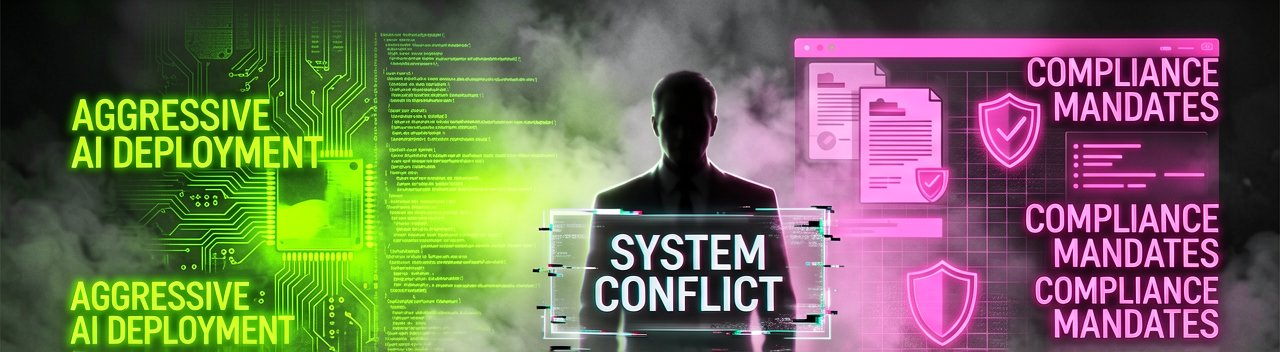
Furthermore, an unspoken generational divide is complicating execution at the highest levels. While younger directors and tech-native executives push for aggressive deployment, risk-averse board members are quietly putting on the brakes, haunted by the specter of intellectual property litigation and regulatory penalties. This tension is creating a polarized environment where middle managers are caught in the crossfire. They are tasked with meeting aggressive AI-driven productivity targets set by the CEO, while simultaneously adhering to strict compliance mandates issued by the legal team, resulting in widespread operational paralysis.
Historically, major technology shifts like the transition to cloud computing allowed organizations a multi-year grace period to adapt their cultures and infrastructure. AI offers no such luxury, as the pace of algorithmic breakthroughs drastically outruns institutional learning curves. Seasoned executives recognize that the current crisis isn't one of software procurement, but of change management. The firms successfully navigating this terrain are those treating AI not as an IT upgrade, but as a fundamental restructuring of how human capital is deployed, shifting their focus from eliminating headcount to amplifying institutional knowledge.
Reading Between the Lines: The Irony of Automation
The prevailing boardroom orthodoxy assumes that implementing artificial intelligence will automatically streamline operations and shrink corporate overhead. This logic is seductive, yet it ignores a glaring historical contradiction: every major wave of corporate automation has initially increased structural complexity rather than reducing it. As organizations deploy networks of autonomous agents, they are not eliminating management layers; they are merely shifting the burden from overseeing human employees to auditing algorithmic outputs. The anticipated cost savings are frequently swallowed whole by the ballooning expenses of model maintenance, specialized cloud compute, and the elite engineering talent required to keep these systems from hallucinating.
This dynamic exposes a deeper hypocrisy in current corporate strategies. CEOs publicly champion AI as a tool for liberating workers from mundane tasks, yet internal budget allocations tell a completely different story. Capital is flowing overwhelmingly toward surveillance, basic optimization, and automated compliance rather than genuine employee empowerment. This short-sighted focus creates an environment of quiet resistance among staff, who quickly learn to game automated metrics rather than using the technology to drive authentic innovation. By treating AI strictly as a tool for cost reduction, leadership risks hollowed-out operations that are hyper-efficient at executing outdated processes but utterly incapable of adapting to sudden market shifts.
The long-term implication is a corporate landscape characterized by algorithmic monoculture. As vendors bundle identical foundation models into ubiquitous enterprise software suites, competing companies are effectively outsourcing their strategic thinking to the same handful of tech giants. True competitive advantage will not come from adopting these off-the-shelf tools, but from the messy, proprietary data that corporations have spent years neglecting. The senior leaders who survive the upcoming market consolidation will be those who reject the vendor-driven hype cycle and recognize that an AI tool is only as valuable as the unique human insight directing it.
"We are spending millions to replace our most creative minds with algorithms, only to discover we need to hire twice as many consultants just to explain why the machine keeps recommending we liquidate our core business."
Artūras Malašauskas is an AI Systems Integrator with 20+ years of production-grade web engineering experience. He has designed, shipped, and scaled enterprise Python/PHP systems for logistics, SaaS, and public-sector clients. For the past year, he has focused exclusively on AI integrations: deploying open-source LLMs, building generative media pipelines (image, audio, video), and engineering multi-agent workflows for real production environments. His standard: reproducibility, security, cost-efficient inference—no vaporware. He documents and evaluates emerging AI tooling, separating verified capabilities from marketing noise. Technical editor at: muza-ai.eu, ai-verslas.lt, ai-naujinos.lt Connect on LinkedIn
Comments