Beyond the Bot: Fushi Tech’s AI Agent Play for Global Commerce

Fushi Tech isn't just jumping on the AI bandwagon; they’re trying to drive it. With the recent unveiling of their strategic AI Agent upgrade, the subsidiary of Yeahka (9923.HK) is pivoting from being a mere software provider to offering what they call "digital employees" for overseas merchants. The centerpiece of this move is the Fynix AI shop, a full-stack product that moves past simple chatbots to handle the heavy lifting of customer acquisition, conversion, and even in-conversation payments. It's a calculated bet that the next era of SaaS isn't about giving businesses better tools, but about giving them the ability to take action autonomously.
The strategy specifically targets fast-growing markets in Southeast Asia and beyond, where many small to mid-sized merchants are still navigating the early stages of digitalization. By embedding AI directly into industry-specific workflows—particularly in the F&B sector—Fushi Tech is positioning itself to "leapfrog" traditional SaaS models. As reported by Media OutReach, this approach bridges the gap between having information and actually closing deals, integrating payments and CRM data to refine consumer profiles in real-time. It’s a sophisticated play that acknowledges a hard truth: in a world of converging AI models, the winner is whoever makes the technology invisible and the results undeniable.
From Tools to Operators
What makes this pivot interesting is the shift in the value chain. Most enterprise AI solutions today act as "copilots," requiring a human to stay in the loop to click the final buttons. Fushi’s Fynix AI shop is designed to be an "operator," executing tasks across the merchant's full operational cycle without constant hand-holding. From generating menu pages and product listings to managing loyalty programs through its acquisition of Singapore-based Ascentis, the focus is on end-to-end automation. This isn't just about efficiency; it's about localized empowerment that leverages Yeahka’s massive existing payment infrastructure to secure a foothold where pure-play AI firms often struggle.
Localization as a Competitive Moat
The tech world is littered with "global" solutions that fail because they don't understand how people actually shop in Singapore or Malaysia. Fushi Tech seems to have learned this lesson early, placing heavy emphasis on the localization of its SaaS functionalities. By tailoring AI agents to specific vertical industries and local consumer preferences, they’ve managed to maintain a merchant retention rate exceeding 90%. As noted by Taiwan News, this strategy isn't just about exporting Chinese tech; it's about evolving into an integrated ecosystem that combines payments, data, and AI to redefine how international commerce functions in an agentic world.
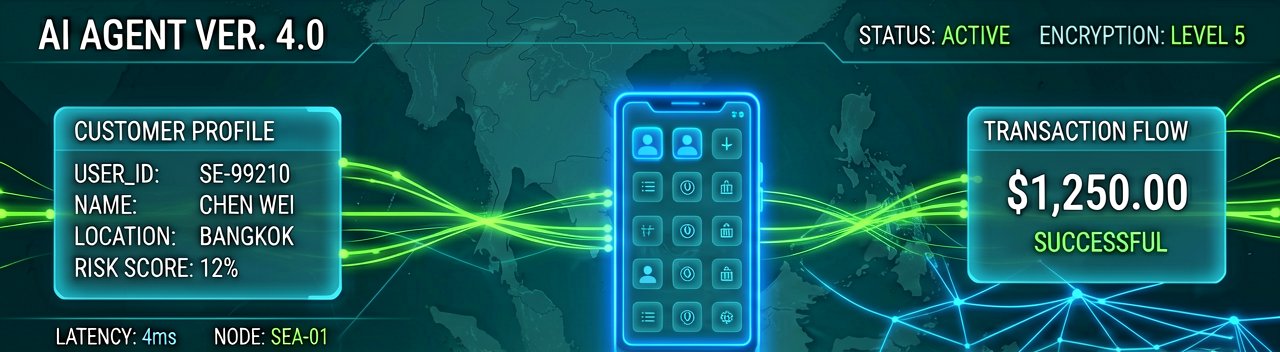
The Merchant’s New Engine: Why Agents Matter Now
The Quiet Revolution: While the tech world has spent the last two years obsessing over Large Language Models (LLMs) that can write poems or summarize emails, the real commercial battle is moving toward "agentic" workflows. Fushi Tech’s pivot represents a move away from the "SaaS 1.0" era, where software was essentially a digital ledger that required a human operator to do the work. By rebranding their offering as a "digital employee," they are acknowledging that for a busy restaurant owner in Singapore or a retailer in Kuala Lumpur, the bottleneck isn't a lack of software—it's a lack of time and skilled labor.
The historical context here is vital for understanding the stakes. Yeahka, Fushi's parent company, built its empire on the back of QR code payments and merchant services in China’s hyper-competitive fintech landscape. They saw firsthand how payment data is the ultimate source of truth for a business. By layering AI Agents on top of this payment rail, Fushi isn't just offering a chatbot; they are creating a closed-loop system where the AI sees the transaction, understands the customer's history, and can autonomously trigger a loyalty discount or a personalized upsell without the merchant lifting a finger.
Industry insiders point out that the acquisition of Ascentis was the tactical masterstroke in this strategy. Ascentis brought with it a massive database of member behaviors and established relationships with premium brands across Southeast Asia. This gave Fushi the "data fuel" needed to train AI agents that understand local nuances—like the specific timing of peak F&B hours in different districts or the cultural sensitivity required in customer service. This isn't generic AI; it is vertically integrated intelligence designed to solve the "last mile" problem of digital transformation.
From a stakeholder perspective, this shift changes the ROI conversation for overseas merchants. Traditional SaaS often feels like an overhead cost—a monthly subscription for a tool you still have to manage. Fushi’s AI Agent strategy attempts to flip the script by positioning the technology as a revenue generator. When the AI agent can handle an inquiry on WhatsApp or Telegram and convert it into a paid order via an integrated link, the software stops being an expense and starts being a salesperson. This is particularly critical in markets where labor costs are rising and finding reliable staff is becoming a perennial headache.

However, the road ahead isn't without its speed bumps. The success of this "agent-first" strategy depends heavily on the reliability of the underlying infrastructure and the merchant's willingness to hand over the keys to their customer relationships. Fushi is betting that the high retention rates they've seen so far—averaging over 90%—are a sign that merchants are ready to trust the machine. By focusing on "high-frequency, high-value" interactions in the F&B and retail sectors, they are building a defensive moat that purely software-based competitors will find difficult to breach.
Ultimately, Fushi Tech’s expansion highlights a broader trend in global tech: the "de-democratization" of complex AI. By packaging sophisticated agentic capabilities into a simple, industry-specific interface, they are allowing small businesses to compete with the data-driven giants. As they continue to roll out these solutions across the Asia-Pacific region, the metric of success won't just be how many merchants sign up, but how many tasks these digital employees can take off the plates of their human counterparts. The goal is a seamless ecosystem where the boundary between a payment, a marketing campaign, and a customer service chat simply disappears.
The Friction of Autonomy: A Reality Check
Reading Between the Lines: The narrative of "digital employees" is an intoxicating one for investors, but it glosses over the messy reality of real-world deployment. While Fushi Tech highlights its 90% retention rate, the challenge for any AI agent in the "wild" is the unpredictability of human behavior. Moving from a tool that assists to an agent that acts independently requires a level of trust that few merchants are truly ready to grant. The transition from a "copilot" to an "operator" isn't just a technical upgrade; it is a psychological shift that demands the AI handle the edge cases—the angry customer, the misunderstood dietary requirement, or the failed payment—without defaulting to a generic "I don't understand" response.
There is also an inherent contradiction in the promise of standardized "local" solutions. Fushi's strategy relies on the efficiency of scale, yet the very markets they are targeting—Southeast Asia—are a fragmented mosaic of languages, payment preferences, and regulatory environments. An AI agent that works flawlessly in a high-end Singaporean bistro might struggle in a street-food stall in Bangkok or a boutique in Jakarta. The cost of "hyper-localization" is high, and there is a looming question of whether the margins on small-to-medium merchant subscriptions can actually sustain the heavy R&D required to keep these agents truly intelligent across diverse verticals.
Projecting forward, the broader implication of Fushi’s strategy is the potential for "platform lock-in." By integrating payments, CRM, and AI operations into a single vertical stack, merchants may find themselves in a golden cage. If the AI agent is the one holding the customer data and managing the loyalty loops, switching providers becomes an operational nightmare. This creates a powerful moat for Fushi Tech and its parent, Yeahka, but it also places a significant amount of power in the hands of a single vendor. As the novelty of AI wears off, the focus will shift from what these agents can do to who actually owns the relationships they build.
Furthermore, we must consider the risk of "automated mediocrity." If every merchant in a specific sector uses the same AI agent strategy, the competitive advantage of personalized marketing evaporates into a sea of identical, algorithmically generated "special offers." Fushi’s challenge will be ensuring their agents can provide genuine brand differentiation rather than just a more efficient version of the same old noise. The technology is impressive, but the ultimate test remains whether an AI can truly replicate the "hospitality" that defines the F&B industry or if it will simply turn every transaction into a frictionless, but soulless, exchange.
It turns out the dream of the automated future isn't a robot butler serving you drinks, but a digital clerk tirelessly upselling you a side of fries while you’re just trying to pay the bill.
Artūras Malašauskas is an AI Systems Integrator with 20+ years of production-grade web engineering experience. He has designed, shipped, and scaled enterprise Python/PHP systems for logistics, SaaS, and public-sector clients. For the past year, he has focused exclusively on AI integrations: deploying open-source LLMs, building generative media pipelines (image, audio, video), and engineering multi-agent workflows for real production environments. His standard: reproducibility, security, cost-efficient inference—no vaporware. He documents and evaluates emerging AI tooling, separating verified capabilities from marketing noise. Technical editor at: muza-ai.eu, ai-verslas.lt, ai-naujinos.lt Connect on LinkedIn
Comments