The Shift from Chatbot to Colleague: Gemini’s Proactive Turn
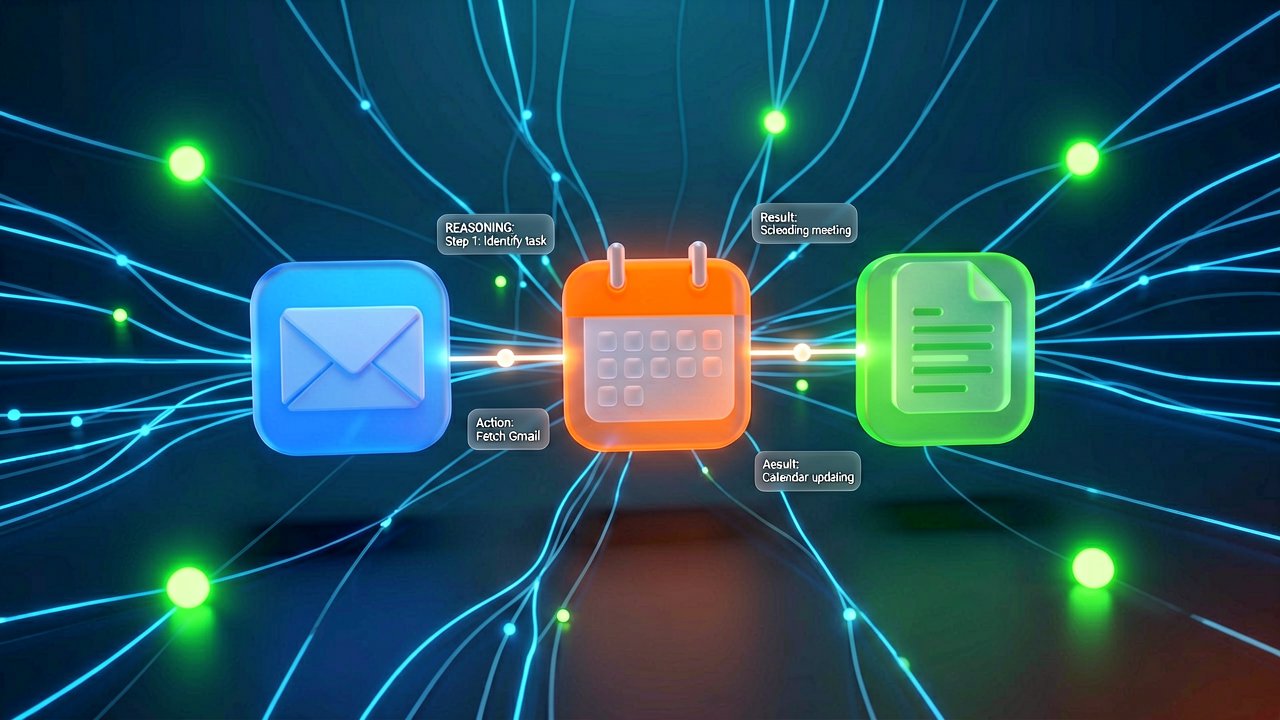
For the longest time, interacting with AI felt like a high-stakes game of 20 Questions. You’d poke it with a prompt, wait for the cursor to blink, and hope the result didn't hallucinate a new law of physics. But according to the Official Google Blog, we’re officially entering the "agentic era." Google’s Gemini app is shedding its reactive skin to become a 24/7 proactive partner that doesn’t just wait for your commands—it anticipates them. It’s a shift from a tool you use to a teammate that works alongside you, even when you aren't looking at your screen.
The centerpiece of this evolution is Gemini Spark, a personal AI agent designed to handle the logistical heavy lifting of digital life. We’re talking about an assistant that can autonomously navigate your Workspace ecosystem—digging through Gmail, checking your Calendar, and updating Docs—to manage multi-step tasks on your behalf. Unlike the static bots of yesteryear, these agents leverage reasoning frameworks like ReAct to "think" through complex problems step-by-step. As noted by MindStudio, the real magic is that Spark is always running in the background, transforming the Gemini app from a simple chat interface into a persistent digital concierge.
The Architecture of Proactivity
This isn't just about a smarter calendar reminder; it’s about a fundamental change in how AI processes our world. With the integration of Gemini Live, the assistant can now "see" what you’re seeing through your camera or screen, offering real-time suggestions based on visual context. If you're looking at a flyer for a concert, the agent doesn't just recognize the text—it can offer to book parking nearby or check your availability for the date. Google Blog highlights that this "Gemini Intelligence" on Android is specifically built to automate the tedious "middle-man" steps of shopping, planning, and research that usually eat up our afternoons.
Privacy and the $4,000 Question
Of course, giving an AI permission to roam your inbox 24/7 raises some eyebrows. Google is leaning heavily into "secure-by-design" infrastructure, promising that these proactive agents operate within sandboxed environments where you hold the keys. There’s also the matter of cost; while basic agentic features are rolling out to the masses, the high-compute reasoning required for truly complex, multi-hour tasks remains a premium experience. Industry analysts at point out that while advanced reasoning can currently cost a small fortune in compute power per task, the trajectory of AI suggests these "expensive today" capabilities will be the standard of tomorrow.

By moving beyond individual prompts and into the realm of persistent memory and autonomous action, Gemini is finally starting to fulfill the original promise of the digital assistant. It’s no longer just about getting an answer; it’s about getting things done. We’re moving toward a world where your phone doesn't just beep with a notification, but presents you with a completed task and a "don't worry, I handled it" attitude.
The Hidden Engine: What Most Reports Miss
Beyond the Automated Surface: While the headlines focus on the convenience of a 24/7 assistant, the real story lies in the transition from Large Language Models (LLMs) to Large Action Models (LAMs). For years, Google’s primary challenge wasn't just understanding language, but safely navigating the "walled gardens" of third-party applications. The true breakthrough in Gemini’s agentic shift is the use of tool-calling protocols that allow the AI to interact with software APIs with the same nuance a human brings to a mouse and keyboard. This represents a pivot from generative output to functional execution, where the AI isn't just predicting the next word, but predicting the next necessary click.
Industry insiders have long noted that the "hallucination problem" takes on a much darker tone when an AI is empowered to send emails or move funds. To mitigate this, Google has implemented a "Human-in-the-Loop" architecture for high-stakes tasks, creating a tiered autonomy system. This historical shift mirrors the early days of autonomous driving; we are currently in "Level 2" of AI agency, where the assistant handles the steering on a clear highway of data, but expects the user to keep their hands on the wheel when things get messy. This cautious approach is a direct response to the public relations disasters faced by earlier, more reckless iterations of digital assistants.
From a stakeholder perspective, the move toward proactivity is a play for "platform stickiness." By embedding Gemini so deeply into the Android and Workspace ecosystems, Google is creating a high switching cost for users. If your AI agent has spent months learning your specific scheduling preferences, the tone of your professional correspondence, and your travel habits, moving to a competitor's ecosystem becomes a logistical nightmare. This isn't just a feature update; it is a defensive moat built out of personal data and automated habits, ensuring that the user remains anchored to the Google cloud.

Historical context also reveals that this is the fulfillment of a decade-long vision that started with Google Now in 2012. Back then, the technology relied on rigid, rule-based heuristics that often felt more like spam than help. Today’s agentic Gemini utilizes semantic understanding to distinguish between a "meeting that can be moved" and a "meeting that is non-negotiable." This qualitative leap in reasoning allows the agent to navigate the grey areas of human scheduling that previously required a human secretary. The evolution from "if-this-then-that" logic to deep neural reasoning is what finally makes the 24/7 assistant viable.
Finally, the environmental and economic cost of "always-on" agency is the elephant in the room that tech journalists are only starting to address. Running an agent that constantly monitors and reasons in the background requires a massive increase in inference compute compared to a standard search query. Google is offseting this by moving more of the "proactive" processing to on-device chips like the Tensor G4, which handles smaller, privacy-sensitive tasks locally. This hybrid approach—cloud for the heavy lifting and local silicon for the 24/7 vigil—is the only way to scale the agentic era without melting the power grid or compromising user latency.
The Paradox of Autonomy
Reading Between the Lines: The narrative of the frictionless digital life assumes that we actually want our AI to make executive decisions on our behalf, yet this overlooks the fundamental human need for agency. There is a thin line between a helpful assistant and a digital over-manager that sanitizes our spontaneity. While Google markets the "24/7 proactive" nature of Gemini as a liberation from the mundane, it risks creating a feedback loop where we only see the options the AI deems relevant based on our past behavior. This brand of algorithmic determinism could inadvertently narrow our professional and social horizons under the guise of efficiency.
Furthermore, the industry's rush toward "agentic" AI reveals a glaring contradiction in the tech giant's stance on privacy. We are told that our data is "secure-by-design," yet for a proactive agent to function with any degree of competence, it must have unfettered access to the most intimate corners of our digital existence—our private drafts, our unvoiced calendar conflicts, and our real-time location. The trade-off for a truly effective agent isn't just a monthly subscription fee; it is the total transparency of the individual to the platform. Silicon Valley is essentially asking us to trust that the "sandbox" is thick enough to keep our data in while allowing the utility to leak out.
There is also a functional skepticism regarding the reliability of multi-step reasoning. Even the most advanced models today struggle with "cascading failures," where a small misunderstanding in step one of a ten-step task leads to a catastrophic error by step ten. If an agentic Gemini autonomously reschedules a flight based on a misunderstood email thread, the real-world cost of that "proactive help" could be immense. Until these models can demonstrate a near-zero failure rate in logical deduction, the proactive era may be characterized more by high-stakes troubleshooting than by the leisure time we’ve been promised.
Finally, we must consider the long-term cognitive implications of outsourcing our "logistical heavy lifting." If an AI manages our schedules, synthesizes our research, and drafts our communications, the mental muscles required for organization and critical synthesis may begin to atrophy. We are effectively beta-testing a world where the human role is reduced to that of a "final approver," a position that sounds prestigious until you realize that the person who controls the options controls the outcome. The agentic era isn't just changing our software; it's recalibrating the human experience into a series of "accept" or "decline" prompts.
The ultimate irony of the proactive AI age is that we’ll finally have all that extra free time we’ve been promised, only to spend most of it explaining to our digital assistant why "scheduling a 6:00 AM brainstorm" was technically possible, yet socially unforgivable.
Artūras Malašauskas is an AI Systems Integrator with 20+ years of production-grade web engineering experience. He has designed, shipped, and scaled enterprise Python/PHP systems for logistics, SaaS, and public-sector clients. For the past year, he has focused exclusively on AI integrations: deploying open-source LLMs, building generative media pipelines (image, audio, video), and engineering multi-agent workflows for real production environments. His standard: reproducibility, security, cost-efficient inference—no vaporware. He documents and evaluates emerging AI tooling, separating verified capabilities from marketing noise. Technical editor at: muza-ai.eu, ai-verslas.lt, ai-naujinos.lt Connect on LinkedIn
Comments