SAP CEO: “Almost Right” Isn’t Enough as AI Moves to the Driver’s Seat
At the annual Sapphire conference in Orlando, SAP CEO Christian Klein laid down a heavy gauntlet for the future of enterprise technology. Launching the company’s new "Autonomous Suite," Klein argued that the era of AI acting merely as a sidekick is coming to a close. For businesses running mission-critical operations like global supply chains or complex financial closes, the margin for error is effectively zero. "Eighty percent accuracy is just not good enough when you run the world's most business-critical processes," Klein told the crowd, a clear jab at the "hallucination-prone" reputation of generic large language models. The message was sharp: in the high-stakes world of ERP, being "almost right" is a recipe for disaster.
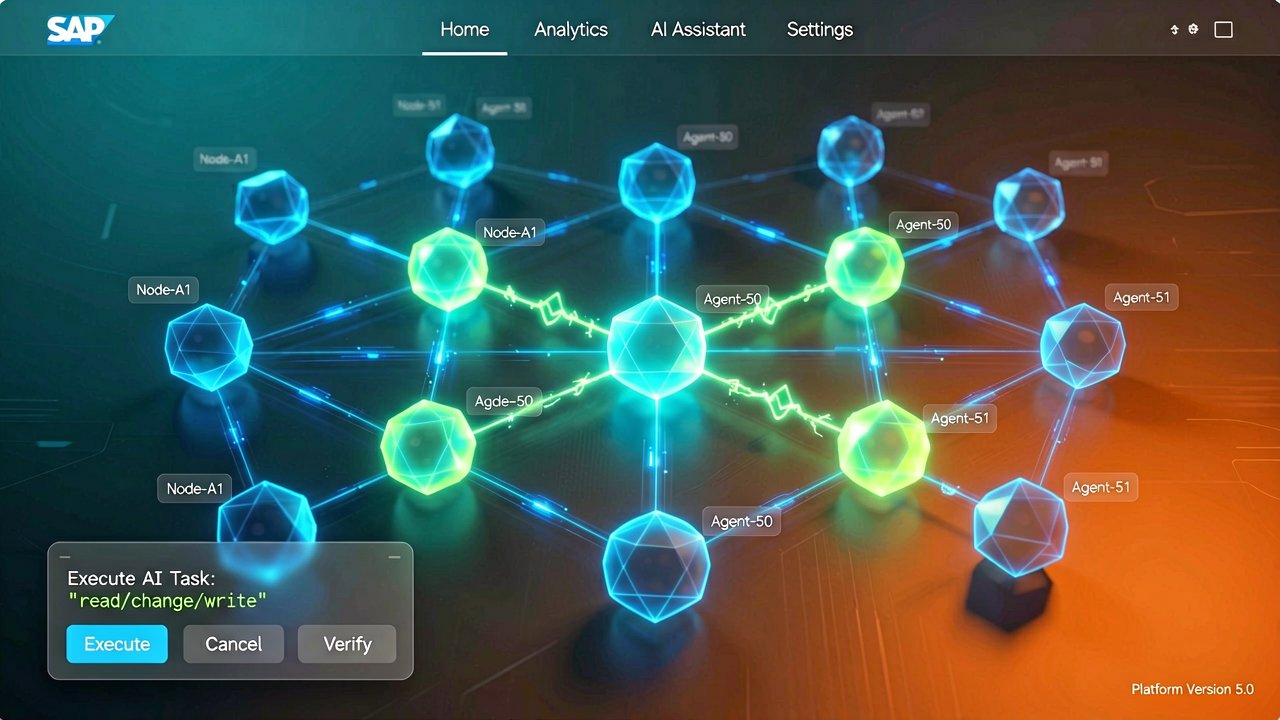
The centerpiece of this shift is the expansion of Joule, SAP’s AI copilot, which is evolving from a conversational interface into a conductor for a massive orchestra of autonomous agents. The company unveiled more than 50 Joule assistants and 200 specialized agents designed to execute tasks end-to-end without constant human steering. By anchoring these agents directly into the SAP Business AI Platform, the software giant is betting that its deep well of proprietary business data and governance rules will provide the precision that horizontal AI competitors currently lack. It’s an aggressive pivot that attempts to transform SAP from a system of record into a system of execution.
The Real Stakes of Autonomy
What Most Reports Miss: While much of the buzz surrounds the "cool factor" of autonomous software, the real story is SAP's attempt to solve the "last mile" problem of enterprise AI—the point where an insight must actually turn into an action. For years, AI in the workplace has been a passive observer, offering suggestions that a human then has to manually type into a system. By introducing agents that can "read, change, and write back" into the system of record, SAP is asking its customers to hand over the keys to the kingdom. It is a massive leap of faith, predicated on the idea that SAP’s Knowledge Graph can map out the complex web of permissions and business logic better than any human operator could.
From a historical perspective, this move feels like the natural conclusion of the journey SAP started decades ago with process standardization. Back then, the goal was to get every employee to follow the same digital blueprint; now, the goal is to have the software follow that blueprint itself. Industry veterans will notice that this isn't just about efficiency—it's about survival in a market where competitors like Salesforce and Oracle are also racing to claim the "Agentic AI" throne. However, SAP’s advantage remains its "stickiness" in the back office, where the most sensitive data lives and where the cost of a mistake is highest.

Stakeholders, particularly CFOs and supply chain leads, are watching this roll-out with a mix of optimism and healthy skepticism. The promise of compressing a financial close from weeks to days using an "Autonomous Close Assistant" is a compelling ROI story, but it raises thorny questions about auditability and human oversight. Klein addressed this by emphasizing "human-in-the-loop" controls, allowing companies to dial the level of autonomy up or down based on their comfort level. Yet, the underlying strategy is clear: SAP wants to make its software so "wise" that the manual work of navigating menus and screens eventually becomes a legacy relic of the 20th century.
The financial commitment behind this vision is equally telling. With a €100 million fund earmarked for partners to build out this ecosystem, SAP is admitting that it can’t build every specialized agent alone. This creates a new "AI flywheel" where the more data and domain-specific logic a partner plugs into the suite, the more indispensable the platform becomes. It’s a classic platform play, but with the added complexity of generative AI. If SAP can truly deliver on the promise of "accurate, compliant, and secure" autonomous actions, it may successfully redefine what it means to be an enterprise software company in the 2020s.
At the annual Sapphire conference in Orlando, SAP CEO Christian Klein laid down a heavy gauntlet for the future of enterprise technology. Launching the company’s new "Autonomous Suite," Klein argued that the era of AI acting merely as a sidekick is coming to a close. For businesses running mission-critical operations like global supply chains or complex financial closes, the margin for error is effectively zero. "Eighty percent accuracy is just not good enough when you run the world's most business-critical processes," Klein told the crowd, a clear jab at the "hallucination-prone" reputation of generic large language models. The message was sharp: in the high-stakes world of ERP, being "almost right" is a recipe for disaster.
The centerpiece of this shift is the expansion of Joule, SAP’s AI copilot, which is evolving from a conversational interface into a conductor for a massive orchestra of autonomous agents. The company unveiled more than 50 Joule assistants and 200 specialized agents designed to execute tasks end-to-end without constant human steering. By anchoring these agents directly into the SAP Business AI Platform, the software giant is betting that its deep well of proprietary business data and governance rules will provide the precision that horizontal AI competitors currently lack. It’s an aggressive pivot that attempts to transform SAP from a system of record into a system of execution.

The Real Stakes of Autonomy
What Most Reports Miss: While much of the buzz surrounds the "cool factor" of autonomous software, the real story is SAP's attempt to solve the "last mile" problem of enterprise AI—the point where an insight must actually turn into an action. For years, AI in the workplace has been a passive observer, offering suggestions that a human then has to manually type into a system. By introducing agents that can "read, change, and write back" into the system of record, SAP is asking its customers to hand over the keys to the kingdom. It is a massive leap of faith, predicated on the idea that SAP’s Knowledge Graph can map out the complex web of permissions and business logic better than any human operator could.
From a historical perspective, this move feels like the natural conclusion of the journey SAP started decades ago with process standardization. Back then, the goal was to get every employee to follow the same digital blueprint; now, the goal is to have the software follow that blueprint itself. Industry veterans will notice that this isn't just about efficiency—it's about survival in a market where competitors like Salesforce and Oracle are also racing to claim the "Agentic AI" throne. However, SAP’s advantage remains its "stickiness" in the back office, where the most sensitive data lives and where the cost of a mistake is highest.
Stakeholders, particularly CFOs and supply chain leads, are watching this roll-out with a mix of optimism and healthy skepticism. The promise of compressing a financial close from weeks to days using an "Autonomous Close Assistant" is a compelling ROI story, but it raises thorny questions about auditability and human oversight. Klein addressed this by emphasizing "human-in-the-loop" controls, allowing companies to dial the level of autonomy up or down based on their comfort level. Yet, the underlying strategy is clear: SAP wants to make its software so "wise" that the manual work of navigating menus and screens eventually becomes a legacy relic of the 20th century.
The Friction of Perfection
Reading Between the Lines: SAP’s insistence on "perfection" highlights a fundamental tension in the AI arms race: the gap between marketing a vision and the messy reality of legacy data. While the CEO decries the "almost right" nature of generic AI, SAP’s own autonomous ambitions rely on the assumption that customer data—often siloed, inconsistent, and decades deep—is ready for prime time. The irony is that for many enterprises, the greatest hurdle isn't the AI's intelligence, but the chaotic state of the data foundations it is being asked to manage. An autonomous agent is only as precise as the ledger it reads, and a perfectly executed action based on a flawed data entry is still a mistake, just one made at the speed of light.
Furthermore, there is a certain corporate bravado in pivoting toward total autonomy while simultaneously reassuring workers that they remain in control. SAP is walking a tightrope between offering massive labor savings through automation and avoiding the "job killer" label that haunts AI conversations. The "human-in-the-loop" narrative serves as a necessary safety net, yet if the system truly reaches the "autonomous" status Klein describes, the loop will inevitably tighten until the human is little more than a bystander. This creates a psychological barrier for mid-level management who may view these high-precision agents not as tools for empowerment, but as efficient replacements for their own oversight roles.
There is also the matter of the "AI Tax." While SAP claims these tools will drive unprecedented value, the infrastructure required to run high-precision, agentic workflows is notoriously expensive. We are seeing a shift where the cost of software isn't just in the license, but in the tokens and compute power consumed by these autonomous assistants. For the enterprise customer, the math must eventually move beyond the novelty of a "self-closing book" to a hard-nosed assessment of whether the efficiency gains outweigh the soaring costs of AI consumption. The vision is undeniably bold, but the road to an autonomous enterprise is paved with expensive GPUs and a lot of uncomfortable questions about who is truly liable when the "perfect" agent finally makes a mistake.
After forty years of teaching humans to speak the language of databases, SAP is finally teaching databases to speak the language of business; we can only hope the software has more patience for our messiness than we ever had for its menus.
Artūras Malašauskas is an AI Systems Integrator with 20+ years of production-grade web engineering experience. He has designed, shipped, and scaled enterprise Python/PHP systems for logistics, SaaS, and public-sector clients. For the past year, he has focused exclusively on AI integrations: deploying open-source LLMs, building generative media pipelines (image, audio, video), and engineering multi-agent workflows for real production environments. His standard: reproducibility, security, cost-efficient inference—no vaporware. He documents and evaluates emerging AI tooling, separating verified capabilities from marketing noise. Technical editor at: muza-ai.eu, ai-verslas.lt, ai-naujinos.lt Connect on LinkedIn
Comments