The 12-Hour OS: How Google Antigravity 2.0 Just Rewrote the Rules of Development
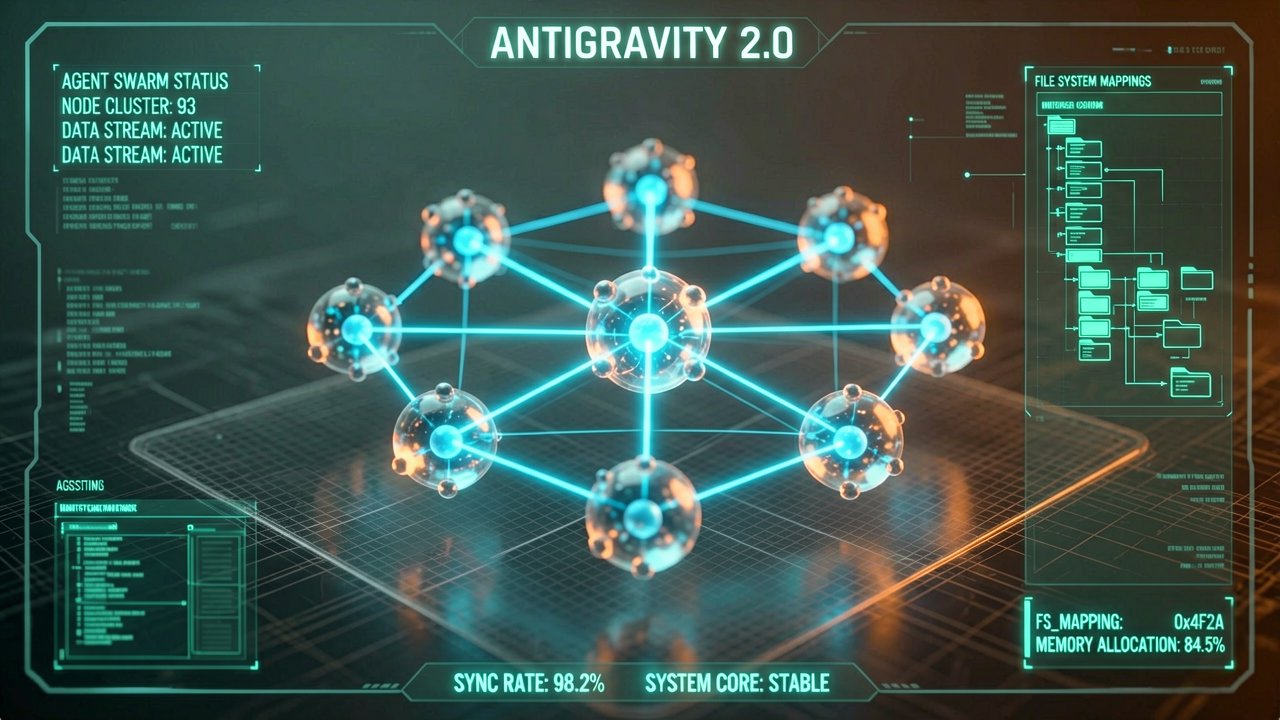
Google I/O 2026 didn’t just move the goalposts; it set the old ones on fire and launched them into orbit. The headline-grabber was a demo that felt less like a tech presentation and more like a flex of pure computational muscle. Google claimed that TechCrunch reports their new Antigravity 2.0 platform—an "unabashedly agent-first" IDE—built the core of a functional operating system in just 12 hours. Using a swarm of 93 parallel subagents, the system handled everything from memory management to file systems without a single human-written line of code, proving that the era of the "lone genius" programmer might be facing its final boss.
But the real story for the millions of us stuck in the daily grind is the mainstreaming of "vibe coding." According to the Official Google Blog, native Android vibe coding is now a reality within Google AI Studio. It’s a shift from syntax to sentiment, where you essentially describe what an app should *feel* like and let the Gemini 3.5 Flash engine handle the heavy lifting. This isn't just about speed; it's about accessibility. Google is betting that if you can talk, you can build. It’s a bold gamble that could either democratize software creation or flood the Play Store with "vibey" but structurally questionable code.
From Syntax to Vibes: Android’s New Reality
The transition to vibe coding on Android isn't just a fancy skin for a chatbot; it's a deep integration into the development stack. By bringing native Kotlin support to AI Studio, Google allows developers to "vibe" their way through complex tasks like migrating to Jetpack Compose or handling intricate API integrations. It feels like the natural evolution of Karpathy's 2025 prophecy, turning the developer into more of a creative director than a technician. While the purists might cringe at the lack of manual control, the efficiency gains highlighted by The Business Engineer—running Doom on a 12-hour-old OS—are hard to ignore.
Antigravity 2.0: The Orchestration Engine
The new Antigravity 2.0 desktop app is the command center for this new world. It doesn't just suggest code; it orchestrates agents that can download SDKs, run tests in sandboxed environments, and even "grill" the developer with architectural questions before starting a task. This level of autonomy is designed to take the friction out of "vibe-coded" prototypes, scaling them into production-ready software. For those who live in the terminal, the new Antigravity CLI replaces the legacy Gemini tools entirely, offering a lightweight, high-velocity alternative for managing these autonomous swarms.
The Hidden Architecture of Autonomy
Beyond the Keynote Hype: While the 12-hour OS demo provided the perfect "wow" moment for the cameras, seasoned observers are looking closely at the underlying orchestration layer that makes Antigravity 2.0 more than just a glorified script generator. This isn't merely about LLMs predicting the next token; it is about a decentralized swarm of specialized agents that possess an unprecedented level of environmental awareness. Unlike the fragmented AI tools of 2024, Antigravity 2.0 acts as a cohesive nervous system, capable of self-correcting logic errors across disparate modules without manual intervention. It effectively bridges the gap between high-level intent and low-level execution by maintaining a persistent "global state" that prevents the agents from hallucinating conflicting architectures.
The move to bring vibe coding into the heart of Android development signals a major shift in Google's internal philosophy toward technical debt. For years, the Android ecosystem has struggled with legacy code bloat and the steep learning curve of Jetpack Compose. By integrating Gemini 3.5 Flash directly into the Studio workflow, Google is essentially offering a "clean slate" button. Developers are no longer tethered to the minutiae of boilerplate code; they are managing the outcome. However, this has sparked a quiet tension within Mountain View. Traditionalists argue that abstracting the logic so far away from the developer could lead to a generation of "black box" applications that are impossible to audit for security vulnerabilities or performance bottlenecks.
Historically, this evolution mirrors the industry's shift from assembly language to high-level languages like C and Java. Each step removed a layer of manual control in exchange for exponential gains in productivity. Antigravity 2.0 is the logical conclusion of this trajectory, where "natural language" becomes the ultimate programming language. Stakeholders in the enterprise sector are particularly bullish, seeing this as a solution to the perennial talent shortage. If a junior product manager can "vibe" a functional internal tool into existence in a single afternoon, the ROI on AI investment suddenly becomes tangible rather than theoretical.
The 12-hour OS experiment specifically targeted the kernel and driver layers—the most unforgiving parts of software engineering. By utilizing a "chain-of-verification" methodology, the Antigravity agents ran millions of simulated stress tests in parallel with the code generation process. This suggests that Google is confident enough in the reliability of agent-to-agent auditing to bypass traditional human code reviews for core infrastructure. It is a bold statement of trust in their own models, effectively betting the future of the Android ecosystem on the idea that AI can be more rigorous than the humans who created it.

Ultimately, the "vibe coding" era is less about the death of the programmer and more about the birth of the software architect. The role is shifting from someone who writes code to someone who defines the parameters of a digital ecosystem. As these agents become more autonomous, the value of a developer will be measured by their ability to provide the right "vibe"—a combination of design thinking, user empathy, and strategic foresight—rather than their proficiency with a debugger. The 2026 I/O conference will likely be remembered as the moment the industry stopped talking about AI as a tool and started treating it as a teammate.
The Mirage of the Zero-Effort Stack
Reading Between the Lines: For all the talk of "vibe coding" liberating the creative spirit, there is a gaping hole in the narrative regarding long-term maintainability. Google’s 12-hour OS demo is a masterclass in rapid prototyping, but it conveniently ignores the "Day 2" problem: who debugs a system that no human actually designed? When an agent-built kernel encounters a race condition three months into production, a developer who "vibed" the architecture into existence will find themselves staring at a wall of machine-optimized logic that defies human intuition. We are potentially trading the manageable complexity of human-written code for a chaotic, emergent complexity that requires even more AI just to interpret it.
There is also a palpable contradiction in Google's push for democratization versus the reality of computational costs. While vibe coding is pitched as a way for anyone to build, the sheer amount of tokens and GPU cycles required to run 93 parallel agents is staggering. This creates a new kind of gatekeeping. Instead of being limited by technical knowledge, creators are now limited by their API credits and the depth of their pockets. If the future of Android development requires a high-bandwidth connection to a proprietary "sovereign" AI cloud, we aren't exactly democratizing software; we are centralizing it under a more user-friendly interface.
Furthermore, the reliance on "vibe" as a technical requirement introduces a level of ambiguity that would make any legacy systems engineer break out in hives. Vibe is subjective; logic is not. By moving away from deterministic syntax, we risk a future where software behavior is dictated by the latest model update rather than a fixed specification. If Gemini 3.5 Flash decides a "minimalist vibe" today means something different than it did yesterday, the consistency of the Android ecosystem could fracture into a thousand different interpretations of what a "good" user experience actually looks like.
The skepticism from the security community is equally sharp. An operating system built in a dozen hours is an operating system with twelve hours of security vetting. While Google claims their agents "grill" each other for vulnerabilities, the history of software is a graveyard of "unbreakable" systems that failed due to unforeseen edge cases. Entrusting the entire stack to a black-box agent swarm assumes that the AI won't inadvertently reinvent classic exploits—or worse, invent new ones that our current suite of static analysis tools aren't even programmed to detect.
Finally, we must consider the psychological toll on the developer. There is a specific kind of satisfaction in solving a hard engineering problem that vibe coding threatens to automate away. If we reduce the act of creation to a series of high-level prompts, we may find that we have built a world where everyone can "code," but no one actually knows how anything works. We are rushing toward a future where we are all creative directors of projects we don't understand, standing atop a mountain of automated infrastructure that we can’t fix if the power goes out.
The good news is that you can now build a custom OS before lunch; the bad news is that when it crashes during dessert, you'll have to ask the AI nicely to remember what it was thinking when it hallucinated the memory management system.
Artūras Malašauskas is an AI Systems Integrator with 20+ years of production-grade web engineering experience. He has designed, shipped, and scaled enterprise Python/PHP systems for logistics, SaaS, and public-sector clients. For the past year, he has focused exclusively on AI integrations: deploying open-source LLMs, building generative media pipelines (image, audio, video), and engineering multi-agent workflows for real production environments. His standard: reproducibility, security, cost-efficient inference—no vaporware. He documents and evaluates emerging AI tooling, separating verified capabilities from marketing noise. Technical editor at: muza-ai.eu, ai-verslas.lt, ai-naujinos.lt Connect on LinkedIn
Comments