The Great Pivot: Why Japan’s Gaming Giants Are Winning as the AI Hype Cools
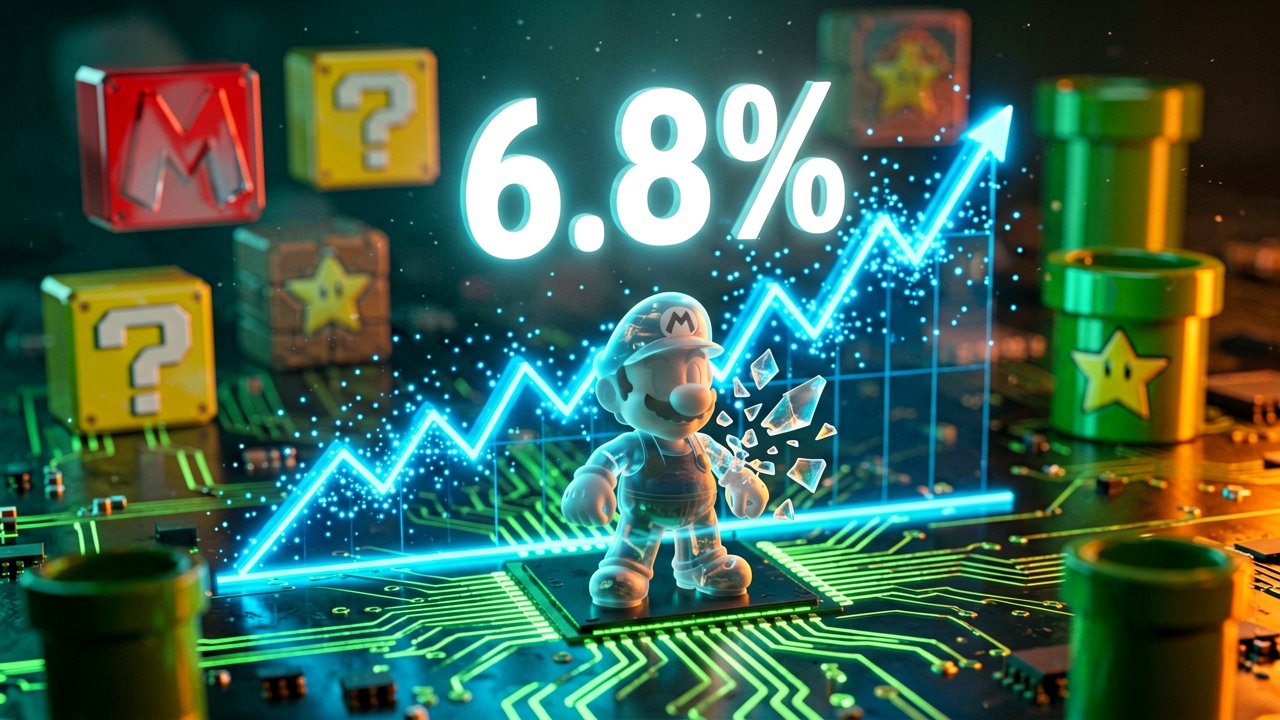
For months, the Tokyo Stock Exchange has been a high-stakes playground for AI-adjacent firms, but the wind is shifting. In a classic "flight to quality," Japanese investors are beginning to cool on the speculative frenzy surrounding artificial intelligence, opting instead to pour capital back into the reliable, IP-rich bastions of the gaming world. This rotation has triggered a significant rally for the industry’s heavy hitters: Nintendo saw its shares jump as much as 6.8% this Tuesday, while both Bandai Namco and Konami Group enjoyed even steeper climbs, each surging more than 9% in a single session.
This isn't just a random spike; it’s a symptom of "AI fatigue." After a year where anything with a neural network was priced for perfection, the market is finally asking the "what's next" question. While AI firms are grappling with massive capital expenditure cycles and the pressure to prove immediate monetization, the likes of Nintendo and Konami offer something far more tangible: world-class intellectual property and established consumer loyalty that doesn't rely on the next GPU shipment. For Nintendo, in particular, this rebound is a much-needed breath of fresh air after a rocky start to May, where a tepid fiscal forecast and rumors of a Switch 2 price hike had sent the stock into a temporary tailspin.
The Safe Harbor of Proven IP
What Most Reports Miss: The recent surge in gaming stocks isn't merely a rejection of AI, but a strategic bet on the terminal value of Japanese entertainment. Institutional buyers are increasingly wary of the $700 billion AI capex cycle projected for 2026, questioning whether the earnings will ever justify the gargantuan infrastructure costs. In contrast, companies like Bandai Namco and Konami operate on a completely different financial plane. Their value is locked in character models, legendary franchises, and a 75-day cash conversion cycle that would make any silicon-valley startup envious. By pivoting back to these "beaten-down" names, investors are looking for assets that have already survived the supply chain crunches of the last two years and are now poised to benefit from a more stable macroeconomic environment.
Historically, Japanese investors have a deep-seated caution toward speculative bubbles, a trait forged in the fires of the 1990s asset collapse. While the global market stayed drunk on AI promises, Tokyo’s institutional base has been quietly monitoring the "AI losers"—established software and hardware makers whose valuations were suppressed by fears of AI-driven disruption. The tide turned when it became clear that while AI might change how games are built, it cannot easily replace the cultural footprint of Mario or Gundam. This realization has turned former skeptics into buyers, viewing the recent lows in gaming stock prices as a rare entry point for high-quality consumer franchises.

The technical setup for this rotation was perfect. Nintendo had just weathered its longest monthly losing streak in a decade, and Bandai Namco’s valuation had drifted into territory that analysts at Seeking Alpha noted lacked a safety margin—until the recent price drop made them look like absolute bargains. When you combine this "value hunt" with the upcoming 2026 World Cup—a massive catalyst for Konami’s eFootball—and the looming launch of the next Nintendo hardware, the narrative for gaming becomes far more compelling than another abstract AI roadmap. The market is effectively signaling that it prefers the visible earnings runway of a new console cycle over the uncertain "hallucinations" of a saturated AI market.
Furthermore, the internal discipline of these Japanese firms is playing a massive role in their sudden attractiveness. Unlike Western developers who often chase infinite growth through aggressive monetization and layoffs, Nintendo’s focus on talent retention and long-term IP health is proving to be a powerful differentiator. Investors are tired of the "pump and dump" nature of tech stock prices and are gravitating toward the structural stability of the Japanese corporate culture. As memory chip supply crunches ease, the fear that component shortages would cripple hardware sales is evaporating, leaving the door wide open for a sustained rally as we head into the second half of the year.
As the "AI gold rush" enters a correction phase, the gaming sector is re-emerging as a dominant force in the TOPIX. The recent 9% gains for Konami and Bandai Namco aren't just outliers; they are a loud declaration that in the battle between speculative technology and legendary entertainment, the smart money is currently betting on the ones who own the stories. This shift marks a return to fundamentals where unit economics and IP dominance outweigh the buzzwords of the day, suggesting that the "Lost Decades" caution is exactly what's protecting Japanese portfolios from the next big tech pop.
For months, the Tokyo Stock Exchange has been a high-stakes playground for AI-adjacent firms, but the wind is shifting. In a classic "flight to quality," Japanese investors are beginning to cool on the speculative frenzy surrounding artificial intelligence, opting instead to pour capital back into the reliable, IP-rich bastions of the gaming world. This rotation has triggered a significant rally for the industry’s heavy hitters: Nintendo saw its shares jump as much as 6.8% this Tuesday, while both Bandai Namco and Konami Group enjoyed even steeper climbs, each surging more than 9% in a single session.

This isn't just a random spike; it’s a symptom of "AI fatigue." After a year where anything with a neural network was priced for perfection, the market is finally asking the "what's next" question. While AI firms are grappling with massive capital expenditure cycles and the pressure to prove immediate monetization, the likes of Nintendo and Konami offer something far more tangible: world-class intellectual property and established consumer loyalty that doesn't rely on the next GPU shipment. For Nintendo, in particular, this rebound is a much-needed breath of fresh air after a rocky start to May, where a tepid fiscal forecast and rumors of a Switch 2 price hike had sent the stock into a temporary tailspin.
The Safe Harbor of Proven IP
What Most Reports Miss: The recent surge in gaming stocks isn't merely a rejection of AI, but a strategic bet on the terminal value of Japanese entertainment. Institutional buyers are increasingly wary of the $700 billion AI capex cycle projected for 2026, questioning whether the earnings will ever justify the gargantuan infrastructure costs. In contrast, companies like Bandai Namco and Konami operate on a completely different financial plane. Their value is locked in character models, legendary franchises, and a 75-day cash conversion cycle that would make any silicon-valley startup envious. By pivoting back to these "beaten-down" names, investors are looking for assets that have already survived the supply chain crunches of the last two years and are now poised to benefit from a more stable macroeconomic environment.
Historically, Japanese investors have a deep-seated caution toward speculative bubbles, a trait forged in the fires of the 1990s asset collapse. While the global market stayed drunk on AI promises, Tokyo’s institutional base has been quietly monitoring the "AI losers"—established software and hardware makers whose valuations were suppressed by fears of AI-driven disruption. The tide turned when it became clear that while AI might change how games are built, it cannot easily replace the cultural footprint of Mario or Gundam. This realization has turned former skeptics into buyers, viewing the recent lows in gaming stock prices as a rare entry point for high-quality consumer franchises.
The technical setup for this rotation was perfect. Nintendo had just weathered its longest monthly losing streak in a decade, and Bandai Namco’s valuation had drifted into territory that analysts at Seeking Alpha noted lacked a safety margin—until the recent price drop made them look like absolute bargains. When you combine this "value hunt" with the upcoming 2026 World Cup—a massive catalyst for Konami’s eFootball—and the looming launch of the next Nintendo hardware, the narrative for gaming becomes far more compelling than another abstract AI roadmap. The market is effectively signaling that it prefers the visible earnings runway of a new console cycle over the uncertain "hallucinations" of a saturated AI market.
The Valuation Paradox: Substance Over Synthesis
Reading Between the Lines: The irony of this sudden bull run for gaming is that it thrives on the very "un-intelligence" of traditional entertainment. While AI stocks are punished the moment their large language models show a hint of diminishing returns, Konami and Bandai Namco are being rewarded for doing exactly what they have done for decades: milking legacy franchises. There is a fundamental contradiction in the market’s logic here; investors are fleeing the "black box" of AI algorithms only to dive headfirst into the equally opaque "black box" of creative hit-making. Betting on a plumber in red overalls to save a portfolio is technically no more scientific than betting on a chatbot, yet the psychological comfort of a physical character brand provides a floor that silicon dreams currently lack.
Furthermore, we should view the 9% surges with a healthy dose of skepticism regarding their longevity. Much of this movement is fueled by "short covering" and algorithmic rebalancing rather than a sudden, profound revelation about the intrinsic value of Pac-Man. The narrative that AI is a "bubble" and gaming is a "safe haven" is a convenient oversimplification that ignores the massive R&D risks inherent in the next generation of hardware. If Nintendo’s successor to the Switch fails to capture the zeitgeist, the very investors currently fleeing "AI risk" will find themselves trapped in a "hardware risk" cycle that is far more punishing to their bottom line.
There is also the awkward reality that these gaming companies are themselves heavily invested in the very AI technology the market is currently shunning. From automated QA testing to procedural world-building, the efficiency gains from AI are what will keep these giants profitable in a high-inflation environment. Therefore, the "flight from AI" is more of a flight from AI infrastructure providers back to AI beneficiaries. It is a cynical, yet pragmatic, reshuffling of the deck: investors still want the technological edge, but they want it wrapped in a recognizable mascot and sold at a retail markup they can actually track on a balance sheet.
Ultimately, this rotation suggests that the market’s patience for "disruptive potential" has run dry. The shift toward Nintendo and its peers is a vote for the status quo—a preference for companies that sell a finished product for a fixed price rather than a subscription to a promise of future intelligence. While the AI sector will undoubtedly bounce back once the infrastructure begins to bear fruit, the current trend underscores a hard truth: when the future starts to look a bit too blurry, everyone suddenly remembers how much they like the classics.
In the end, it turns out that even the most sophisticated algorithms are no match for a mustachioed plumber when the market gets the jitters; apparently, investors find it much easier to trust a digital dragon they can fight than a neural network they can't explain.
Artūras Malašauskas is an AI Systems Integrator with 20+ years of production-grade web engineering experience. He has designed, shipped, and scaled enterprise Python/PHP systems for logistics, SaaS, and public-sector clients. For the past year, he has focused exclusively on AI integrations: deploying open-source LLMs, building generative media pipelines (image, audio, video), and engineering multi-agent workflows for real production environments. His standard: reproducibility, security, cost-efficient inference—no vaporware. He documents and evaluates emerging AI tooling, separating verified capabilities from marketing noise. Technical editor at: muza-ai.eu, ai-verslas.lt, ai-naujinos.lt Connect on LinkedIn
Comments