Far Far West Publisher Draws a Line in the Dust Over GenAI

In an era where tech giants are sprinting to "disrupt" creative workflows with generative AI, Fireshine Games—the publisher behind the breakout Steam hit Far Far West—is planting a very firm boot in the sand. CEO Brian Foote recently made it clear that while the industry is awash in AI hype, his company isn’t interested in the "slop." In an interview with GamesIndustry.biz , Foote defined a "red line" for the publisher: they simply won’t partner with developers who rely on generative AI for core game art or assets.
The stance isn't just about moral posturing; it's a savvy reading of a player base that is increasingly wary of the "uncanny valley" and the legal quagmires surrounding AI-generated content. With Far Far West already galloping past the million-copy mark in its first few weeks of Early Access, Fireshine has the momentum to back up its words. Foote pointed out that while minor tools like code completion or office-suite assistants (think Microsoft Copilot) are a reality of modern life, the "fundamental game development process" should remain a human endeavor to keep the industry healthy and the players happy.
The Human Touch in the Weird West
What Most Reports Miss: This isn't just a isolated protest—it’s the beginning of a stratified market where "Hand-Crafted" is becoming a premium label. While companies like Ubisoft and Microsoft experiment with AI-driven NPCs and world-building, Fireshine’s rejection of generative assets reflects a growing sentiment among indie-adjacent heavyweights that players can smell the difference between a designer's intent and an algorithm’s average. The success of Far Far West, developed by the French studio Evil Raptor, proves that the specific, quirky soul of a game is what drives those "97% positive" Steam reviews that every CEO craves.
The "red line" Foote mentions is as much about legal insurance as it is about artistic integrity. As WN Hub reports, the industry is currently navigating a "Wild West" where AI training data and copyright ownership are legal ticking time bombs. By ensuring their partners avoid generative art, Fireshine is essentially future-proofing their catalog against potential lawsuits or platform bans that could arise when the legal railroads finally catch up to the technology.
This sentiment echoes the hard stance taken by Hooded Horse CEO Tim Bender earlier this year. Bender famously warned developers against using AI for even placeholder assets, noting that "scaffolding" has a habit of ending up in the final build. The consensus among these boutique publishers is clear: the risk of alienating a community that values human craft far outweighs the marginal cost-savings offered by a prompt-box. It’s a gamble on the long-term value of a brand over the short-term efficiency of a machine.
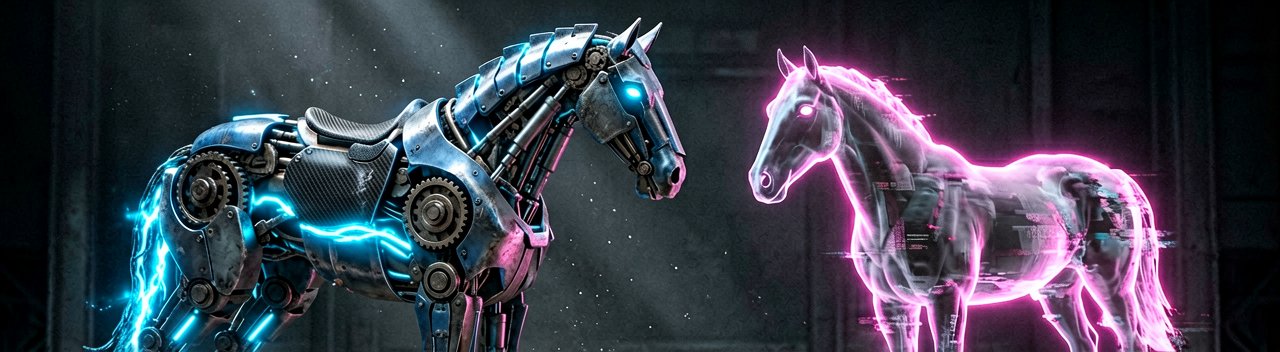
Behind the scenes, the developers at Evil Raptor have focused on the tactile feel of Far Far West—the specific animation of a robot horse or the chaotic synergy of hand-coded "Joker" modifiers. This level of intentionality is precisely what generative AI struggles to replicate. When a developer spends months fine-tuning the physics of a laser-cowboy’s six-shooter, it creates a feedback loop with the player that an AI-generated asset simply can't bridge. Fireshine's policy ensures that this loop remains unbroken by synthetic noise.
Ultimately, Fireshine's move suggests that the "AI revolution" in gaming might face its toughest battle not in the boardrooms, but on the digital storefronts. As more publishers follow the lead of Fireshine and Hooded Horse, we’re likely to see a divide: a world of "efficient" but increasingly homogenous AAA blockbusters on one side, and a vibrant, human-led indie scene that uses its rejection of AI as a badge of honor. For now, the robot cowboys of Far Far West are doing just fine without any help from a neural network.
The commitment to human development isn't just a trend—it's a defensive maneuver against the commoditization of creativity. By prioritizing the health of the development community over the allure of rapid, automated content generation, Fireshine is positioning itself as a haven for studios that still believe in the "old ways." It’s a bold strategy in a high-tech age, but with a million sales in the bag, it’s hard to argue with the results.

The Pragmatic Limits of Digital Purity
Reading Between the Lines: While Fireshine’s stance is being hailed as a heroic defense of the arts, there is a certain irony in drawing a "red line" in an industry that has lived and breathed procedural generation for decades. We have long accepted that an algorithm can "craft" the placement of trees in a forest or the loot tables in a chest, yet we recoil when that same logic begins to touch the pixels of a character’s face. The distinction Fireshine is making relies on a fragile definition of "core assets," a boundary that will only become more porous as AI tools are baked directly into the industry-standard software like Photoshop and Unreal Engine.
There is also the matter of the "Supply Chain of Creativity." Fireshine can vet its primary developer, but in the modern outsourcing ecosystem, ensuring every third-party contractor or asset-store contributor has kept their hands "clean" of generative tools is a logistical nightmare. This policy might inadvertently create a "don't ask, don't tell" culture among smaller studios who are desperate for the efficiency gains AI provides but terrified of losing their publishing deals. The risk is that "Human-Made" becomes less of a verifiable fact and more of a marketing label that publishers hope no one looks at too closely.
Furthermore, the financial skepticism behind this move shouldn't be ignored. By distancing themselves from GenAI, Fireshine isn't just protecting art; they are insulating themselves from the volatility of the AI hype cycle and the looming threat of the "Dead Internet Theory" affecting game storefronts. If Steam becomes flooded with low-effort AI shovelware, being the publisher that guarantees a human touch is a powerful way to command a price premium. It’s a classic "Quality over Quantity" play, but it remains to be seen if this purity can survive a future where AI-augmented studios start producing games twice as fast at half the cost.
The projected implication here is a widening chasm in the market. We are likely heading toward a world where "Certified Human" games are sold like organic produce—more expensive and slightly less polished, but with a perceived moral and aesthetic superiority. Meanwhile, the mid-tier of the industry may vanish as it struggles to compete with the sheer volume of AI-assisted output. Fireshine is betting that the soul of a game like Far Far West is worth the extra overhead, but in a hit-driven business, one major flop could make those cost-saving AI "slop" tools look a lot more tempting to the next board of directors.
"In the end, we’re all just fighting to ensure that when a game crashes your PC, it was a real person’s mistake that caused it, rather than a hallucinating server in a data center trying to figure out what a cowboy’s fingers are supposed to look like."
Artūras Malašauskas is an AI Systems Integrator with 20+ years of production-grade web engineering experience. He has designed, shipped, and scaled enterprise Python/PHP systems for logistics, SaaS, and public-sector clients. For the past year, he has focused exclusively on AI integrations: deploying open-source LLMs, building generative media pipelines (image, audio, video), and engineering multi-agent workflows for real production environments. His standard: reproducibility, security, cost-efficient inference—no vaporware. He documents and evaluates emerging AI tooling, separating verified capabilities from marketing noise. Technical editor at: muza-ai.eu, ai-verslas.lt, ai-naujinos.lt Connect on LinkedIn
Comments