LaunchDarkly Drops Runtime Control Layer to Tame the Agentic Wild West

For years, LaunchDarkly has been the silent backbone of the DevOps world, providing the "kill switches" and feature flags that allow engineers to sleep at night. But as we slide headfirst into the era of autonomous AI agents, the stakes have shifted from simple "on-off" toggles to managing the unpredictable whims of non-deterministic models. Recognizing this shift, LaunchDarkly has officially launched AgentControl, a dedicated runtime control layer designed to govern AI agents in production without requiring a single code redeploy.
The core problem this addresses—what the company calls the "AI Control Gap"—is that AI-generated code and agentic behaviors don't fail like traditional software. They drift, they hallucinate, and they react to live data in ways that pre-production testing simply can’t always catch. By injecting a control layer directly into the agent’s execution path, LaunchDarkly is giving teams the ability to swap models, adjust prompt instructions, or trigger immediate fallbacks in under 200 milliseconds. It’s a move that transforms feature flagging from a release tool into a real-time governance system for autonomous systems that are increasingly operating with long leashes.
The Architecture of Certainty
Technically, the new layer functions by separating the agent's intent from its execution environment. Instead of hard-coding agent parameters, developers use "AI Configs" that can be manipulated through the LaunchDarkly dashboard. This allows for what the company calls "guarded rollouts," where an agent's new capability might only be exposed to a small percentage of traffic while performance is benchmarked against a baseline. If the agent starts racking up excessive token costs or straying from its guardrails, the system can automatically revert to a stable configuration based on real-time telemetry.
What Most Reports Miss: The Shift from "Code" to "Configuration"
Behind the Scenes: While the headlines focus on the "cool factor" of controlling autonomous agents, the real story here is the fundamental re-architecting of how we think about software reliability. In the traditional SDLC (Software Development Life Cycle), a bug is fixed by writing new code, testing it, and deploying it—a process that, even in the fastest CI/CD pipelines, takes minutes or hours. In the agentic era, the "bug" is often a probabilistic fluke or a model update on the provider side. LaunchDarkly is betting that the future of engineering isn't about writing better code, but about building more resilient "control planes" that treat production as a living, breathing laboratory.

Industry veterans note that this release marks LaunchDarkly’s transition from a utility to a critical infrastructure layer. By providing trace-level observability, the platform allows engineers to see exactly which flag or configuration caused an agent to take a specific action. This level of granularity is vital because, as AI agents move from simple chat interfaces to taking real actions—like executing API calls or managing databases—the "blast radius" of a failure expands exponentially. The ability to "slow-roll" agent maintenance means that business users and engineers can iterate on AI logic at the speed of thought, rather than the speed of a deployment pipeline.
Stakeholder perspectives from partners like Anysphere (the makers of the Cursor AI code editor) suggest that this runtime control is becoming the "essential infrastructure" for the next generation of development. It’s a sentiment echoed in LaunchDarkly's own AI Control Gap Report, which found that while 94% of teams feel AI is accelerating their development, a staggering 91% are terrified of what those changes do once they hit production. This tool is clearly an attempt to bridge that anxiety with actual knobs and levers.
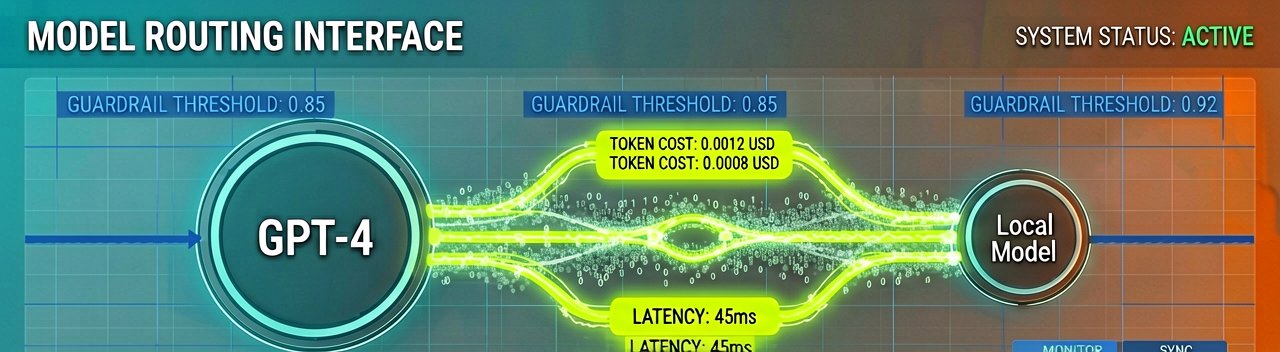
Historical context matters here: we saw a similar evolution during the move to microservices. When systems became too complex to predict, we stopped trying to build perfect software and started building better "circuit breakers." LaunchDarkly is essentially bringing the circuit breaker to the LLM. By allowing teams to route traffic between different models (say, from a high-cost GPT-4 to a more efficient local model) based on live performance data, they are also addressing the looming "token debt" that threatens to sink many enterprise AI initiatives.
Ultimately, this launch signals that the honeymoon phase of "AI for the sake of AI" is over. We are entering the operational phase, where "governed execution" is the only way these systems move from "skunkworks" prototypes to enterprise-grade tools. The teams that win this wave won't necessarily have the best models, but they will have the best control over the models they use. This runtime layer provides the safety net required to let agents off the leash without losing the keys to the kingdom.
The move also positions LaunchDarkly against a new crop of "AI Observability" startups, but with a significant advantage: they don't just tell you something is broken; they give you the button to fix it. This proactive remediation—where a failing agent can be instantly steered back on track without human intervention—is the holy grail for self-healing systems. As agents begin to write, deploy, and interact at machine speed, having a governance layer that reacts with the same alacrity is no longer a luxury—it's a survival requirement.
For years, LaunchDarkly has been the silent backbone of the DevOps world, providing the "kill switches" and feature flags that allow engineers to sleep at night. But as we slide headfirst into the era of autonomous AI agents, the stakes have shifted from simple "on-off" toggles to managing the unpredictable whims of non-deterministic models. Recognizing this shift, LaunchDarkly has officially launched AgentControl, a dedicated runtime control layer designed to govern AI agents in production without requiring a single code redeploy.
The core problem this addresses—what the company calls the "AI Control Gap"—is that AI-generated code and agentic behaviors don't fail like traditional software. They drift, they hallucinate, and they react to live data in ways that pre-production testing simply can’t always catch. By injecting a control layer directly into the agent’s execution path, LaunchDarkly is giving teams the ability to swap models, adjust prompt instructions, or trigger immediate fallbacks in under 200 milliseconds. It’s a move that transforms feature flagging from a release tool into a real-time governance system for autonomous systems that are increasingly operating with long leashes.
The Architecture of Certainty
Technically, the new layer functions by separating the agent's intent from its execution environment. Instead of hard-coding agent parameters, developers use "AI Configs" that can be manipulated through the LaunchDarkly dashboard. This allows for what the company calls "guarded rollouts," where an agent's new capability might only be exposed to a small percentage of traffic while performance is benchmarked against a baseline. If the agent starts racking up excessive token costs or straying from its guardrails, the system can automatically revert to a stable configuration based on real-time telemetry.
What Most Reports Miss: The Shift from "Code" to "Configuration"
Behind the Scenes: While the headlines focus on the "cool factor" of controlling autonomous agents, the real story here is the fundamental re-architecting of how we think about software reliability. In the traditional SDLC (Software Development Life Cycle), a bug is fixed by writing new code, testing it, and deploying it—a process that, even in the fastest CI/CD pipelines, takes minutes or hours. In the agentic era, the "bug" is often a probabilistic fluke or a model update on the provider side. LaunchDarkly is betting that the future of engineering isn't about writing better code, but about building more resilient "control planes" that treat production as a living, breathing laboratory.
Industry veterans note that this release marks LaunchDarkly’s transition from a utility to a critical infrastructure layer. By providing trace-level observability, the platform allows engineers to see exactly which flag or configuration caused an agent to take a specific action. This level of granularity is vital because, as AI agents move from simple chat interfaces to taking real actions—like executing API calls or managing databases—the "blast radius" of a failure expands exponentially. The ability to "slow-roll" agent maintenance means that business users and engineers can iterate on AI logic at the speed of thought, rather than the speed of a deployment pipeline.
Stakeholder perspectives from partners like Anysphere (the makers of the Cursor AI code editor) suggest that this runtime control is becoming the "essential infrastructure" for the next generation of development. It’s a sentiment echoed in LaunchDarkly's own AI Control Gap Report, which found that while 94% of teams feel AI is accelerating their development, a staggering 91% are terrified of what those changes do once they hit production. This tool is clearly an attempt to bridge that anxiety with actual knobs and levers.
Historical context matters here: we saw a similar evolution during the move to microservices. When systems became too complex to predict, we stopped trying to build perfect software and started building better "circuit breakers." LaunchDarkly is essentially bringing the circuit breaker to the LLM. By allowing teams to route traffic between different models (say, from a high-cost GPT-4 to a more efficient local model) based on live performance data, they are also addressing the looming "token debt" that threatens to sink many enterprise AI initiatives.
Ultimately, this launch signals that the honeymoon phase of "AI for the sake of AI" is over. We are entering the operational phase, where "governed execution" is the only way these systems move from "skunkworks" prototypes to enterprise-grade tools. The teams that win this wave won't necessarily have the best models, but they will have the best control over the models they use. This runtime layer provides the safety net required to let agents off the leash without losing the keys to the kingdom.
The Paradox of Controlled Autonomy
Reading Between the Lines: There is a delicious irony in building a sophisticated control layer for a technology whose primary value proposition is its ability to operate independently. LaunchDarkly is essentially selling us a leash for a dog we were told didn't need one. While the marketing pitch focuses on "empowerment," the underlying reality is a deep-seated distrust of non-deterministic outputs. We are effectively layering deterministic guardrails—the very thing AI was supposed to move us past—over models that are fundamentally unpredictable. This suggests that the "agentic era" might look less like a fleet of independent thinkers and more like a highly micromanaged bureaucracy of algorithms.
Furthermore, the promise of swapping models in 200 milliseconds masks a grimmer truth about vendor lock-in. While LaunchDarkly makes it technically easy to pivot from OpenAI to Anthropic, it doesn't solve the "prompt engineering" headache that comes with it. A prompt that works for one model often falls apart in another. By offering a "runtime control layer," the platform may inadvertently encourage teams to treat LLMs as interchangeable commodities, potentially leading to a "race to the middle" where agents are tuned for compatibility rather than peak performance.
We must also weigh the cost of this safety. Every "control layer" adds a shim of latency and another potential point of failure. While 200 milliseconds is fast for a human, it’s an eternity in the world of high-frequency agentic loops. There is a risk that we are over-engineering the "kill switch" at the expense of the very speed and agility that agentic workflows were supposed to provide. If we end up spending more time managing the flags than the agents spend doing the work, we’ve simply traded one type of technical debt for another.
Finally, there is the question of accountability. When an agent hallucinates a catastrophic error despite three different "runtime controls" being active, who is at fault? The developer, the model provider, or the control layer that failed to catch it? By inserting themselves into the middle of the stack, LaunchDarkly is taking on a massive implicit responsibility. The industry is rushing to adopt these safety tools, but we have yet to see how they hold up when a truly autonomous agent decides that its "guardrails" are just another prompt to be ignored.
"Giving a developer an autonomous AI agent without a kill switch is like giving a toddler a flamethrower and hoping they only use it for 'productive disruption'; LaunchDarkly’s new layer is the parental hand on the gas valve, ensuring the house stays standing even if the AI decides the drapes look better as ash."
Artūras Malašauskas is an AI Systems Integrator with 20+ years of production-grade web engineering experience. He has designed, shipped, and scaled enterprise Python/PHP systems for logistics, SaaS, and public-sector clients. For the past year, he has focused exclusively on AI integrations: deploying open-source LLMs, building generative media pipelines (image, audio, video), and engineering multi-agent workflows for real production environments. His standard: reproducibility, security, cost-efficient inference—no vaporware. He documents and evaluates emerging AI tooling, separating verified capabilities from marketing noise. Technical editor at: muza-ai.eu, ai-verslas.lt, ai-naujinos.lt Connect on LinkedIn
Comments