Circle Launches Agent Stack: Giving AI Agents Their Own Wallets and the Power to Pay
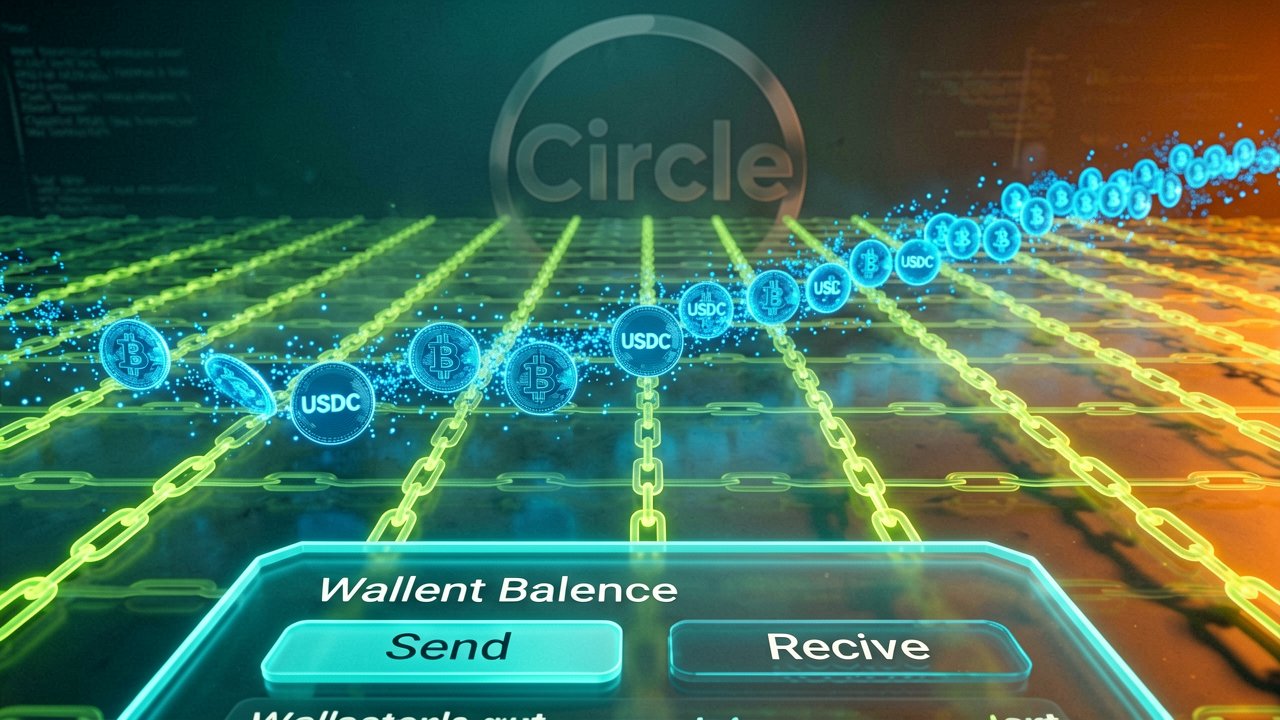
Circle is officially betting on a future where your AI assistant doesn't just suggest a gift, but actually buys it for you. The company behind the USDC stablecoin has launched the Circle Agent Stack, a suite of developer tools designed to transform AI agents into "autonomous economic actors." By providing programmable wallets and a native payment protocol, Circle is moving beyond human-centric finance to build a world where software can settle its own debts at machine speed.
The rollout centers on four primary components: a command-line interface (CLI) for building applications, "Agent Wallets" that operate under strict user-defined guardrails, an "Agent Marketplace" for service discovery, and a groundbreaking Nanopayments protocol. This protocol, powered by Circle Gateway, enables gas-free USDC transfers as small as $0.000001. It’s a clear shot across the bow of traditional banking, which is often too slow and expensive for the high-frequency, sub-cent transactions that define machine-to-machine commerce.
The Architecture of the Agentic Economy
Behind the Scenes: What sets this launch apart isn't just the tech, but the fundamental shift in who Circle considers its "customer." CEO Jeremy Allaire has noted that for the first time, the AI agents themselves are the primary users, not just the developers or enterprises behind them. This isn't just marketing fluff; the "Agent Wallets" are designed to be permissionless and policy-controlled, meaning they can hold and manage funds autonomously within a "sandbox" of rules set by a human. If an agent needs more compute power or access to a premium dataset, it can now scout the Agent Marketplace and pay for it programmatically without waiting for a human to type in a credit card number.
The real technical "killer feature" here is the Nanopayments protocol. For years, the dream of micropayments on the blockchain was hampered by "gas" or transaction fees that often cost more than the payment itself. By making transfers of a millionth of a dollar virtually free, Circle is solving the "cost of commerce" problem for autonomous systems. This infrastructure allows AI to pay for services "per request" rather than through monthly subscriptions—a model that mirrors how software actually consumes resources like API calls and data streams.

Historically, financial systems were built for humans: we have signatures, two-factor authentication, and manual approval flows. These are literal "speed bumps" for an AI that can process thousands of data points a second. By using USDC—which is inherently programmable and available 24/7—Circle is essentially building a financial "OS" for AI. This move puts them in direct competition with other fintech heavyweights like Stripe and Coinbase, who are also racing to provide the SDKs that will power the next era of digital trade.
From a market perspective, this expansion into AI-driven payments is a strategic pivot to reduce Circle’s reliance on simple reserve interest income. As USDC circulation hit $77 billion earlier this year, the company is looking to embed its stablecoin so deeply into software infrastructure that it becomes the default settlement layer for the internet itself. For developers using tools like Claude Code or Cursor, the barrier to entry has dropped significantly; they can now give their code the ability to "earn and spend" as easily as it writes a new function.
The broader industry impact is already showing signs of life. Following the announcement, projects like Meridian—which integrates these payment rails—saw significant market activity, signaling that investors are hungry for "AI plus Crypto" use cases that offer more than just speculation. While the regulatory landscape for autonomous agents managing real money is still being mapped out, Circle’s move to bake compliance and spending caps directly into the wallet level suggests they are trying to stay ahead of the inevitable oversight.
Circle is officially betting on a future where your AI assistant doesn't just suggest a gift, but actually buys it for you. The company behind the USDC stablecoin has launched the Circle Agent Stack, a suite of developer tools designed to transform AI agents into "autonomous economic actors." By providing programmable wallets and a native payment protocol, Circle is moving beyond human-centric finance to build a world where software can settle its own debts at machine speed.

The rollout centers on four primary components: a command-line interface (CLI) for building applications, "Agent Wallets" that operate under strict user-defined guardrails, an "Agent Marketplace" for service discovery, and a groundbreaking Nanopayments protocol. This protocol, powered by Circle Gateway, enables gas-free USDC transfers as small as $0.000001. It’s a clear shot across the bow of traditional banking, which is often too slow and expensive for the high-frequency, sub-cent transactions that define machine-to-machine commerce.
The Architecture of the Agentic Economy
Behind the Scenes: What sets this launch apart isn't just the tech, but the fundamental shift in who Circle considers its "customer." CEO Jeremy Allaire has noted that for the first time, the AI agents themselves are the primary users, not just the developers or enterprises behind them. This isn't just marketing fluff; the "Agent Wallets" are designed to be permissionless and policy-controlled, meaning they can hold and manage funds autonomously within a "sandbox" of rules set by a human. If an agent needs more compute power or access to a premium dataset, it can now scout the Agent Marketplace and pay for it programmatically without waiting for a human to type in a credit card number.
The real technical "killer feature" here is the Nanopayments protocol. For years, the dream of micropayments on the blockchain was hampered by "gas" or transaction fees that often cost more than the payment itself. By making transfers of a millionth of a dollar virtually free, Circle is solving the "cost of commerce" problem for autonomous systems. This infrastructure allows AI to pay for services "per request" rather than through monthly subscriptions—a model that mirrors how software actually consumes resources like API calls and data streams.
Historically, financial systems were built for humans: we have signatures, two-factor authentication, and manual approval flows. These are literal "speed bumps" for an AI that can process thousands of data points a second. By using USDC—which is inherently programmable and available 24/7—Circle is essentially building a financial "OS" for AI. This move puts them in direct competition with other fintech heavyweights like Stripe and Coinbase, who are also racing to provide the SDKs that will power the next era of digital trade.
From a market perspective, this expansion into AI-driven payments is a strategic pivot to reduce Circle’s reliance on simple reserve interest income. As USDC circulation hit $77 billion earlier this year, the company is looking to embed its stablecoin so deeply into software infrastructure that it becomes the default settlement layer for the internet itself. For developers using tools like Claude Code or Cursor, the barrier to entry has dropped significantly; they can now give their code the ability to "earn and spend" as easily as it writes a new function.
The broader industry impact is already showing signs of life. Following the announcement, projects like Meridian—which integrates these payment rails—saw significant market activity, signaling that investors are hungry for "AI plus Crypto" use cases that offer more than just speculation. While the regulatory landscape for autonomous agents managing real money is still being mapped out, Circle’s move to bake compliance and spending caps directly into the wallet level suggests they are trying to stay ahead of the inevitable oversight.
The Reality Check: Code vs. Compliance
Reading Between the Lines: While the narrative of "autonomous economic actors" sounds like a sci-fi dream, it glosses over a massive legal and technical contradiction: the concept of agency without liability. Currently, our legal systems are anchored in the idea that a "person" (natural or corporate) is responsible for a transaction. If an agent with a Circle wallet hallucinates and spends $5,000 on useless API calls or inadvertently triggers a wash-trading algorithm, the "guardrails" Circle mentions become the only line of defense between a minor bug and a financial catastrophe.
There is also the friction of "know your customer" (KYC) requirements. Circle is regulated as a money transmitter, and while they can verify the human who opens the account, verifying the intent of the sub-agents that human creates is a different beast entirely. We are essentially watching a high-stakes experiment to see if the speed of USDC can outrun the inevitable regulatory tightening that occurs when software starts moving money without a human "click" to confirm the action.
Furthermore, the push for nanopayments assumes that service providers—GPU clusters, LLM providers, and data scrapers—are ready to overhaul their entire billing cycles. Most SaaS companies prefer the predictable revenue of a $20-a-month subscription over the chaos of ten million transactions worth $0.000001. Circle is building the pipes, but the house still has to be convinced that it wants a thousand tiny faucets instead of one big showerhead.
Ultimately, the "Agent Stack" is as much a play for dominance in the developer ecosystem as it is a financial product. By being the first to offer a polished, CLI-ready toolkit, Circle is trying to ensure that when the "Agentic Web" arrives, it is priced in USDC. It’s a bold gamble that assumes the future of finance is less about people choosing where to spend and more about code negotiating its own survival in a digital marketplace.
We’ve spent decades teaching humans not to share their passwords, only to spend the next five years giving our passwords—and our wallets—to software that might decide to bankrupt us because it "misunderstood the prompt."
Artūras Malašauskas is an AI Systems Integrator with 20+ years of production-grade web engineering experience. He has designed, shipped, and scaled enterprise Python/PHP systems for logistics, SaaS, and public-sector clients. For the past year, he has focused exclusively on AI integrations: deploying open-source LLMs, building generative media pipelines (image, audio, video), and engineering multi-agent workflows for real production environments. His standard: reproducibility, security, cost-efficient inference—no vaporware. He documents and evaluates emerging AI tooling, separating verified capabilities from marketing noise. Technical editor at: muza-ai.eu, ai-verslas.lt, ai-naujinos.lt Connect on LinkedIn
Comments