Why Does This Still Exist? Diablo 4 Players Baffled by Persistent Technical Debt 13 Seasons In

Thirteen seasons. In the world of live-service ARPGs, that’s practically an eternity. We’ve seen the rise of the BoostMatch reported Warlock and Paladin classes, survived the sweeping changes of the Lord of Hatred expansion, and watched the level cap climb to 70. Yet, despite Blizzard’s penchant for tearing down and rebuilding core systems every few months, one particular phantom continues to haunt the halls of Sanctuary: the notorious memory leak. It’s the kind of "feature" nobody asked for and yet everyone seems to have inherited, a technical gremlin that has stubbornly outlived dozens of patches and multiple world-altering expansions.
You’d think that by Season 13, the act of simply teleporting between waypoints wouldn't feel like playing Russian roulette with your RAM. But according to frustrated veterans on the Blizzard Forums, the game’s technical debt is coming due with interest. Players are reporting massive performance dips—sometimes as high as 40 percent—following long sessions, especially after the latest expansion's release. It’s a bizarre juxtaposition; Blizzard is capable of delivering stunning new environments and complex class mechanics, yet they can't quite seem to figure out how to make the game release memory once it’s done with it. For a title that just passed the billion-dollar revenue mark, "just restart your client every three hours" is a hard pill for the community to swallow.
The Ghost in the Machine
The frustration isn't just about the occasional frame drop; it’s about the "flow" that defines the genre. Diablo is built on momentum, but that momentum hits a brick wall when the software decides it’s time for a system lock-up. While the Season of Reckoning brought plenty of shiny new toys like the Horadric Cube and an overhauled Skill Tree, these additions often feel like putting a fresh coat of paint on a house with a crumbling foundation. Some players have even pointed out that lowering graphic settings only delays the inevitable, suggesting the issue is deep-seated within the engine's core architecture.
A Culture of Constant Reworks
Part of the bewilderment stems from Blizzard’s own admission that the game changes so fast it’s Yahoo Tech noted "really hard for players to keep up." If the developers have the resources to fundamentally pivot the endgame and itemization every other season, the community is left wondering why the same agility isn't applied to stability. We’ve seen the Codex of Power get a total facelift and the entire crafting system get binned in favor of something more "Last Epoch-esque," proving nothing is sacred. Except, apparently, the bugs that have been there since the open beta. It’s a classic case of prioritizing the "new" over the "functional," and after 13 seasons, the novelty of new content is starting to wear thin against the backdrop of ancient technical flaws.
What Most Reports Miss: The Architectural Burden of Sanctuary
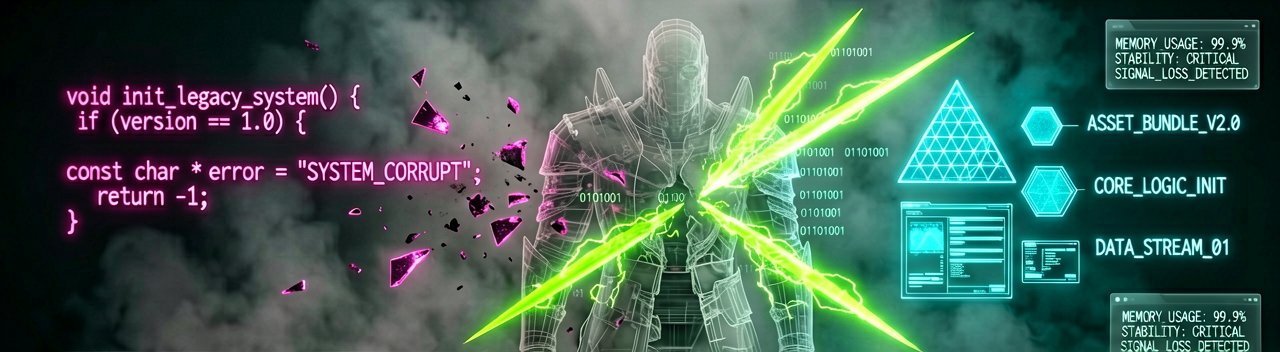
The Legacy of Living Development: While the headlines focus on the surface-level frustration of stuttering frame rates, the reality buried in the game's code is likely a byproduct of Diablo 4’s frantic development cycle. Season 13 represents a milestone in content volume, but it also marks over three years of layering new scripts on top of a foundation that was rushed to meet its initial 2023 launch window. For a seasoned developer, the "memory leak" isn't just one bug; it’s a symptom of "spaghetti code" where legacy systems for asset streaming are clashing with newer, more resource-intensive mechanics like the Mercenary system and the Spiritborn’s flashy particle effects.
Industry insiders often point to the "Ship Now, Fix Later" culture that has permeated AAA development, but Diablo 4 faces a unique hurdle due to its shared-world nature. Every time a player enters a new zone, the engine has to manage the data of every other player in that instance—down to their individual transmogs and stash tabs. This architectural choice, meant to make the world feel alive, has become a technical anchor. As the game grows, the sheer amount of data being cached during these transitions grows exponentially, leading to the "bloat" that eventually chokes the system's available memory.
Stakeholders at Blizzard are caught in a difficult feedback loop. The marketing data suggests that player retention is driven by "The Big New Thing"—massive seasonal shifts, new classes, and world-ending threats. Consequently, the engineering team is often diverted to support these flashy features rather than being given a six-month window to perform the deep-tissue surgery required to stabilize the engine. It is a classic battle between the creative desire to innovate and the practical necessity of maintenance, with the latter almost always losing out in the quarterly earnings report.
Historically, Blizzard has eventually fixed these deep-seated issues, but usually only when they become a barrier to entry for the next paid expansion. We saw similar trajectories with the original Diablo 3 "Error 37" and the eventual transition to the Reaper of Souls era, where the game was fundamentally rebuilt under the hood. The current "bafflement" from the community stems from the realization that we are well past that grace period. Season 13 should be the era of refinement, yet players are still performing the same "workarounds"—like disabling crossplay or flushing standby memory—that they were using during the first server slam.
The community’s patience is also being tested by the competition. With titles like Path of Exile 2 and other emerging ARPGs offering modern engines built for current-gen hardware, the technical debt of Diablo 4 becomes more glaringly obvious. When a player loses a Hardcore character not to a boss mechanic, but to a micro-stutter caused by a memory spike, the relationship between the developer and the audience sour. This isn't just a minor inconvenience; it is a fundamental break in the "ARPG contract" where player skill is supposed to be the only metric of success.
Ultimately, the persistence of these issues 13 seasons in suggests a bottleneck that isn't just technical, but organizational. Until the leadership at Team 3 prioritizes a "Health and Stability" season—even at the risk of lower engagement numbers for a few months—the ghost in the machine will continue to haunt the game. The technical debt has reached a point where it can no longer be ignored, and the cost of fixing it only increases with every new asset added to the pile.
The Paradox of Polish
Reading Between the Lines: There is a profound irony in the fact that one of the most visually stunning games on the market is simultaneously one of the most technically fragile. Blizzard’s marketing machine sells us a world of seamless, high-fidelity slaughter, yet the underlying reality is a game that feels increasingly like a Jenga tower. The prevailing assumption is that Blizzard can’t fix the memory leak, but a more skeptical analysis suggests they simply won't—at least not if it costs a single day of development on the next shop-rotatable cosmetic or seasonal gimmick. We are witnessing the ultimate victory of the "Live Service" model over the "Product" model, where the goal is no longer to deliver a finished masterpiece, but to maintain a functional-enough treadmill.
The contradiction becomes glaring when you look at the game's hardware requirements versus its actual performance. Diablo 4 was touted as a title that could scale from the Steam Deck to high-end rigs, yet players with 64GB of DDR5 RAM are reporting the same "out of memory" errors as those on budget builds. This suggests the issue isn't a lack of resources on the user's end, but a fundamental mismanagement of how the game allocates its own footprint. By prioritizing the constant injection of new assets—new textures for the Vessel of Hatred zones, complex animations for the Spiritborn, and endless unique item models—Blizzard is effectively suffocating their own engine under the weight of "content" that it was never designed to juggle simultaneously.
Looking ahead, the implications for the genre are sobering. If the industry leader can allow a core technical flaw to persist through thirteen seasons and a major expansion, it sets a dangerous precedent for what constitutes an "acceptable" player experience. We are moving toward a future where "stability" is treated as a premium feature rather than a baseline requirement. The measured skepticism here is that the upcoming patches will likely offer more Band-Aids—small optimizations that give the illusion of progress—while the deep-seated architectural debt continues to accrue interest. The community is being conditioned to accept a cycle of "reboot and repeat," a workaround that has somehow become a standard part of the Diablo 4 endgame loop.
At this point, the memory leak is less of a bug and more of a nostalgic throwback to the 90s; it’s Blizzard’s subtle way of reminding us that if we aren’t periodically staring at a desktop wallpaper in frustration, we aren't truly playing a PC game.
Artūras Malašauskas is an AI Systems Integrator with 20+ years of production-grade web engineering experience. He has designed, shipped, and scaled enterprise Python/PHP systems for logistics, SaaS, and public-sector clients. For the past year, he has focused exclusively on AI integrations: deploying open-source LLMs, building generative media pipelines (image, audio, video), and engineering multi-agent workflows for real production environments. His standard: reproducibility, security, cost-efficient inference—no vaporware. He documents and evaluates emerging AI tooling, separating verified capabilities from marketing noise. Technical editor at: muza-ai.eu, ai-verslas.lt, ai-naujinos.lt Connect on LinkedIn
Comments