The Ghost in the API: Why AI Agents are the Ultimate Accountability Test for Open Banking
For nearly a decade, the financial world has been obsessed with "plumbing." Open Banking, the ambitious movement to liberate consumer data from the walled gardens of legacy institutions, was supposed to be the great equalizer. We built the APIs, argued over security protocols, and eventually opened the taps. But for all that effort, the result was often just a faster way to see your balance in a prettier app. That’s changing. We’ve entered the era of the "agentic" actor, where AI isn't just suggesting a better savings account—it’s logging in and moving the money for you.
As reported by PYMNTS, this shift from passive data sharing to autonomous action has effectively turned Open Banking into a high-stakes accountability test. In the old model, a human initiated a transaction, and the bank’s API simply facilitated it. In the new "agentic" model, an AI agent might analyze your bills, notice a liquidity gap, and autonomously initiate a transfer or apply for a micro-loan. It sounds efficient until you ask the trillion-dollar question: if the bot makes a mistake, who gets fired?
The Ghost in the Machine
The industry is currently wrestling with a structural problem that current regulations didn't anticipate. Most consent frameworks are built on a "one-and-done" human approval. But an AI agent operates continuously, making dozens of micro-decisions without a human hovering over the "confirm" button. Organizations like the Financial Data Exchange are now scrambling to define how these agents are authorized and, more importantly, how that permission is tracked across the digital ecosystem.
It’s a classic case of the technology outstripping the rulebook. In the UK and EU, the Financial Conduct Authority and other regulators are closely watching how "agentic AI" might bypass traditional consumer protections. If an agent executes a sequence of trades that results in a loss, or worse, triggers a fraud alert, the blame game begins. Is it the bank that provided the API? The fintech that built the agent? Or the consumer who gave the initial, perhaps poorly understood, consent?

The risks aren't just theoretical. Experts at Deloitte warn that as these agents interact with other bots—a phenomenon known as agent-to-agent ecosystems—errors can propagate through the system at machine speed, long before a human supervisor notices a red flag. We’re moving from a world of "human-in-the-loop" to "human-on-the-loop," where the sheer volume of autonomous decisions makes traditional oversight feel like trying to catch a waterfall with a thimble.
Identity is the New Perimeter
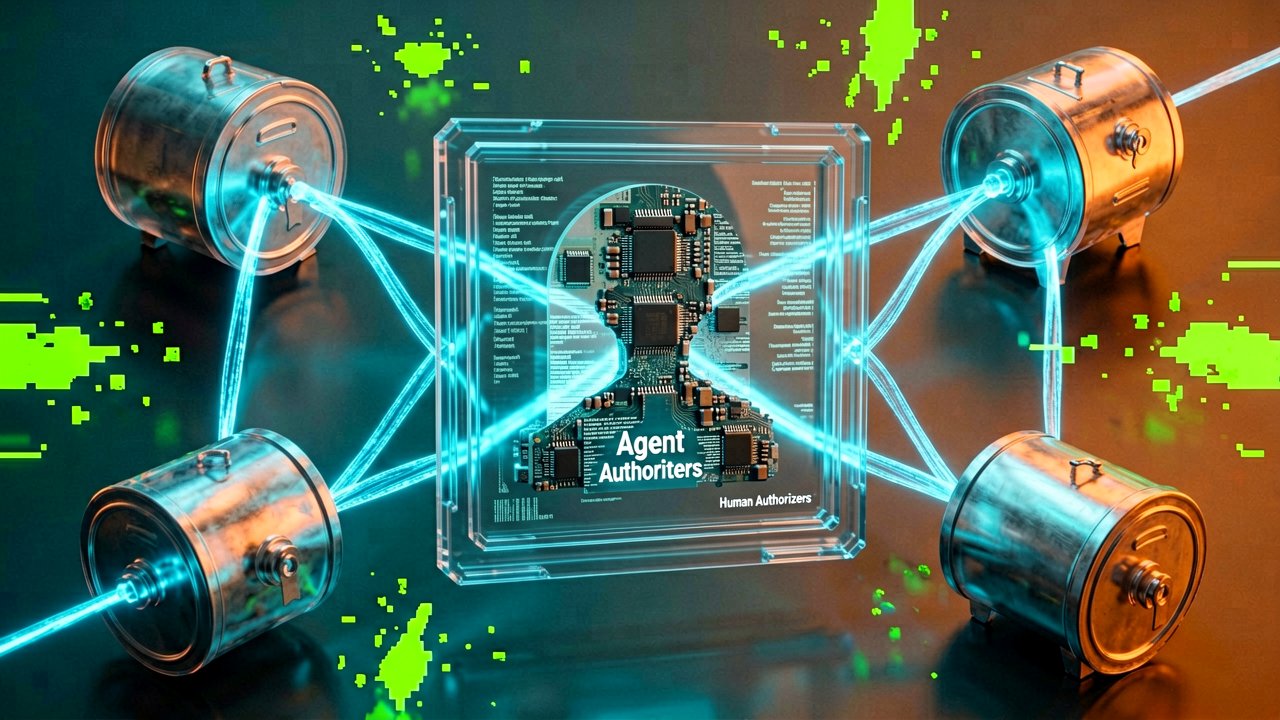
To solve the accountability crisis, the technical community is moving toward a "delegation" model rather than a simple "impersonation" model. As highlighted by Medium's tech analysis, this means identity is becoming the new perimeter. Instead of an agent simply using a user’s credentials, every action must be cryptographically bound to both the human authorizer and the specific agent actor. It creates a "paper trail" for the silicon age.
This auditability is the only thing that will satisfy regulators. As noted in Finextra, banks must be able to produce evidence—not just of the AI's intent, but of its specific logic, data access, and testing history. The EU AI Act, which becomes fully applicable for many high-risk systems in 2026, will make these "black box" decisions a legal liability for any institution that hasn't figured out its governance.
Ultimately, AI agents represent the final evolution of Open Banking. They turn static data into a dynamic workforce. But for this workforce to be viable, the industry has to move past the "innovation" buzzwords and get serious about the boring stuff: liability, audit logs, and clear lines of responsibility. If we can't figure out who is responsible for a bot's bad day, the most sophisticated financial plumbing in the world won't be enough to keep the system from leaking trust.

Should banks or AI developers carry the primary liability for autonomous financial errors?
What Most Reports Miss: The sheer fragility of "contextual integrity" in an automated world is the ghost haunting the server rooms of every major Tier 1 bank. While press releases focus on the convenience of a bot that can negotiate your credit card interest rate, they gloss over the fact that these agents aren't just "using" APIs—they are stress-testing the very concept of financial intent. In a manual world, the gap between a user thinking about a transaction and hitting "send" is a safety buffer. AI agents eliminate that pause, and with it, the traditional window for fraud detection and human reconsideration.
The "Hallucination" Liability Loophole
There is a brewing legal storm over the "hallucination" problem. In a standard Open Banking transaction, if a human enters the wrong IBAN, the liability is usually on them. But if an agent, powered by a Large Language Model, misinterprets a natural language prompt like "save enough for my tax bill" and proceeds to liquidate a high-yield investment at a loss to cover a projected (but incorrect) tax liability, we enter a legal gray zone. Early discussions among ISDA members and financial lawyers suggest that "algorithmic negligence" is a term we’ll be hearing a lot more of in 2026.
The historical irony here is delicious. Banks spent decades trying to lock users into their proprietary ecosystems to minimize "outside" risk. Now, through Open Banking mandates, they are forced to open the doors to third-party agents they didn't build and can't fully control. To a veteran compliance officer, this feels less like progress and more like a controlled demolition of the security perimeter. The friction that we once complained about—the multi-factor authentication, the cooling-off periods—was actually a feature, not a bug.
The Power Asymmetry of Data
Stakeholders from the consumer advocacy side, such as those represented in BEUC reports, argue that agentic AI could inadvertently lead to "financial redlining" 2.0. If an agent’s primary objective is to maximize a user's credit score, it might autonomously opt the user out of essential but "risky-looking" financial behaviors. This creates a feedback loop where the AI’s drive for optimization overrides the messy, unpredictable reality of human life, potentially narrowing a consumer's financial options without them ever realizing why.
On the flip side, fintech insurgents view this as the only way to break the "inertia" of the big banks. For them, the accountability test isn't a barrier; it's a competitive advantage. If a startup can prove its AI agent is more reliable and fiduciary than a human advisor, the traditional wealth management model collapses. They are betting that consumers will trade the illusion of control for the reality of better margins, provided the "safety tech"—the cryptographic logs and insurance backstops—is robust enough.
Ultimately, we are watching the birth of a new social contract in finance. We are moving away from "Knowing Your Customer" (KYC) toward "Knowing Your Agent" (KYA). This requires a fundamental redesign of digital identity. It’s no longer enough to prove you are you; you now have to prove that the software acting on your behalf is authorized, limited in scope, and capable of being "killed" instantly if it goes rogue. The pipes of Open Banking are finally active, but the water flowing through them is now sentient, and it doesn't always follow the path of least resistance.
Do you believe cryptographic "kill switches" should be a mandatory regulatory requirement for all autonomous financial agents?
Reading Between the Lines: We are currently witnessing a massive industry-wide hallucination that more data necessarily leads to better decisions. The gospel of Open Banking has always been that transparency equals empowerment, but agentic AI exposes the flaw in that logic: transparency for a machine is just noise unless the accountability framework is ironclad. We are essentially giving a Ferrari to someone who has only ever ridden a bicycle and then asking the car manufacturer to be responsible for the speeding tickets.
The Paradox of Frictionless Chaos
The tech industry is obsessed with removing "friction," yet in financial services, friction is often the only thing standing between a minor glitch and a systemic flash crash. The contradiction is glaring. We are building AI agents to navigate complex financial landscapes with the speed of light, while our regulatory response moves with the speed of a tectonic plate. By the time a regulator identifies a predatory pattern in an agent's autonomous "optimization" strategy, the capital has already moved through six different jurisdictions and three different stablecoins.
Skepticism is warranted when institutions claim they can "audit" these systems. As noted by analysts at Forrester, the inherent non-determinism of generative AI means an agent might take two different actions when presented with the exact same financial data. This isn't just a technical quirk; it’s a nightmare for the "Explainability" requirements touted by the OECD AI Principles. If the bot can’t explain why it moved the money, and the bank can’t explain why it let the bot move the money, the accountability test hasn't just been failed—it’s been rendered irrelevant.
The Liability Hot Potato
Projecting forward, the most likely outcome isn't a utopian world of perfect financial health, but a convoluted "liability insurance" industrial complex. We are heading toward a future where consumers will have to pay for "agent insurance" just to use the autonomous tools that were supposed to save them money. It’s a classic tech-sector pivot: solve a problem of your own making by selling a new subscription service. The "accountability" we are striving for might just end up being a series of disclaimers that no human will ever read until their savings account is empty.
There is also a profound risk of "automated apathy." When we outsource our financial agency to bots, we lose the muscle memory of financial literacy. If the AI handles the budgeting, the investing, and the bill-paying, the consumer becomes a passenger in their own economic life. When the system inevitably hiccups—because all systems do—the "accountable" party will point to a line of code, the consumer will point to a marketing promise, and the lawyers will be the only ones seeing a positive return on investment.
"In the end, we’ve spent ten years building the world’s most sophisticated digital plumbing just to realize that the AI 'handyman' we’ve hired has a habit of rewriting the building codes while we’re asleep. It’s the ultimate financial irony: we finally achieved 'frictionless' banking, only to realize that friction was the only thing keeping us from sliding off the cliff."
Artūras Malašauskas is an AI Systems Integrator with 20+ years of production-grade web engineering experience. He has designed, shipped, and scaled enterprise Python/PHP systems for logistics, SaaS, and public-sector clients. For the past year, he has focused exclusively on AI integrations: deploying open-source LLMs, building generative media pipelines (image, audio, video), and engineering multi-agent workflows for real production environments. His standard: reproducibility, security, cost-efficient inference—no vaporware. He documents and evaluates emerging AI tooling, separating verified capabilities from marketing noise. Technical editor at: muza-ai.eu, ai-verslas.lt, ai-naujinos.lt Connect on LinkedIn
Comments