The Architect in the Machine: Dataiku’s Cobuild and the Rise of Supervised Automation
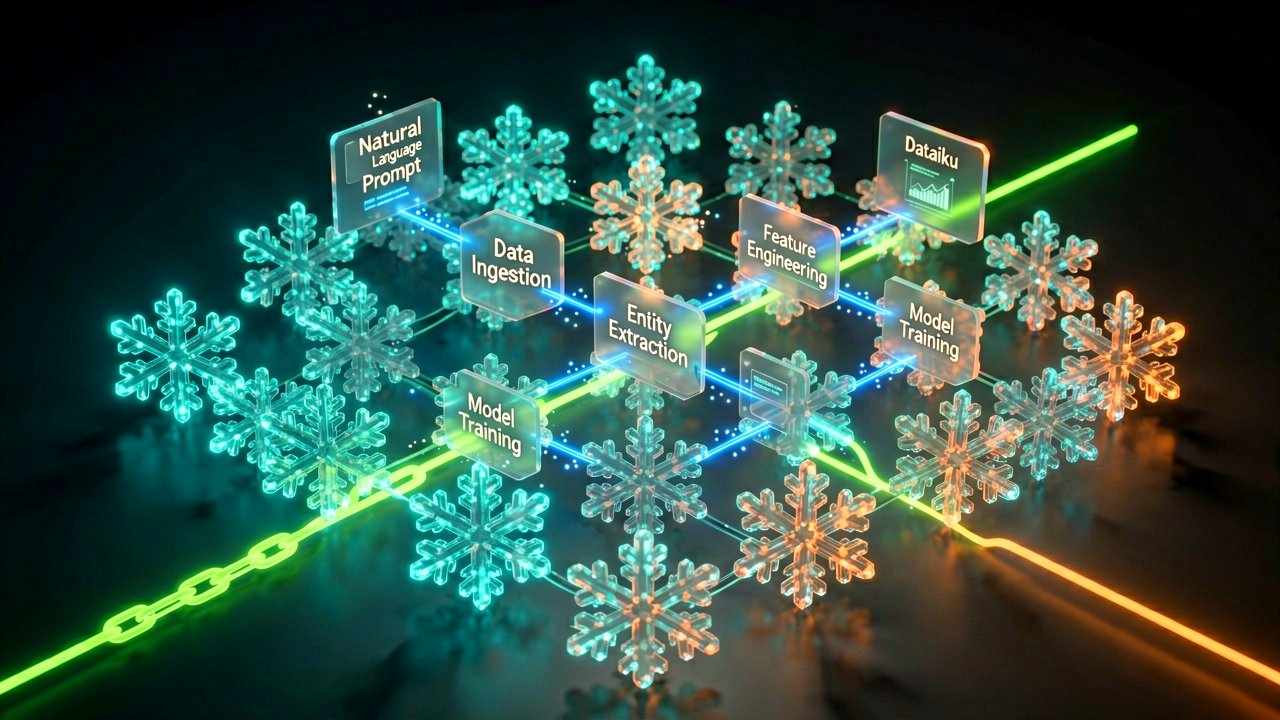
In the high-stakes world of enterprise AI, the gap between a flashy prototype and a production-ready system is often a yawning chasm filled with messy code and governance nightmares. Dataiku is looking to bridge that divide with the launch of Cobuild on Snowflake, a new integration designed to turn natural-language prompts into fully governed, visual AI workflows within the Snowflake environment.
For years, the partnership between these two heavyweights has been one of the most productive in the data space. Dataiku, long recognized as a leader in enterprise AI orchestration, and Snowflake, the cloud data powerhouse, have repeatedly snagged "Partner of the Year" accolades for their ability to streamline complex analytics. This latest move feels like the natural evolution of that relationship, moving beyond simple data prep and into the realm of "agentic AI"—systems that don't just process data but take action on it.
The End of the "Black Box" Coding Assistant
The tech industry has no shortage of AI coding assistants, but as Dataiku CEO Florian Douetteau pointed out during the launch, enterprises can’t afford to unleash "opaque, unvalidated workflows" where accuracy and compliance are non-negotiable. Unlike tools that spit out lines of mystery code, Cobuild generates a visual Dataiku project. Every step—from data parsing to the logic of an AI agent—is laid out in an inspectable flow that technical teams can validate and IT can audit before a single bit moves toward production.
By leveraging Snowflake Cortex AI, Cobuild allows users to describe their business intent in plain English. Want to build a model that predicts customer churn or an AI agent that automates claims processing? You describe it, and the system scaffolds the entire architecture. It’s a compelling pitch for organizations that want to democratize AI development without losing their grip on security or cost control.

Keeping Data Where It Lives
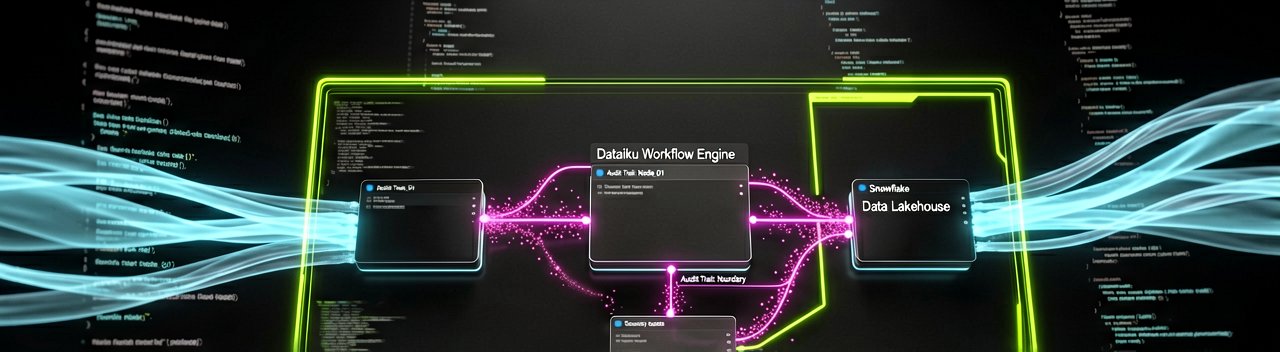
One of the quietest but most significant features here is where the work actually happens. The entire generation process is designed to execute natively within the customer’s Snowflake environment via a secure REST API. This "stay-in-place" philosophy is a massive win for industries like finance and healthcare, where moving data across different cloud environments is a logistical and regulatory headache. Companies like have already shown how combining these two platforms can slash processing times from weeks to hours while maintaining a lean headcount.
Initially, this capability is rolling out to joint customers of both platforms, though a broader release for the wider Snowflake ecosystem is on the roadmap. As enterprises move past the experimental "Generative AI honeymoon phase" and start demanding real-world ROI, tools that prioritize transparency and governance—like Cobuild—are likely to become the new standard for how we build in the cloud.
Behind the Scenes: While the headline focuses on the marriage of natural language and data, the real story is a calculated strike against the "black box" nature of modern AI development. For the better part of a decade, Dataiku has championed a visual-first approach to data science, a philosophy that often felt at odds with the code-heavy rise of LLMs. With Cobuild on Snowflake, they aren't just jumping on the GenAI bandwagon; they're attempting to force the bandwagon into a lane that enterprise IT can actually tolerate.
The tension in most boardrooms today is palpable. On one side, 78% of CEOs fear that failing to adopt AI could cost them their jobs, according to a recent Dataiku Global AI Confessions Report. On the other, IT leaders are terrified of "shadow AI"—a world where business users spin up unverified scripts that hallucinate financial projections or leak sensitive data. Cobuild acts as the diplomatic envoy between these two camps by ensuring that every AI-generated suggestion is translated into a transparent, visual workflow before it ever touches live data.
The Orchestration Layer vs. The Coding Assistant
To understand why this matters, you have to look at how most AI "assistants" function. Standard coding copilots are great at writing snippets, but they often leave the engineer with a pile of code that requires hours of manual testing. Dataiku's Cobuild flips this script by utilizing Snowflake Cortex AI to build high-level architecture rather than just low-level syntax. It’s the difference between hiring a bricklayer and an architect who provides a fully interactive 3D blueprint.
From a stakeholder perspective, this shift is critical for long-term scalability. Baris Gultekin, VP of AI at Snowflake, has consistently emphasized that AI shouldn't require moving data to the model. By running the orchestration via a secure REST API within Snowflake’s perimeter, Dataiku is leaning into the "Data Gravity" trend. If your data lives in Snowflake, your AI logic should too. This "stay-in-place" execution isn't just about speed; it's about maintaining a single point of truth for security credentials and audit logs.
Governance as a Competitive Edge
Veteran reporters will recall the early days of "self-service BI," which promised to empower business users but often resulted in chaotic, conflicting spreadsheets. Dataiku is clearly trying to prevent history from repeating itself with AI agents. By exposing the workflow logic visually, they allow a human-in-the-loop to intervene at any stage—editing a join, adjusting a filter, or swapping an LLM prompt—before the agent is operationalized.
Ultimately, the success of Cobuild will depend on how quickly non-technical staff can move from "intent" to "insight" without breaking things. For joint customers like , the proof is already in the performance gains. As the enterprise AI stack matures, the winners won't just be the ones with the fastest models, but the ones who can prove their models are doing exactly what they were told to do.
Reading Between the Lines: The promise of "prompt-to-production" is the tech industry’s latest great siren song, and while Dataiku’s integration with Snowflake is technically impressive, it glosses over a fundamental tension: the more we automate the creation of workflows, the less the creators may actually understand the underlying logic. We are moving into an era where "writing" a data pipeline is replaced by "approving" one. This shift assumes that the human-in-the-loop possesses the focus and the expertise to catch the subtle, logical drift that an AI might introduce when translating a vague business request into a complex SQL join.
There is also the matter of the "walled garden" paradox. By tightening the knot between Dataiku and Snowflake, both companies are creating a powerful, high-performance ecosystem that is increasingly difficult to leave. For the enterprise, this "integrated stack" offers a seductive path of least resistance. However, it also creates a massive dependency on Snowflake’s Cortex AI pricing and Dataiku’s orchestration seat licenses. When the marketing materials talk about "democratizing AI," they often neglect to mention that democracy in the cloud usually comes with a monthly subscription fee that only goes in one direction.
The Ghost in the Governance Machine
Furthermore, the claim that visual workflows solve the "black box" problem is only half true. While a visual flow is certainly more readable than five hundred lines of Python, the *prompts* that drive the AI agents within those flows remain inherently squishy. If an AI agent interprets "optimize for revenue" differently than a human auditor, a visual diagram of that mistake doesn’t necessarily make the error easier to spot—it just makes the error look more professional. The industry is betting heavily that Dataiku's governance layer can act as a safety net, but a net is only as good as the person watching it.
Ultimately, Cobuild on Snowflake represents a gamble on the "agentic" future of work. If it succeeds, it will turn data analysts into "AI supervisors," spending their days fine-tuning prompts and validating auto-generated flows. If it falters, it risks creating a new generation of technical debt—one where nobody quite remembers how the workflows were built, because nobody actually built them; they just asked for them. As these tools move from preview to general availability, the real metric of success won't be how many workflows are created, but how many of them survive their first encounter with a messy, real-world data set.
"In the end, we’re essentially teaching machines to do our jobs so that we can spend more time in meetings discussing why the machines aren't doing our jobs exactly the way we wanted. It’s the ultimate job security, provided you’re the one who knows where the 'Off' switch is hidden."
Artūras Malašauskas is an AI Systems Integrator with 20+ years of production-grade web engineering experience. He has designed, shipped, and scaled enterprise Python/PHP systems for logistics, SaaS, and public-sector clients. For the past year, he has focused exclusively on AI integrations: deploying open-source LLMs, building generative media pipelines (image, audio, video), and engineering multi-agent workflows for real production environments. His standard: reproducibility, security, cost-efficient inference—no vaporware. He documents and evaluates emerging AI tooling, separating verified capabilities from marketing noise. Technical editor at: muza-ai.eu, ai-verslas.lt, ai-naujinos.lt Connect on LinkedIn
Comments