The Automation Paradox: SAP’s High-Stakes Bet on the Autonomous Enterprise
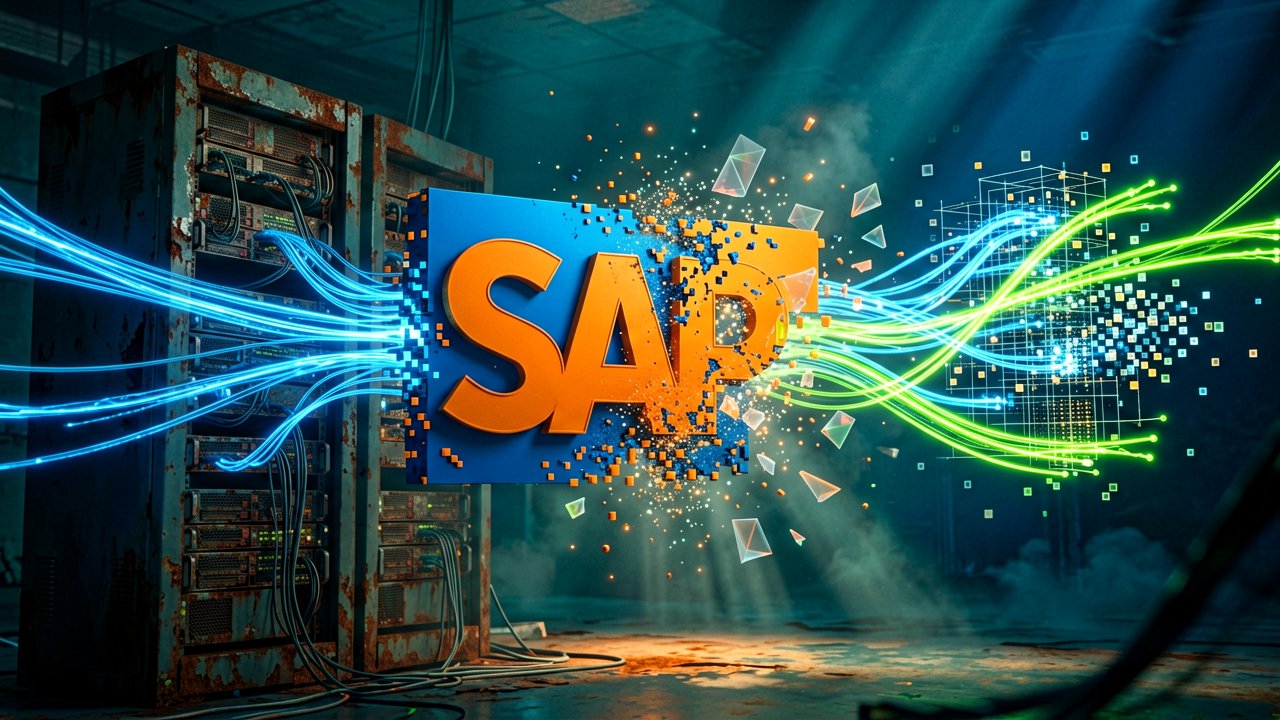
The Hard Truth Behind the Hype: It’s easy to get swept up in the slick keynotes and the promise of a "self-driving" corporation, but SAP’s current predicament isn't just about a missed earnings beat or a fluctuating ticker symbol. It is a fundamental clash between the fast-moving world of generative AI and the glacial pace of enterprise resource planning (ERP) migrations. For decades, SAP has been the bedrock of global commerce, but that legacy is now its heaviest anchor. As CEO Christian Klein pushes the "Autonomous Enterprise" vision, he isn’t just selling software; he’s asking thousands of risk-averse CFOs to hand over the keys to their most sensitive data processes to an unproven AI layer.
The "Clean Core" Conundrum
At the heart of this market skepticism lies the "Clean Core" strategy. For the Autonomous Enterprise vision to actually work, customers must move away from the highly customized, "spaghetti code" on-premise environments they’ve spent twenty years perfecting. SAP’s pitch is simple: move to S/4HANA Cloud, keep the core standard, and let AI handle the rest. However, long-time observers know that for a multinational manufacturer, "standard" is a four-letter word. The sheer cost and operational risk of unravelling these customizations are what keep investors up at night, regardless of how many "Joule" AI credits SAP bundles into its contracts.
Stakeholders on the ground—the system integrators and IT directors—often paint a different picture than the one seen in Waldorf. While the SAP marketing machine focuses on autonomous finance and supply chain resilience, the user base is still grappling with the basics of cloud parity. There is a growing sentiment that SAP is trying to run before it can walk, promising AI-driven autonomy to customers who are still struggling to migrate their basic ledger functions to the cloud. This disconnect is a primary reason why the stock hasn't seen the "AI bump" enjoyed by the likes of Microsoft or Nvidia.
Market Fatigue and the Legacy Tax
Wall Street's hesitancy also stems from what many are calling "transformation fatigue." We’ve seen this movie before—from "Leonardo" to "Rise with SAP." Each rebranding promises a simplified future, yet the complexity of the licensing and the migration path often remains. Investors are looking for more than just a vision; they are looking for accelerated Cloud ERP Suite revenue that doesn't just come from forced migrations, but from genuine, value-add innovation. Until the "Autonomous" part of the vision yields measurable ROI for a significant portion of the Fortune 500, the market is likely to treat these claims as speculative at best.
Finally, we have to consider the competitive landscape. With Salesforce, Workday, and Oracle all vying for the same "autonomous" crown, SAP no longer has the luxury of a captive audience. The "moat" around SAP’s ecosystem is being challenged by nimble, AI-native startups that don't carry the baggage of legacy R/3 systems. To recover its shares and its standing, SAP must prove that its vision is more than just a defensive maneuver to keep its massive installed base from looking elsewhere. It’s a high-stakes game of poker where the pot is the future of enterprise intelligence, and right now, the market is calling SAP's bluff.
Reading Between the Lines: The Friction of Autonomy
Reading Between the Lines: There is a delicious irony in SAP’s pivot toward the "Autonomous Enterprise." For forty years, the company’s primary value proposition was control—the ability for a human executive to look into every granular corner of a global supply chain and dictate its movement. Now, SAP is effectively asking those same executives to trust a decentralized swarm of AI agents to optimize processes they can no longer see. It is a pivot from "transparency" to "trust," and in the world of high-stakes enterprise finance, trust is a currency SAP hasn't fully earned in the cloud era. The market’s skepticism isn’t born of a lack of faith in the code, but rather a realistic appraisal of the human-to-machine handoff.
The contradiction is glaring. On one hand, SAP is touting 50 specialized "Joule" assistants and a unified AI platform as the future of agility. On the other, their own technical requirements for a "Clean Core" are forcing customers into multi-year, high-friction migration projects that feel like anything but agile. It’s a bit like being promised a self-driving Tesla while being told you first have to spend three years rebuilding the entire highway system by hand. This "legacy tax" is the invisible weight pulling on the stock; investors see the shiny autonomous destination, but they are terrified of the wreckage that often litters the road of an ERP transformation.
Furthermore, SAP’s aggressive acquisition spree—snapping up data lakehouse players like Dremio and tabular AI specialists like Prior Labs—suggests a quiet admission. The "Autonomous Enterprise" cannot live on SAP data alone. By reaching outside its own walls, SAP is acknowledging that the future of enterprise AI isn't just about managing the ledger; it’s about making sense of the chaotic, unstructured data that lives in emails and third-party silos. While this is a smart long-term play, it introduces a fresh layer of execution risk. Can a company built on rigid structures successfully pivot to being an orchestrator of unstructured "Company Memory"?

The competitive math doesn't help. While SAP remains a revenue giant, peers like Workday and Oracle are running the same playbook with arguably less technical debt. When Workday drops $1.1 billion on an AI-native learning platform like Sana, they are attacking the "user experience" problem from the ground up, rather than trying to skin a legacy beast with a Fiori interface. SAP’s share struggle reflects a growing realization that "market leadership" in 2026 is no longer about who has the most modules, but who can make the AI feel the most invisible. For now, SAP’s AI still feels like a very visible, very expensive construction project.
Ultimately, the "Autonomous Enterprise" vision projects a future where the software manages itself, but the current reality is that it requires more high-priced consultants than ever to get it off the ground. Until SAP can prove that "Joule" can actually reduce the headcount required for a migration, rather than just adding another line item to the bill, the stock will likely remain in its current holding pattern. Autonomy is a wonderful dream, but for most SAP customers, they’d settle for a system that simply doesn't require a decade-long roadmap to update.
"In the end, SAP’s biggest challenge isn’t teaching AI how to run a business; it’s convincing a generation of CFOs that 'letting go' is a strategy rather than a surrender. We’re being told the future is a self-driving office, yet most of us would be thrilled if the current version just stopped asking for a password reset every fourteen minutes."
Artūras Malašauskas is an AI Systems Integrator with 20+ years of production-grade web engineering experience. He has designed, shipped, and scaled enterprise Python/PHP systems for logistics, SaaS, and public-sector clients. For the past year, he has focused exclusively on AI integrations: deploying open-source LLMs, building generative media pipelines (image, audio, video), and engineering multi-agent workflows for real production environments. His standard: reproducibility, security, cost-efficient inference—no vaporware. He documents and evaluates emerging AI tooling, separating verified capabilities from marketing noise. Technical editor at: muza-ai.eu, ai-verslas.lt, ai-naujinos.lt Connect on LinkedIn
Comments