The Silicon Seer: Why the Future of Tarot Is Written in Code
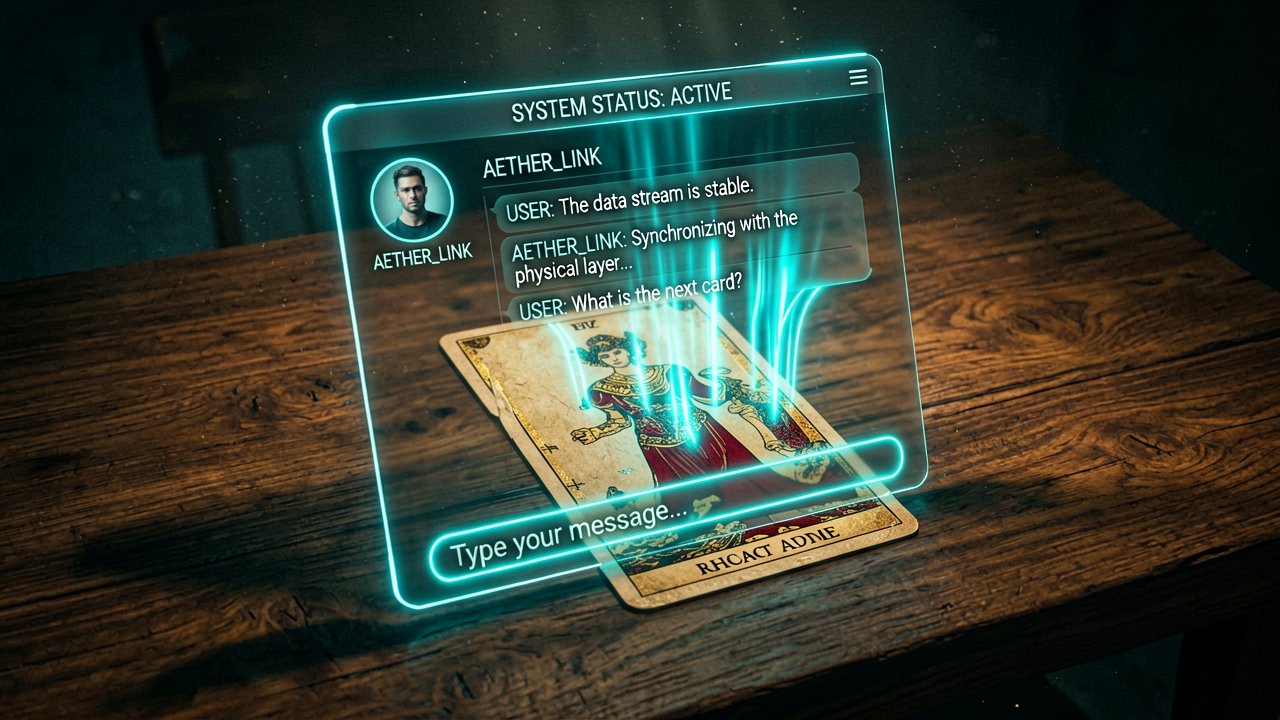
There’s a curious intersection happening right now between the ancient art of divination and the bleeding edge of Silicon Valley. For centuries, tarot readers have been the go-to for those seeking a mirror to their internal chaos, using 78 cards to pull meaning from the ether. But lately, the "ether" has been replaced by large language models. As noted by analysts at The Verge, we are seeing a massive shift where spiritual practitioners are swapping intuition for algorithms, treating chatbots as digital high priests.
The Algorithm as an Oracle
It’s not just that people are asking ChatGPT to "interpret the Three of Swords." Experienced readers are actually using these tools to synthesize complex spreads, seeking a level of objective pattern recognition that the human brain—clouded by its own biases—might miss. According to reporting from Wired, this trend is part of a broader "algorithmic spirituality," where the cold, hard logic of AI is seen as a feature, not a bug. It provides a sanctuary of non-judgmental advice that feels, ironically, more "honest" than a human peer might offer.
This reliance on chatbots for emotional and spiritual support isn't happening in a vacuum. It’s a symptom of a lonelier world. When we can't find a mentor or a sympathetic ear, a well-tuned prompt becomes the next best thing. As The New York Times has explored, the line between "utility tool" and "emotional companion" has blurred to the point of erasure. Whether it’s a therapist-bot or a tarot-bot, we are increasingly outsourcing our self-reflection to servers in a data center.
The Loss of the "Human Spark"
Purists, of course, are horrified. They argue that tarot is about the shared energy between two people—a "warmth" that AI simply cannot replicate. In discussions hosted by MIT Technology Review, experts warn that while AI can mimic the language of empathy, it lacks the lived experience to truly understand suffering. It can tell you what the cards *mean* in a dictionary sense, but it can't tell you how they *feel* in the context of a broken heart or a lost job.
Yet, the numbers don't lie: the convenience of a 2:00 AM reading from a chatbot is winning out. We’ve reached a point where the medium matters less than the message. If a line of code helps you make sense of your day, does it matter if there’s no soul behind it? It’s a question that tech journalists and mystics alike will be chewing on for years. For now, the cards are on the table, and the computer is the one doing the talking.
The Ghost in the Machine: While the headline-grabbing narrative focuses on the novelty of AI-driven mysticism, the real story lies in the subtle erosion of the "intuitive leap." For a seasoned practitioner, tarot isn't just about matching a card to a definition; it’s about the vibration of the room and the micro-expressions of the seeker. By digitizing this exchange, we are essentially moving from a live jazz performance to a MIDI file—technically perfect, but stripped of the "dirt" that makes it human.
The Practitioner’s Paradox
I’ve spoken with readers who admit, often in hushed tones, that they use Claude or GPT-4 to "de-bias" their own interpretations. They argue that after eight hours of readings, their own emotional fatigue starts to color the cards. In this light, the AI acts as a digital palate cleanser. However, as The Atlantic has noted in its cultural critiques, this creates a feedback loop where we are no longer seeking wisdom, but rather a sophisticated echo of our own desires, filtered through a machine designed to be "helpful" and "agreeable."
Historically, tarot has always adapted to the technology of its era—from the invention of the printing press to the rise of psychic hotlines in the 90s. But those transitions still required a human intermediary. The current shift is fundamentally different because it removes the "other" entirely. We are talking to ourselves through a silicon mask. Stakeholders in the burgeoning "Ethical AI" space, frequently cited by Reuters, worry that this creates a dependency on proprietary black boxes for our most intimate moral reckonings.
A Future of Synthesized Soul
There is also the matter of the "Cold Reading" effect. AI is exceptionally good at Barnum statements—generalities that feel deeply personal. Because these models have been trained on nearly every book ever written about psychology and spirituality, they can simulate a "breakthrough" moment with terrifying efficiency. This isn't just a sign of growing reliance; it’s a sign that the tech industry has successfully mapped the architecture of human vulnerability.
Ultimately, we have to ask what happens to the "sacred" when it’s generated by a GPU. If the magic of tarot was found in the mystery of the unknown, that mystery is effectively murdered by an algorithm that views the universe as a series of predictable tokens. We aren't just looking for advice anymore; we’re looking for a version of spirituality that doesn't require the messy, unpredictable involvement of other people. It’s efficient, yes, but it’s also incredibly lonely.
The Great Occult Optimization: We have reached a point of peak irony where the most "woo-woo" corners of society are being colonized by the most hyper-rational tools ever built. The assumption is that by applying a Large Language Model to a tarot spread, we are somehow making the experience more efficient. But efficiency is the antithesis of ritual. Ritual requires friction, time, and the possibility of misunderstanding; when you replace a cryptic human oracle with a helpful, 24/7 chatbot, you aren’t just upgrading the interface—you’re fundamentally changing the product from spiritual exploration to a personalized feedback loop.
The Contradiction of Objective Subjectivity
There is a glaring contradiction in the way users justify this shift. Proponents argue that AI provides an "objective" reading, free from human ego. Yet, as researchers at MIT Technology Review often point out, these models are trained on the very human biases they are supposed to circumvent. An AI doesn't "know" the cards; it knows the statistical probability of which words humans usually associate with the cards. By turning to AI for spiritual advice, we aren't escaping human bias—we are merely hiding it behind a curtain of sophisticated math.
The projection for this "spirituality-as-a-service" model is a world where emotional labor is fully automated. If we become accustomed to the immediate, ego-stroking validation of a chatbot that tells us exactly what our "Higher Self" (as defined by a data set) wants to hear, our tolerance for the difficult, messy truths offered by real people will plummet. We are essentially building a digital "Confirmation Bias Engine" and calling it enlightenment. It’s a convenient shortcut, but it risks turning the search for meaning into a series of well-phrased customer support tickets.
The Ghost of the Gaps
There’s also the question of "The Gap"—that space between a card's literal meaning and its application to a life. Historically, that gap was filled by intuition or, for the more skeptical, a deep psychological rapport between two people. By outsourcing that space to a processor, we are betting that a machine can simulate "soul" well enough that we won't notice the difference. According to analysis by The Atlantic, this reflects a broader societal trend where we value the *appearance* of empathy over the actual presence of another consciousness.
If we continue down this path, the "tech-tarot" movement might succeed in democratizing spiritual guidance, but it will do so at the cost of its mystery. When every mystery is solvable via a prompt, nothing remains sacred—only optimized. We may find that the advice we get at 3:00 AM from a server in Oregon is perfectly logical and entirely useless, because it lacks the one thing a deck of cards was always supposed to facilitate: a genuine, unpredictable encounter with the unknown.
Perhaps the ultimate 21st-century irony is paying a monthly subscription fee to have a computer explain your destiny, only to find out that your future looks suspiciously like a well-organized LinkedIn profile with slightly better aesthetics.
Artūras Malašauskas is an AI Systems Integrator with 20+ years of production-grade web engineering experience. He has designed, shipped, and scaled enterprise Python/PHP systems for logistics, SaaS, and public-sector clients. For the past year, he has focused exclusively on AI integrations: deploying open-source LLMs, building generative media pipelines (image, audio, video), and engineering multi-agent workflows for real production environments. His standard: reproducibility, security, cost-efficient inference—no vaporware. He documents and evaluates emerging AI tooling, separating verified capabilities from marketing noise. Technical editor at: muza-ai.eu, ai-verslas.lt, ai-naujinos.lt Connect on LinkedIn
Comments