The End of the Black Box: Decoding the New G7 Blueprint for AI Transparency
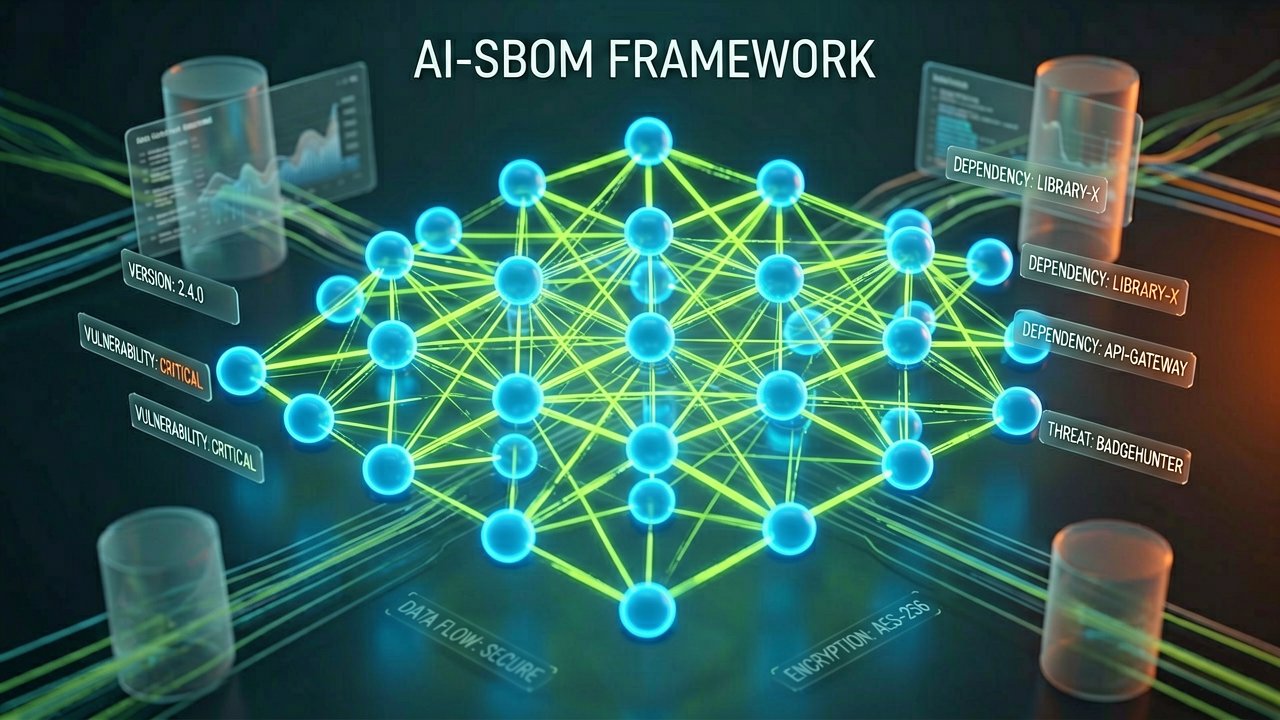
For years, the tech industry has treated artificial intelligence like a shiny black box: we marvel at what comes out, but we’re often clueless about what’s actually happening inside. That era of blissful ignorance is officially hitting a wall. This week, the Cybersecurity and Infrastructure Security Agency (CISA) and its G7 partners—representing the world's most influential economies—dropped a heavy hammer in the form of new joint guidance titled Software Bill of Materials for AI – Minimum Elements . It’s a direct attempt to peel back the curtain on the "secret sauce" of AI and expose the massive supply chain risks we’ve been ignoring.
If you aren't familiar with the term, a Software Bill of Materials (SBOM) is basically an ingredients list for your code. In the traditional software world, it tells you which open-source libraries or third-party snippets you’re using so you can actually find them when a vulnerability like Log4j hits the fan. But as SecurityWeek points out, AI systems are infinitely more complex. They aren’t just code; they’re a messy soup of datasets, pre-trained models, specialized hardware, and "agentic" layers that act on our behalf. The new G7 framework acknowledges that a standard "ingredients list" isn't enough when the ingredients themselves can learn and change.
Mapping the AI "Hidden Layer"
The framework breaks down the AI supply chain into seven critical clusters, ranging from metadata and model provenance to dataset properties and infrastructure. This isn't just bureaucratic red tape; it’s a survival guide for a world where "poisoned" training data can turn a reliable corporate tool into a liability. According to Industrial Cyber , the goal is to provide a machine-readable manifest of every single dependency. If a specific dataset used to train your customer service bot is later found to be legally compromised or maliciously altered, an AI-SBOM lets you know exactly which of your systems are at risk.
What makes this push particularly urgent is the rise of "agentic AI"—systems that don't just answer questions but take actions in the real world. CISA’s guidance arrives alongside warnings about the "visibility gap" in AI. As CSO Online notes, security teams often have no idea what data is flowing into their models or how those models are interacting with production environments. Without a standardized way to document these dependencies, we're essentially flying blind while handing the keys of our infrastructure over to autonomous agents.

Critics might argue that these "minimum elements" create visibility but not necessarily assurance. They’re right. Knowing what’s in the box doesn’t mean the box is safe, but you can’t secure what you can't see. By mandating transparency across the U.S., Canada, France, Germany, Italy, Japan, the U.K., and the EU, this framework sets a global baseline. It forces developers to stop hiding behind "proprietary secrets" and start treating AI security with the same rigor we apply to traditional software. It’s a messy first step, but in a year that won’t forgive yesterday’s lax frameworks, it’s a necessary one.
As we move toward the August 2026 enforcement of major regulations like the EU AI Act, this CISA-G7 collaboration provides the technical blueprint for compliance. Enterprises that start building these "AI ingredients lists" now won't just be checking a regulatory box—they'll be the ones who actually know where their vulnerabilities are hidden before the next major exploit finds them first.
The Accountability Gap: While the headlines focus on the technical "what" of this framework, the real story lies in the "who"—specifically, who is left holding the bag when an AI system hallucinates a security breach or leaks proprietary data. For decades, software vendors have enjoyed a "move fast and break things" liability shield, often burying disclaimers in the fine print. This G7 intervention signals a tectonic shift toward vendor accountability. By standardizing the AI-SBOM, CISA is essentially ending the era of the "unverifiable black box," forcing developers to sign their names to the digital lineage of their models.
Historically, supply chain security was a niche concern, something talked about in windowless rooms by people obsessed with hardware firmware. Then SolarWinds happened. That catastrophe taught the global tech community that the most elegant front-end is useless if the basement is flooded with malware. AI is currently in its pre-SolarWinds phase—a Wild West of scraped datasets and unvetted open-source models being "fine-tuned" in corporate silos. This framework is a preemptive strike, attempting to build a fire suppression system before the house is even fully wired.

The Friction Between Innovation and Audit
There is, of course, a quiet groan emanating from the halls of Silicon Valley. Tech giants have long guarded their training datasets as the crown jewels of their intellectual property. The push for AI-SBOMs creates a natural friction point: how much transparency can you demand before you compromise a company’s competitive edge? CISA’s "minimum elements" approach attempts to walk this tightrope by focusing on security-relevant metadata rather than forcing companies to dump their entire proprietary source code into the public square. It’s a compromise that satisfies the lawyers while giving the security researchers a fighting chance.
Moreover, we have to talk about the "data provenance" problem. It’s one thing to list a library in a standard software manifest; it’s another thing entirely to document the billions of parameters and data points that inform a Large Language Model. A seasoned security architect will tell you that an AI-SBOM is only as good as its update frequency. In an environment where models are continuously learning or being updated with "RAG" (Retrieval-Augmented Generation) systems, a static document is obsolete the moment it’s saved. The industry is now racing to figure out how to make these "ingredients lists" as dynamic as the AI they describe.
Finally, there is the geopolitical angle. This isn't just a CISA project; it’s a G7-wide consensus. By aligning the world’s largest democratic economies, the framework creates a massive "transparency gravity" that non-G7 actors will eventually have to orbit. If you want to sell your AI services in London, Paris, or Washington, D.C., you have to play by these rules. It’s a soft-power play that uses market access as a carrot to drive global security standards, ensuring that "responsible AI" isn't just a marketing buzzword, but a documented technical reality.
The Transparency Paradox: On the surface, the G7’s push for AI-SBOMs feels like a victory for the "trust but verify" crowd, but there is a nagging contradiction at the heart of this initiative. We are attempting to apply a linear, static documentation tool—the SBOM—to a non-linear, stochastic technology. In traditional software, if component A is vulnerable, you patch it. In AI, the vulnerability might not be a "bug" in the code, but an emergent behavior born from the toxic marriage of two perfectly benign datasets. A manifest can tell you what’s in the pot, but it can’t predict how the stew will taste after it’s been simmering for six months in a live environment.
There’s also the uncomfortable reality of "security theater." There is a high risk that AI-SBOMs become the digital equivalent of those "California Proposition 65" warning labels—so ubiquitous and broad that they are eventually ignored by everyone except the auditors. If every AI system comes with a 10,000-page manifest detailing every scraped Reddit thread and open-source snippet, will security teams actually have the bandwidth to parse that data? Without automated, cross-organizational tools to ingest and act on these manifests, we are simply trading a "black box" for a "mountain of paperwork."
The Ghost in the Supply Chain
Furthermore, the framework assumes a level of cooperation from the upstream supply chain that might not exist. Much of the innovation in AI is currently driven by "foundational" models that are licensed out as black boxes. If a Tier-1 provider refuses to disclose the granular specifics of their training set citing "competitive sensitivity," the downstream user’s AI-SBOM becomes a Swiss cheese document—full of holes where the most critical risks likely reside. CISA can mandate the format, but it cannot yet mandate the honesty of global players who view data as their primary moat.
We must also weigh the cost of this "transparency tax." For a nimble startup, the administrative overhead of documenting every iteration of a model’s training cycle could be the difference between shipping a product and running out of runway. If the G7 isn't careful, these regulations could inadvertently favor the incumbent tech giants who have the legal and compliance departments to churn out documentation, effectively stifling the very "open innovation" the framework claims to protect. We are essentially betting that the benefits of visibility will outweigh the friction of bureaucracy, a bet that hasn't always paid off in the history of tech regulation.
Ultimately, the G7 framework is a noble attempt to bring order to chaos, but it projects a sense of control that might be illusory. AI is a moving target, and by the time we’ve perfected the art of the AI-SBOM, the industry will likely have moved on to self-assembling neural architectures that defy current documentation methods. We are building a fence around a fog; it makes us feel safer, and it certainly defines the perimeter, but the fog is likely to drift through the slats anyway.
The tech industry spent a decade telling us that AI would solve every human problem, and now we’re spending the next decade trying to invent enough paperwork to ensure it doesn't accidentally create five new ones while it’s at it.
Artūras Malašauskas is an AI Systems Integrator with 20+ years of production-grade web engineering experience. He has designed, shipped, and scaled enterprise Python/PHP systems for logistics, SaaS, and public-sector clients. For the past year, he has focused exclusively on AI integrations: deploying open-source LLMs, building generative media pipelines (image, audio, video), and engineering multi-agent workflows for real production environments. His standard: reproducibility, security, cost-efficient inference—no vaporware. He documents and evaluates emerging AI tooling, separating verified capabilities from marketing noise. Technical editor at: muza-ai.eu, ai-verslas.lt, ai-naujinos.lt Connect on LinkedIn
Comments