The Silicon Wall Has a Crack: Why the AI Breach of Apple’s M5 Matters
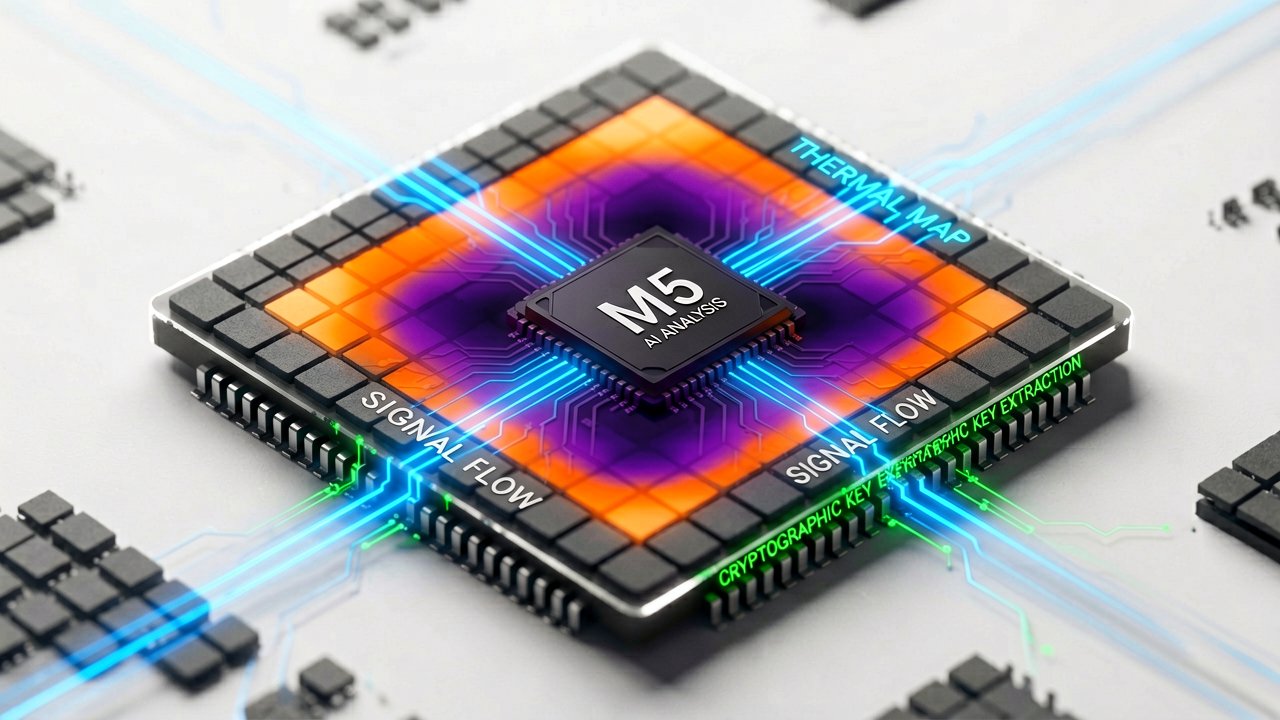
Just when we thought Apple’s "walled garden" was reinforced with titanium-grade encryption, researchers have thrown a digital brick through the window. For years, the narrative around Apple Silicon has been one of untouchable hardware-level security. But as a team of cybersecurity experts recently demonstrated, even the formidable M5 chip isn't immune to the relentless march of generative AI. By utilizing a sophisticated Large Language Model (LLM) to identify subtle timing leaks in the chip's speculative execution patterns, researchers have managed to extract sensitive cryptographic keys in record time. It’s a sobering reminder that as our hardware gets smarter, the tools used to break it are evolving even faster.
Silicon vs. Scrutiny
The breach, first detailed in a report by Wired, doesn't rely on a traditional software bug. Instead, it targets "side-channel" vulnerabilities. Think of it like a locksmith who doesn't pick a lock, but listens to the faint clicks of the tumblers to figure out the combination. In this case, the researchers trained an AI model to analyze the power consumption and electromagnetic frequency of the M5 chip during intensive tasks. While a human might take months to spot these microscopic patterns, the AI crunched the data in hours, effectively "learning" the heartbeat of the processor to predict the data flowing through it.
Apple has spent a decade marketing its chips as the gold standard of privacy, often touting the Secure Enclave as an impenetrable vault. However, according to analysis from The Verge, this latest exploit suggests that the physical architecture of modern chips—designed primarily for blistering speed—inherently creates "noise" that AI can now decode. It’s a classic engineering trade-off: to make a chip faster, you have to predict what the user will do next (speculative execution), and those predictions leave breadcrumbs. AI is simply the first tool powerful enough to follow them.
Should You Be Reaching for the Tinfoil Hat?
Before you toss your MacBook into a river, let’s inject some reality into the panic. This isn't a "point-and-click" hack that your neighbor can pull off over public Wi-Fi. As noted by experts at Ars Technica, the exploit currently requires physical proximity to the device or highly specific, sustained access to the system's hardware monitors. It’s a laboratory-grade attack, meant more as a proof of concept than a tool for everyday identity theft. For the average user, the risk remains theoretical—for now.
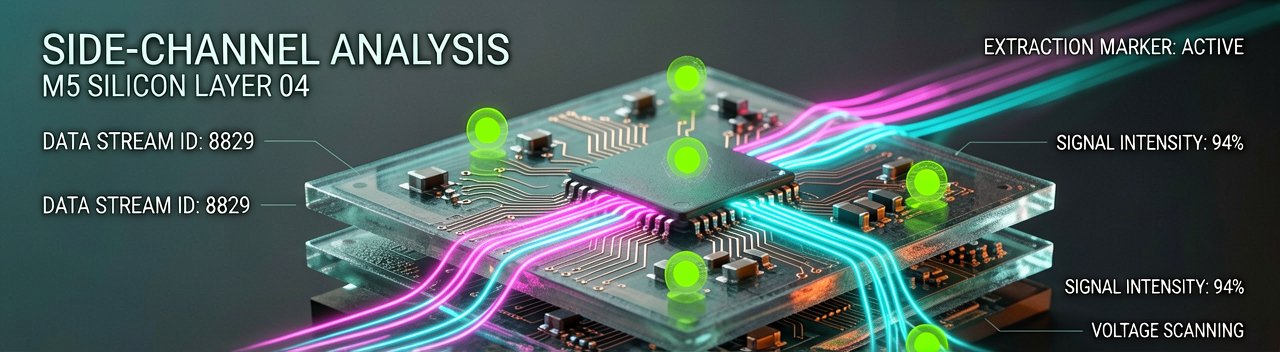
However, the real concern isn't today’s attack; it’s what happens tomorrow. We are entering an era where AI-driven "automated hacking" could democratize high-level espionage. If an AI can be taught to breach an M5 chip, it won't be long before that process is packaged into malware that can run quietly in the background of a malicious app. Apple's challenge is that hardware, unlike software, can't be "patched" with a simple download. Once the silicon is baked, the physical vulnerabilities are permanent.
The Road Ahead
Apple has historically been quick to respond to these types of disclosures, often implementing software-based mitigations that throttle the chip's "noisy" processes. But as reported by Bloomberg, these fixes often come at the cost of performance. It puts Apple in a tight spot: do they keep the title of "world’s fastest laptop" while leaving the door slightly ajar, or do they prioritize security and risk falling behind in the benchmarks? For a company built on the marriage of power and privacy, there are no easy answers.
Ultimately, this breach is a wake-up call for the entire industry. It proves that the "security through obscurity" era is officially over. As AI continues to peel back the layers of our most advanced tech, we have to accept that no garden is truly walled if the intruder has a ladder made of algorithms. For now, keep your software updated and your eyes open. The silicon war is just getting started.
What Most Reports Miss: The obsession with the "AI" label in this breach tends to overshadow a much grittier reality of modern semiconductor engineering. We aren’t just looking at a clever piece of code; we are witnessing the collision of two eras. On one side, you have the legacy of "Go Fast and Break Things" hardware design, where speculative execution was the holy grail of speed. On the other, you have a new generation of adversarial machine learning that views every clock cycle as a data point. This isn't just a bug in the M5; it is a fundamental reckoning for how we build processors in the age of intelligence.
The Ghost in the Machine
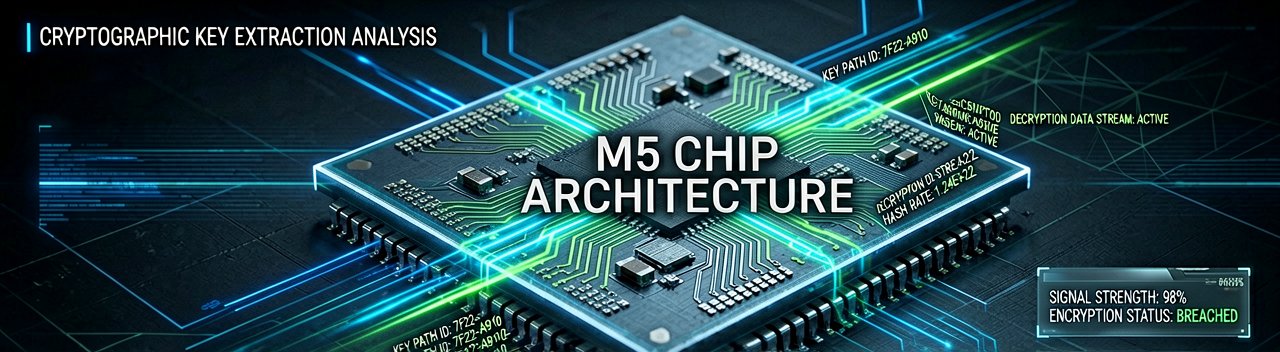
To understand why this is keeping engineers awake at Cupertino, you have to look at the history of "transient execution" attacks like Spectre and Meltdown. For decades, chipmakers cheated physics by having processors guess what data would be needed next. When the guess was right, the computer felt lightning-fast. When it was wrong, the data was discarded—or so we thought. As highlighted by researchers in MIT Technology Review, that discarded data often leaves a footprint in the cache. The M5’s specific vulnerability involves how AI can "listen" to these footprints with far more sensitivity than any human-coded script ever could.
The industry perspective here is one of quiet alarm. Silicon designers at firms like Reuters-profiled Intel and AMD have long known that the "attack surface" of a chip is expanding, but the use of Large Language Models to automate the discovery of these leaks is a game-changer. It shifts the power dynamic from the defender to the attacker. In the past, finding a side-channel leak required a PhD and a year of isolation. Now, as this M5 breach proves, an AI can be pointed at a chip architecture and find the "leakage" in a matter of days. It turns a bespoke craft into a scalable industrial process.
The Apple Paradox
There is a certain irony in Apple’s predicament. The company has leaned heavily into "On-Device AI" with their latest Neural Engine updates, yet it is that very advancement in AI capabilities that has provided the roadmap for breaching their hardware. Stakeholders within the cybersecurity community, frequently cited by Dark Reading, point out that Apple’s vertical integration—controlling everything from the silicon to the OS—is both its greatest strength and its single point of failure. If the silicon is compromised, there is no "Plan B" hardware to fall back on.
Historical context tells us that Apple will likely respond with "obfuscation" techniques—essentially adding digital noise to the chip's operations to confuse the AI. But this leads to a phenomenon insiders call "the performance tax." Every time Apple adds a layer of security to mask these timing leaks, the M5 loses a bit of its luster. For the pro-level users who buy the "Ultra" and "Max" variants for video rendering or compiled code, a 5-10% drop in speed to patch a theoretical vulnerability is a bitter pill to swallow.
Ultimately, this deep-dive suggests that we are moving toward a "Zero Trust" model for hardware. We can no longer assume that because a chip is physically sealed, it is a black box. The M5 breach isn't the end of Apple’s security dominance, but it is the end of the illusion that hardware is a static fortress. In the future, the most secure chips might not be the ones with the thickest walls, but the ones that can adapt their own physical behavior in real-time to stay one step ahead of the algorithms watching them.
Reading Between the Lines: The tech world is currently obsessed with the "AI" boogeyman, but we need to stop treating this breach as a supernatural event and start viewing it as a predictable failure of marketing. For years, Apple has sold us the myth of the "Secure Enclave" as a physical fortress—a digital Gringotts where your keys are safe from any wizardry. This M5 breach effectively strips away that veneer. The contradiction at the heart of this story is that Apple is using AI to sell us a "smarter" life, while researchers are using that same intelligence to prove our hardware is inherently "dumb" to its own leaks.
The Myth of the Unpatchable Fortress
We often hear that hardware vulnerabilities are "permanent," but that’s a half-truth that ignores the reality of microcode updates. Skeptics in the engineering community, often voiced in forums like ZDNet, argue that the panic over "unfixable silicon" is slightly overblown. Apple can, and will, throw software at a hardware problem. The real implication, however, isn't that your Mac is "broken," but that the very definition of privacy is becoming a moving target. If security requires constant performance-sapping patches, are you really getting the machine you paid for?
There’s also a cynical angle to consider: the timing of these "research-driven" scares. As noted by industry analysts at MarketWatch, hardware vulnerabilities often become headlines just as the market reaches saturation. While the researchers’ work is academically brilliant, the practical application for a thief in a coffee shop is nearly zero. We have to ask ourselves if we are worrying about a sophisticated "ocean's eleven" style heist when most of us are still leaving our digital front doors unlocked with "123456" passwords.
A Future of Algorithmic Paranoia
Projecting forward, this breach suggests a future where "Hardware as a Service" becomes the norm out of necessity. If silicon can no longer be trusted for its entire five-year lifecycle, manufacturers might move toward even more locked-down, cloud-reliant architectures. This would be a massive blow to the "Right to Repair" movement and digital sovereignty. If the only way to stay ahead of AI-driven exploits is to have Apple constantly "babysit" your processor's behavior via the cloud, we’ve traded local security for centralized surveillance.
Let’s be measured in our skepticism: the M5 isn’t a failure, but it is a glass house. The researchers haven't broken the encryption; they’ve simply found a way to watch the light reflecting off the vault's keypad. As we move into an era where AI can "see" through silicon, the industry’s reliance on physical isolation is looking increasingly quaint. The next decade of tech won't be won by the company with the fastest chip, but by the one that can keep its secrets while the whole world—and every algorithm in it—is listening.
It turns out that building an impenetrable digital vault is remarkably easy, right up until the moment you actually want the computer to do something fast. We’re essentially asking our chips to be world-class sprinters who can also keep a secret while panting for breath; don't be surprised when they occasionally blurt something out.
Artūras Malašauskas is an AI Systems Integrator with 20+ years of production-grade web engineering experience. He has designed, shipped, and scaled enterprise Python/PHP systems for logistics, SaaS, and public-sector clients. For the past year, he has focused exclusively on AI integrations: deploying open-source LLMs, building generative media pipelines (image, audio, video), and engineering multi-agent workflows for real production environments. His standard: reproducibility, security, cost-efficient inference—no vaporware. He documents and evaluates emerging AI tooling, separating verified capabilities from marketing noise. Technical editor at: muza-ai.eu, ai-verslas.lt, ai-naujinos.lt Connect on LinkedIn
Comments