insured.io Launches Claims AI for Insurance FNOL Automation

The InsurTech sector continues its push toward conversational automation with insured.io rolling out Claims AI, a new virtual claims agent designed to handle First Notice of Loss (FNOL) submissions. The Sacramento-based company announced the product through FinTech Global, positioning it as a unified platform for voice and digital chat interactions.
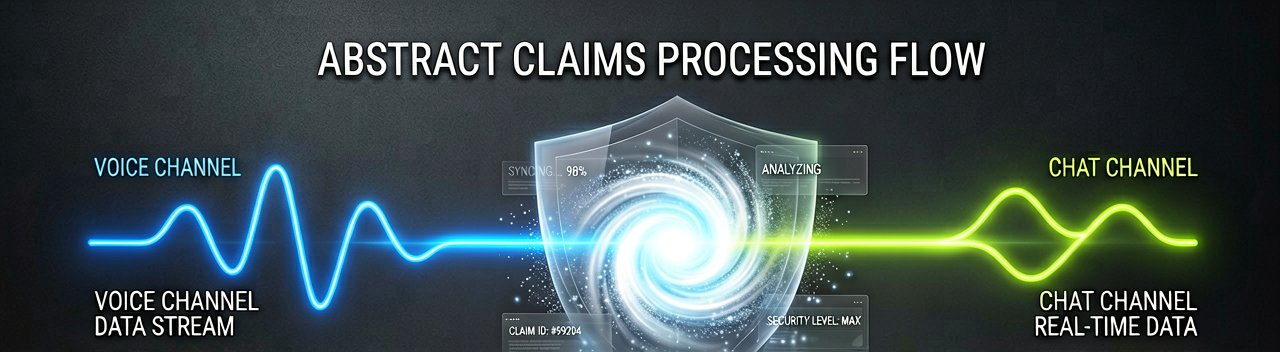
Claims AI automates the initial claims reporting workflow, allowing policyholders to submit claims through either voice calls or text-based chat interfaces. The system integrates directly with insurers' core platforms to retrieve policy data in real-time and submit claims without manual handoffs. This eliminates the friction of policyholders repeating information across different channels or waiting for human agents to verify basic account details.
According to IIR Reporter, the product operates within insured.io's existing customer experience platform infrastructure. The company built Claims AI to combine policy search, claims intake, and workflow automation into a single conversational interface. Carriers can deploy voice, chat, or both channels through a shared workflow backend.
The platform currently supports English and Spanish language interactions out of the box. This bilingual capability addresses a practical gap in many mid-sized carrier operations, where language barriers often create delays in claims processing. Policyholders can speak or type their claim details without needing to navigate complex IVR menus or wait for callback availability.

Steve Johnson, chief product officer at insured.io, emphasized the company's insurance-specific approach to the technology. He stated the innovation doesn't come from an AI company guessing how to handle insurance claims. Instead, the agent was created by insurance experts who understand the processes and are committed to improving the claims experience for insureds.
Johnson added that Claims AI puts insurers in command of every touchpoint in the policyholder relationship. The goal is ensuring a seamless, omnichannel experience that goes beyond simple multi-channel access. This distinction matters because many carriers currently operate voice and digital channels as separate systems with disconnected data flows.
The company cited industry research suggesting AI-powered claims technologies can improve productivity by as much as 80% while increasing classification accuracy by 30% compared with manual workflows. These metrics reflect the potential reduction in administrative overhead when claims data enters core systems directly rather than through intermediate human processing steps.
Claims AI expands insured.io's broader suite of customer engagement products. The existing portfolio already includes policyholder portals, payment and policy IVR services, and messaging tools. The new agent integrates with these capabilities rather than replacing them, creating a more cohesive customer experience infrastructure.
From a technical standpoint, the system's real-time core system connectivity represents a significant integration requirement. Carriers must ensure their backend platforms can handle direct API calls from the conversational interface. This means IT teams need to validate data schemas, authentication protocols, and error handling before deployment.
The physical reality of using this technology differs from traditional claims reporting. Instead of navigating phone menus with touch-tone inputs or filling out web forms with dropdown selections, policyholders describe their situation naturally. The system then extracts relevant data points—policy number, incident date, damage description—and validates them against the carrier's database.
This approach reduces the cognitive load on policyholders during stressful situations. After an accident or property damage event, users don't need to locate policy documents or remember specific account numbers. The conversational interface can guide them through verification while simultaneously collecting claim details.
For insurers, the operational impact centers on workflow automation. Claims that previously required manual data entry now flow directly into processing queues. Adjusters receive structured information rather than notes from call center agents, reducing transcription errors and rework.
The product targets mid-sized insurance carriers specifically. These organizations often lack the resources to build custom conversational AI solutions but face pressure to modernize customer service operations. Claims AI offers a pre-built solution that scales with their operational demands.
Language support represents another practical consideration. Many carriers serve diverse communities where English-only interfaces create barriers. Supporting Spanish out of the box removes the need for separate translation infrastructure or bilingual agent staffing for initial intake.
The launch reinforces insured.io's strategy of offering a single customer engagement platform. Rather than piecing together point solutions from different vendors, carriers can evolve their communication capabilities within one ecosystem. This reduces integration complexity and maintenance overhead.
Industry observers note that conversational claims automation has been developing for years. The difference now lies in accuracy and integration depth. Early attempts struggled with understanding insurance terminology or connecting to legacy core systems. Claims AI appears designed to address these historical friction points.
The 80% productivity improvement claim warrants scrutiny. While AI can handle routine intake tasks, complex claims still require human judgment. The metric likely reflects reduced administrative time rather than total claims processing speed. Carriers should expect gains in initial intake efficiency rather than end-to-end resolution times.
Classification accuracy improvements of 30% suggest better initial claim categorization. This helps route claims to appropriate adjusters faster and reduces misclassification errors that cause delays. However, the actual benefit depends on how well the AI understands the carrier's specific claim types and risk profiles.
Deployment considerations include change management. Claims teams accustomed to manual intake processes may need training on the new workflow. The system changes how information flows through the organization, requiring adjustments to quality assurance and performance metrics.
Security and compliance remain critical factors. Claims data contains sensitive personal information subject to regulatory requirements. The platform must maintain audit trails, encryption, and access controls that meet industry standards. Carriers should verify compliance certifications before integration.
The technology represents incremental progress rather than a complete transformation. Claims AI handles the initial intake phase, but the broader claims lifecycle still involves investigation, negotiation, and payment processing. The value lies in streamlining the first step rather than automating the entire workflow.
Whether carriers actually achieve the promised efficiency gains depends on implementation quality. A well-integrated system with proper training can deliver significant benefits. A poorly configured deployment risks frustrating both policyholders and claims staff.
The insurance industry continues balancing automation with human oversight. Claims AI positions itself as a tool that augments rather than replaces human expertise. The real test comes when carriers measure actual performance improvements against their current manual processes.
For policyholders, the immediate benefit is convenience. Submitting a claim through natural conversation feels less bureaucratic than navigating forms or phone menus. Whether this translates to faster resolutions depends on backend processing capabilities beyond the initial intake.
insured.io's approach reflects broader industry trends toward conversational interfaces. The question remains whether carriers will prioritize this technology over other modernization investments. Budget constraints often force difficult choices between competing operational improvements.
The launch adds another option to an increasingly crowded InsurTech marketplace. Differentiation will come from integration quality, customer support, and demonstrated ROI rather than feature lists alone. Carriers need proven results, not just product capabilities.
Whether users actually pay for the promised efficiency gains remains the real question. The technology works on paper, but real-world deployment introduces variables that no product demo can fully capture. Time will tell if the productivity claims hold up under actual operational conditions.
Artūras Malašauskas is an AI Systems Integrator with 20+ years of production-grade web engineering experience. He has designed, shipped, and scaled enterprise Python/PHP systems for logistics, SaaS, and public-sector clients. For the past year, he has focused exclusively on AI integrations: deploying open-source LLMs, building generative media pipelines (image, audio, video), and engineering multi-agent workflows for real production environments. His standard: reproducibility, security, cost-efficient inference—no vaporware. He documents and evaluates emerging AI tooling, separating verified capabilities from marketing noise. Technical editor at: muza-ai.eu, ai-verslas.lt, ai-naujinos.lt Connect on LinkedIn
Comments