PlayStation CEO Frames AI as Augmentation, Not Replacement for Game Studios

During Sony's latest earnings presentation, PlayStation CEO Hideaki Nishino positioned artificial intelligence as a productivity multiplier rather than a creative substitute. The statement arrives as the gaming industry wrestles with generative AI's expanding footprint in AAA development, where studios face pressure to cut costs while maintaining the handcrafted quality that justifies premium pricing.
Nishino's messaging is specific: AI automates repetitive workflows, not creative vision. "The vision, the design, and the emotional impact of our games will always come from the talent of our studios and performers," he stated during the call. "AI is meant to augment their capabilities, not to replace them." It's a careful distinction that acknowledges the technology's utility while trying to reassure the creative workforce that their jobs aren't being automated away.
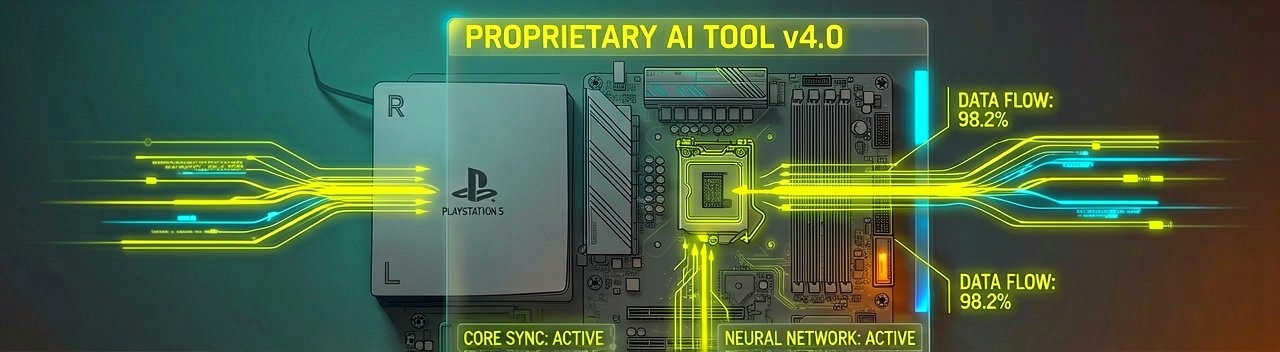
The company has already deployed proprietary AI tools across first-party studios. Mockingbird, an internal animation system, processes performance capture data to generate 3D facial models. Animation work that previously took hours now completes in a fraction of a second. Studios including Naughty Dog, Santa Monica Studio, and San Diego Studio have integrated the tool into production pipelines, with work appearing in titles like Horizon Zero Dawn Remastered.
Another example involves hair animation, traditionally labor-intensive given the volume of individual strands required. PlayStation teams now capture videos of real hairstyles and feed them into an AI system that outputs 3D models with hundreds of strand variations. The physical reality of this workflow shift means artists spend less time manually sculpting individual hair strands and more time on creative iteration (which is how it should be, frankly).

According to Video Games Chronicle's coverage, Nishino explained that these practical applications allow teams to reinvest time into building richer worlds and gameplay. The company also cited Gran Turismo's AI-powered racing agent Sophy, which has added competitive depth for seasoned drivers, and prototypes featuring NPCs with independent personalities that create dynamic worlds for players to explore.
Beyond game development, AI already drives measurable revenue for PlayStation's platform business. AI-powered payment routing tools have generated over $700 million in incremental revenue over the past few years by optimizing transaction paths across payment networks. The company is expanding machine learning projects to personalize recommendations for games, subscriptions, accessories, and merchandise based on player behavior.
The PS5 Pro's PSSR (PlayStation Spectral Super Resolution) feature uses machine learning to enhance image quality, delivering 4K visuals at high frame rates. Games like Saros and Ghost of Yotei have benefited from the technology, which processes rendering data in real-time to upscale output without the computational overhead of native 4K rendering.
Sony Pictures has invested more than $50 million in AI across production planning, content protection, enterprise productivity, data analytics, and 3D conversion. Sony Music is pursuing industry-wide labeling of AI-generated content across platforms. The video arm is collaborating with Bandai Namco to research how generative AI can contribute to video production while respecting creator vision.
Independent reporting from Game Informer notes that Nishino's emphasis on augmentation aligns with investor expectations while attempting to maintain creative credibility. The timing matters: first-party studios like Naughty Dog and Insomniac are known for narrative-driven experiences where creative vision is the entire selling point. Any perception that AI might dilute that vision could damage PlayStation's premium positioning.
There's also a practical business angle. Game development costs have ballooned, with AAA titles now routinely exceeding $100 million budgets and five-year timelines. If AI tools can shave even 10-15% off production time by handling grunt work, that's millions in savings and faster time-to-market. Sony's presentation to investors clearly had both audiences in mind — reassuring creatives while promising shareholders efficiency gains.
The broader industry is watching these early implementations closely. Nvidia's recent GTC conference showcased AI tools specifically designed for game studios, from procedural generation systems to real-time rendering optimizations. The technology is advancing faster than the ethical frameworks around it, leaving companies to figure out acceptable use cases on the fly.
What Sony's statement reveals is that even aggressive AI adopters are learning to hedge their messaging. There's no victory lap here, no bold proclamation that AI will revolutionize gaming. Instead, it's a measured acknowledgment that the tech has utility, paired with explicit guardrails around where it won't be deployed. The proof will come in the games themselves. If AI augmentation actually delivers what Sony promises — faster development without creative compromise — competitors will rush to match it. But if players detect a drop in the handcrafted quality that defines PlayStation exclusives, the backlash could force a rapid retreat.
Whether users actually pay for it remains the real question.
Artūras Malašauskas is an AI Systems Integrator with 20+ years of production-grade web engineering experience. He has designed, shipped, and scaled enterprise Python/PHP systems for logistics, SaaS, and public-sector clients. For the past year, he has focused exclusively on AI integrations: deploying open-source LLMs, building generative media pipelines (image, audio, video), and engineering multi-agent workflows for real production environments. His standard: reproducibility, security, cost-efficient inference—no vaporware. He documents and evaluates emerging AI tooling, separating verified capabilities from marketing noise. Technical editor at: muza-ai.eu, ai-verslas.lt, ai-naujinos.lt Connect on LinkedIn
Comments