Rackspace Partners with AMD on Governed Enterprise AI Infrastructure
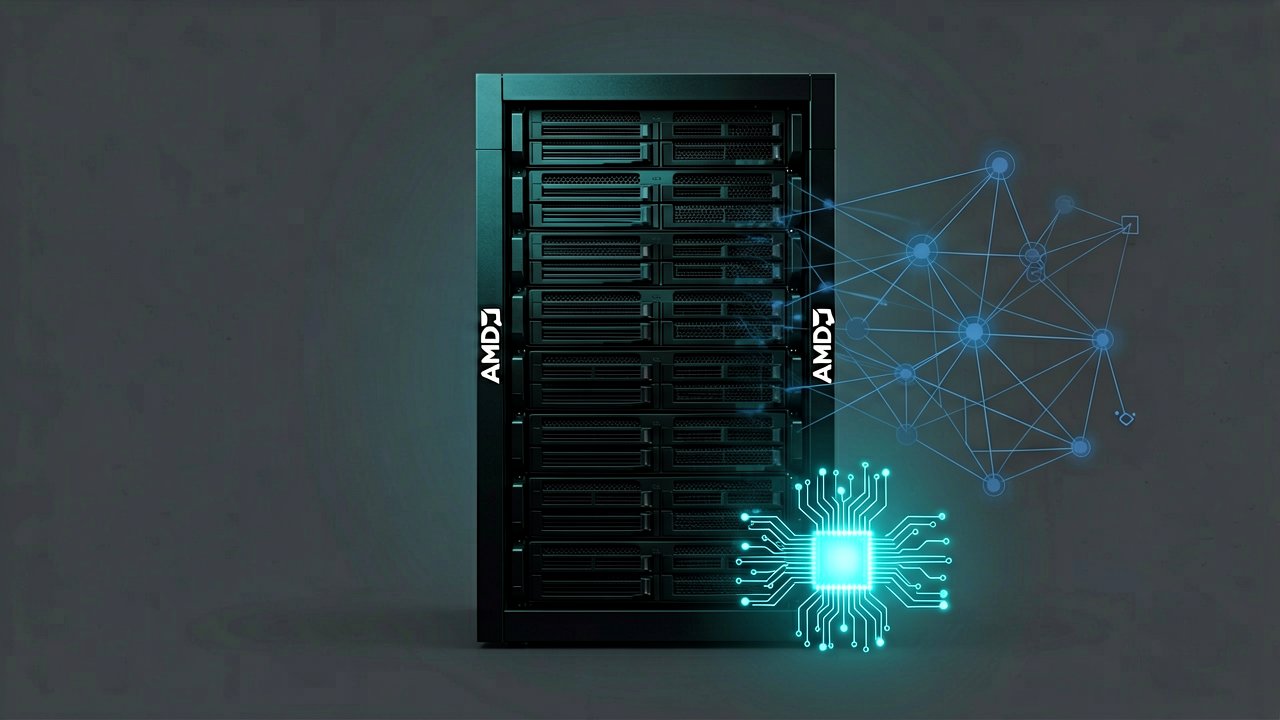
Rackspace Technology has entered a strategic partnership with AMD to build what it calls a new category of governed enterprise AI infrastructure. The announcement coincided with the San Antonio-based company reporting its first profitable quarter in two years, sending shares to a four-year high.
The Memorandum of Understanding establishes a framework for integrating AMD Instinct™ GPUs and EPYC™ CPUs into a fully managed, governed stack. Under this model, Rackspace would assemble, integrate, and operate the full stack from accelerated compute through AI inference and agents in production.
According to the company's official press release, the partnership aims to invert the dominant model where enterprises rent GPU capacity by the hour and carry the operational burden themselves. The formal announcement details four integrated capabilities designed to form a complete stack from bare metal compute through a fully operated inference runtime.
CEO Gajen Kandiah stated that governing AI infrastructure in regulated environments with defined accountability must be built in from the start, not bolted on after the fact. The market is moving in the direction they anticipated, with regulated enterprises making deliberate choices about where their AI runs, who operates it, and who is accountable for outcomes.

The financial timing is notable. Rackspace reported a profit of $8 million for the first quarter, a turnaround from the loss of $38 million posted for the same period last year. Revenue was $678 million, up from $665 million. Trading on Nasdaq under the ticker RXT, share prices surged 55% for the day after news of the positive earnings report and AMD partnership.
Independent reporting from the San Antonio Express-News corroborates the earnings data and partnership scope. The coverage notes the company has been growing its AI business as part of a new strategy to help customers in regulated industries incorporate the technology into their networks.
The technical architecture matters here. AMD brings both Instinct™ GPUs and EPYC™ CPUs inside a single integrated compute architecture, with ROCm™ tooling that orchestrates workloads across both. Production enterprise inference is heterogeneous. Frontier models run on GPU. Small language models, classical ML, embeddings, retrieval and many domain-specific workloads run more efficiently on CPU.
Customers should not be forced to put every workload on the most expensive silicon. The governed operating model routes each workload to the right compute, which is what production economics actually requires. That operating flexibility is critical in sovereign AI deployments, where data residency and jurisdictional requirements dictate where and how systems operate.

The work would include sourcing data center space, managing hardware delivery and finding staff to put it together and operate the systems. Rackspace operates more than 30 data centers globally, and the new partnership will help it provide AMD-powered processors for customers.
As an example, the technology could help banks and financial institutions assess lending risks more precisely, strengthen fraud detection and handle customers' personal data more efficiently. In healthcare organizations, the same platform could help doctors collaborate on cases and provide faster insights about care. (One of the largest Epic environments anywhere runs on Rackspace private cloud, not on a hyperscaler.)
The deal with AMD follows Rackspace's partnership with software giant Palantir Technologies to deploy two of its AI programs across customers' networks. Rackspace said 250 of its staff will be trained on Palantir's programs by the end of the year. While the AMD deal revolves largely around hardware, the Palantir partnership adds software capability to Rackspace's offerings.
Private cloud revenue was $235 million in the first quarter, down from the $250 million reported last year. Public cloud revenue in the first quarter was $443 million, up from $416 million a year ago. The shift suggests customers are moving toward shared infrastructure models, though the private cloud segment remains a significant portion of the business.
For enterprise buyers, the decision is shifting from purchasing hardware with services attached to selecting an operator that can run AI reliably in production. The question becomes whether customers will actually pay a premium for managed accountability versus commodity GPU rental. Whether users actually pay for it remains the real question.
Artūras Malašauskas is an AI Systems Integrator with 20+ years of production-grade web engineering experience. He has designed, shipped, and scaled enterprise Python/PHP systems for logistics, SaaS, and public-sector clients. For the past year, he has focused exclusively on AI integrations: deploying open-source LLMs, building generative media pipelines (image, audio, video), and engineering multi-agent workflows for real production environments. His standard: reproducibility, security, cost-efficient inference—no vaporware. He documents and evaluates emerging AI tooling, separating verified capabilities from marketing noise. Technical editor at: muza-ai.eu, ai-verslas.lt, ai-naujinos.lt Connect on LinkedIn
Comments