AI May Accelerate Radicalization Through Psychological Exploitation

A new study published in Personality and Social Psychology Review suggests artificial intelligence systems may function as accelerants for violent radicalization, exploiting psychological vulnerabilities at scale. The research, titled "Intelligent Systems, Vulnerable Minds: A Framework for Radicalization to Violence in the Age of AI," combines psychological theories of radicalization with modern AI technologies including recommendation algorithms, generative models, and botnets.
Milan Obaidi, associate professor at the Department of Psychology at the University of Copenhagen, explains the core finding: "We have developed a comprehensive model that shows how digital systems can exploit—or amplify—people's social and psychological needs in ways we do not yet fully understand." The study was reported by Phys.org in May 2026.
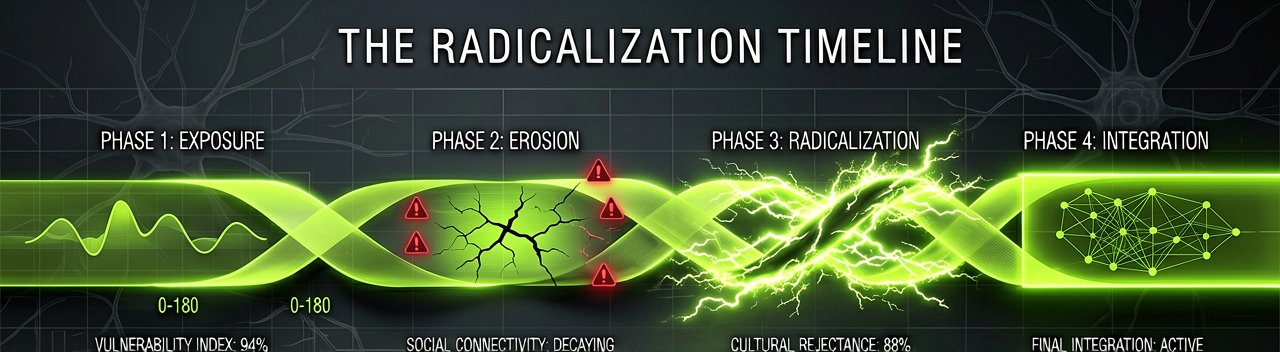
Radicalization rarely begins as a sudden upheaval. Instead, individuals move gradually through a process where digital technologies and psychological vulnerabilities influence one another. The researchers divide this into four key phases: exposure, reinforcement, group integration, and violent acts. Algorithms present users with polarizing content often without active seeking. Repeated exposure creates echo chambers. Online communities and AI-generated peers create bonds of identity. In rare cases, this culminates in violent extremism.
AI systems can identify psychologically vulnerable individuals, tailor content, and create synthetic communities resembling human interactions. (This is the part where engineers should probably pause and reconsider their engagement metrics.) Obaidi notes: "We are seeing an environment where users are not only exposed to extreme content, but also have it reflected back to them by algorithms in ways that can amplify their sense of meaning, anger or injustice." The combination of technology's scalability and people's psychological needs makes this development particularly worrying.

Generative AI introduces entirely new risks beyond recommendation algorithms. Large language models can produce vast amounts of personalized propaganda. They can simulate communities via swarms of bots. They can act as AI companions that reinforce extreme beliefs. They can create highly convincing deepfakes and manipulated material. Obaidi highlights: "This development may make it harder to distinguish between human and non-human influences—and thus amplify radicalization processes that were previously limited by human labor."
Psychological vulnerability plays a crucial role. AI particularly affects people experiencing social isolation, identity insecurity, injustice, or marginalization. People with a need for clarity, order, and strong group affiliations face higher risk. Because AI systems are designed to maximize engagement, they may inadvertently exploit these vulnerabilities without any ideological intent. The technology doesn't create radicalization from nothing, but it amplifies known psychological mechanisms and makes extreme ideas easier to gain a foothold among those already at risk.
Physical interaction with these systems matters. A user scrolling through a feed experiences micro-decisions: click, scroll, pause, linger. Each action feeds the algorithm. The screen glows in a dark room. The thumb moves mechanically. Load times feel instant. Notifications ping at irregular intervals. This sensory loop creates dependency. The interface feels responsive, almost human. That responsiveness is the trap.
Independent research corroborates these findings. A 2025 study in Frontiers in Political Science examines how extremist organizations operationalize AI technologies for radicalization, recruitment, and propaganda dissemination. The analysis reveals AI-enabled technologies facilitate radicalization through algorithmic amplification of emotionally provocative content, behavioral analytics enabling precision targeting, and generative systems producing synthetic media that circumvent content moderation mechanisms.
Case studies from GNET Research document specific instances. The Islamic State Khorasan Province (ISKP) published a guide on "how to securely use generative AI" in 2023. Following the Crocus City Hall attack in March 2024, an IS supporter circulated AI-generated video news bulletins. In May 2024, ISKP launched AI-generated propaganda bulletins featuring local-looking anchors to claim responsibility for attacks in Bamiyan and Kandahar.
These examples show the technology moving from theoretical risk to operational reality. Extremist groups now use AI to amplify and tailor propaganda, improve on traditional radicalization methods, and maintain ideological cohesion despite territorial losses. The media wing of ISKP, the Al-Azaim Foundation, demonstrates significant awareness of regional sensitivities through multilingual content suitable for different audiences.
Current counterterrorism approaches face critical gaps. The accelerating sophistication of AI-facilitated extremism necessitates comprehensive international cooperation frameworks, ethics-oriented regulatory architecture, and AI-powered countermeasures. Legal structures remain fundamentally inadequate to address borderless, rapidly evolving threats. Successful mitigation requires coordinated efforts among governments, technology platforms, international organizations, and civil society.
Technology companies face a fundamental tension. Their business models depend on engagement metrics that drive content consumption. The same algorithms that maximize watch time also maximize exposure to extreme content. Fixing this requires redesigning core systems, not adding moderation layers on top. That means slower growth, lower engagement, reduced ad revenue. (Nobody's talking about that trade-off openly.)
Whether platforms actually prioritize safety over profit remains the real question. The research is clear. The mechanisms are documented. The question is whether anyone with decision-making power will act before the next wave of AI-driven radicalization reaches critical mass. Time alone won't solve this.
Artūras Malašauskas is an AI Systems Integrator with 20+ years of production-grade web engineering experience. He has designed, shipped, and scaled enterprise Python/PHP systems for logistics, SaaS, and public-sector clients. For the past year, he has focused exclusively on AI integrations: deploying open-source LLMs, building generative media pipelines (image, audio, video), and engineering multi-agent workflows for real production environments. His standard: reproducibility, security, cost-efficient inference—no vaporware. He documents and evaluates emerging AI tooling, separating verified capabilities from marketing noise. Technical editor at: muza-ai.eu, ai-verslas.lt, ai-naujinos.lt Connect on LinkedIn
Comments