NRO Director Says AI Essential for Managing 200+ Satellite Constellation
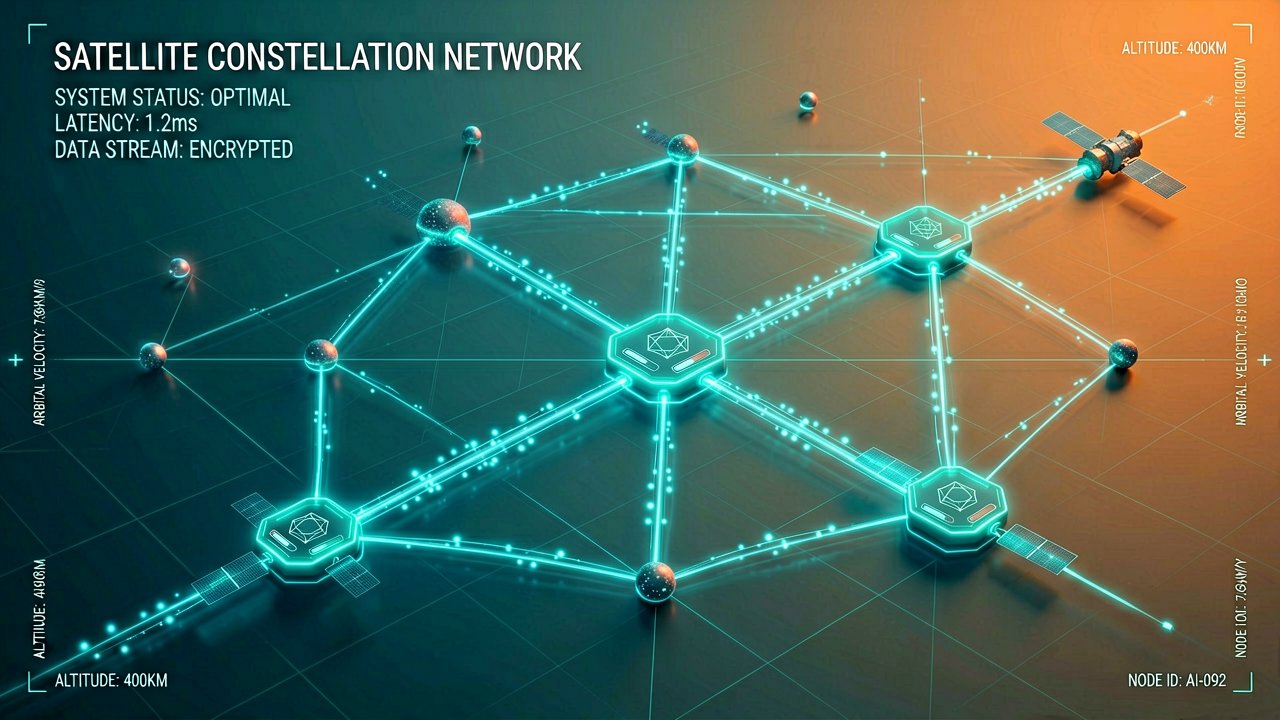
The National Reconnaissance Office is betting heavily on artificial intelligence to manage an expanding satellite constellation that now exceeds 200 spacecraft of varying sizes and capabilities. NRO Director Chris Scolese made the announcement during his keynote address at the GEOINT Symposium, where he outlined how AI will become central to maintaining U.S. space-based intelligence advantages.
According to the official NRO news release, the agency's nearly 65-year history of developing leading-edge space technologies has reached an inflection point. The proliferation of satellites has grown beyond what human operators can effectively manage. This isn't theoretical. The math is simple: more satellites mean exponentially more data streams, more tasking requests, and more systems requiring constant monitoring.
Dr. Scolese's message was direct. "Every application of AI is oriented toward faster delivery of capability, greater accuracy, and the extension of human capabilities." The language suggests a pragmatic shift rather than a technological moonshot. The NRO isn't trying to build something entirely new. They're trying to keep pace with their own growth.
Specific applications include increasing autonomy on spacecraft, enabling on-board processing and real-time recognition for situational response. AI can simplify the tasking process and optimize mission planning across the constellation. The goal is making it conversational rather than complex. Think about the difference between manually configuring satellite parameters versus issuing natural language commands. The physical experience changes from clicking through nested menus to speaking or typing what you need.

There's also the matter of data discoverability. The NRO wants AI to make data easily understood by users, even in high-pressure situations. This matters because intelligence isn't consumed in quiet offices. Analysts and operators need actionable information when decisions are being made in real time. The interface between human and machine becomes critical when seconds count.
Dr. Scolese noted that the NRO is committed to building trust and transparency into every AI system. This includes rigorous testing and validation, continuous monitoring for performance issues, and clear documentation of how each system was developed. He emphasized the need to look inside the "black box" of AI and verify predictions and outputs are correct. Understanding how a model arrived at its prediction is essential for maintaining trust in the NRO's data. (This is where most commercial AI vendors cut corners, unfortunately.)
The transformation doesn't mean replacing humans with machines. One of Dr. Scolese's key priorities is developing an AI-ready workforce. AI capabilities are being integrated across the enterprise in every mission portfolio. The goal is enabling teams and partners to do things better and faster. This distinction matters because it signals the NRO understands that technology alone won't solve the problem. The workforce needs to understand AI, not just use it.
Independent reporting from ClearanceJobs provides additional context from the same GEOINT 2026 conference. Brett Scott, Director of GEOINT at the NRO, offered a complementary perspective on how intelligence delivery timelines are compressing. Decades ago, intelligence collection meant capturing imagery on film, dropping canisters from space, and waiting days or even weeks for processing and analysis.
Today, the expectation isn't minutes. It's seconds. The mission is moving toward timelines where intelligence must be delivered in as little as 10 seconds to support tactical operations. That's not just a technology challenge. It's a systems, workforce, and acquisition challenge all at once. The physical reality of this shift means operators can no longer wait for data to arrive. They need it before they've finished asking for it.
One of the most important ideas Scott emphasized is a shift that's already underway but not fully realized. Historically, GEOINT has been about moving imagery. Now, it's about extracting and delivering just the information that matters. Instead of pushing massive volumes of imagery across networks, the goal is to pull key detections from the image, attach confidence levels and context, and deliver only what the operator needs to act.
This shift does two critical things. It speeds up delivery and makes sharing easier. By separating insight from the source imagery, intelligence can often be shared at lower classification levels. This makes it more usable across coalition partners and even downrange operators. The bandwidth savings alone are significant. Transmitting a detection alert takes milliseconds. Transmitting the full-resolution imagery that generated it takes orders of magnitude longer.
The role of automation is framed as a necessity, not a future concept. The volume of data is already too large for human-only workflows. When timelines shrink to seconds, there's no room for manual processes in the middle. The model described is straightforward: machines handle the "what" (detection, tracking, processing), while humans focus on the "why" (analysis, context, decision-making).
That's a major shift for the GEOINT workforce. It means reskilling isn't optional. And it means the workforce of the future will need to understand AI—not just use it. This is where the NRO's emphasis on an AI-ready workforce becomes concrete. The agency isn't just buying software. They're rebuilding how people work.
If there's a temptation to look for a single breakthrough system or platform to solve these challenges, Scott pushed back on that idea directly. No one satellite, no one system, no one discipline will solve the problem. Instead, the future is about integration across everything: multiple orbital layers, diverse sensor types (EO, radar, infrared, and more), commercial and government systems, and intelligence from across disciplines.
This is where cross-coordination becomes mission-critical. And it's also where industry plays a bigger role than ever before. Lower launch costs and smaller satellite architectures mean more companies can participate, more experimentation is possible, and new ideas can get on orbit faster. This isn't just about traditional primes anymore. It's about tapping into a broader ecosystem of innovation.
Scott made it clear that the NRO doesn't just need new technology from industry. It needs help changing how it thinks about risk. For decades, government acquisition—especially in space—has been built around risk avoidance. Failure wasn't an option. But in today's environment, that mindset creates a different kind of risk: moving too slowly. Scott pointed out that "If you fail faster and in measurable ways, you end up solving issues faster and better."
This isn't about reckless development. It's about managed risk. Avoid catastrophic failure, accept smaller recoverable failures, learn quickly and iterate. Scott even called it out directly: "An 80% solution delivered on time is better than a perfect solution delivered too late." For a workforce used to long timelines and rigid requirements, that's a significant mindset shift.
For cleared professionals, contractors, and anyone working in this space, the implications are real. Adaptability matters more than ever. Understanding AI is becoming foundational. Speed is now part of mission success—not just accuracy. Collaboration across government and industry is no longer optional. And maybe most importantly: being part of the mission doesn't just mean delivering a product. It means helping shape how the mission gets done.
The NRO's AI transformation represents a fundamental rethinking of how space-based intelligence gets delivered. Whether the agency can actually achieve 10-second delivery timelines while maintaining accuracy remains the real question. The technology exists. The workforce adaptation is the harder part.
Artūras Malašauskas is an AI Systems Integrator with 20+ years of production-grade web engineering experience. He has designed, shipped, and scaled enterprise Python/PHP systems for logistics, SaaS, and public-sector clients. For the past year, he has focused exclusively on AI integrations: deploying open-source LLMs, building generative media pipelines (image, audio, video), and engineering multi-agent workflows for real production environments. His standard: reproducibility, security, cost-efficient inference—no vaporware. He documents and evaluates emerging AI tooling, separating verified capabilities from marketing noise. Technical editor at: muza-ai.eu, ai-verslas.lt, ai-naujinos.lt Connect on LinkedIn
Comments