ANSI Maps AI's Past, Present, and Standardization Future
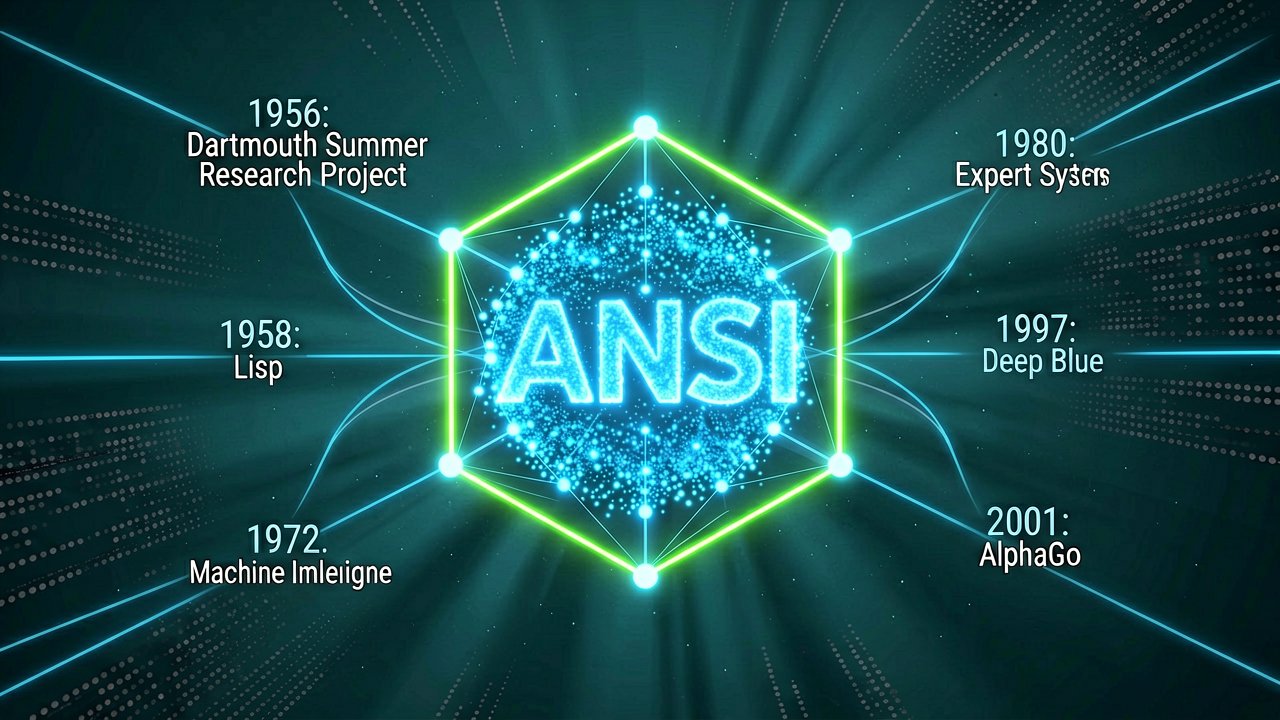
The American National Standards Institute has published a comprehensive overview of artificial intelligence's trajectory, from its philosophical origins to modern standardization challenges. The organization's blog post, Artificial Intelligence: Invention, Evolution & Future, traces the technology's development while highlighting ANSI's current role in shaping governance frameworks.
AI wasn't born from a single eureka moment. The concept stretches back to ancient automatons, but the formal field emerged in 1956 at the Dartmouth Summer Research Project. John McCarthy, Marvin Minsky, Nathaniel Rochester, and Claude Shannon coined the term "Artificial Intelligence" during that conference. They formalized the idea that machines could replicate human cognition.
Alan Turing's 1950 paper "Computing Machinery and Intelligence" established the theoretical foundation. His "imitation game"—now called the Turing Test—asked whether machines could think by having an interrogator distinguish between human and computer responses. The test focused on behavioral similarity rather than internal processes. (This distinction matters more than most people realize when evaluating modern AI systems.)
The 1980s brought an "AI boom" with expert systems and early deep learning. XCON, developed by Digital Equipment Corporation and Carnegie Mellon University in 1978, automatically configured VAX computer systems and saved millions. The Stanford Cart used computer vision for autonomous navigation. Harold Cohen's AARON generated original artwork. These projects proved AI's commercial value while raising questions about machine creativity.

Then came the "AI winter." The term first appeared in 1984, describing the gap between expectations and technological reality. Investors and governments pulled funding due to high costs versus low returns. The cycle repeated through the late 1970s and early 1990s.
By the late 1990s and early 2000s, research refocused on specific solutions rather than general intelligence. The late 2000s and 2010s saw acceleration from big data and computing power advances. Deep learning algorithms, computer vision, and natural language processing enabled machines to recognize images, understand speech, and make predictions.
Today's generative AI era has embedded the technology into society. Recommendation engines, autonomous vehicles, and advanced analytics transform business operations. But integration brings governance challenges that ANSI is actively addressing through standards development.
The organization's Global Information and Communications Technology and Critical and Emerging Technology Standards Program held an inaugural AI workshop in Panama City from September 22-25, 2025. Over 40 technical experts, academics, policymakers, and standards developers from eight Latin American and Caribbean countries participated. The three-day session covered national, regional, and international standards development processes for AI.
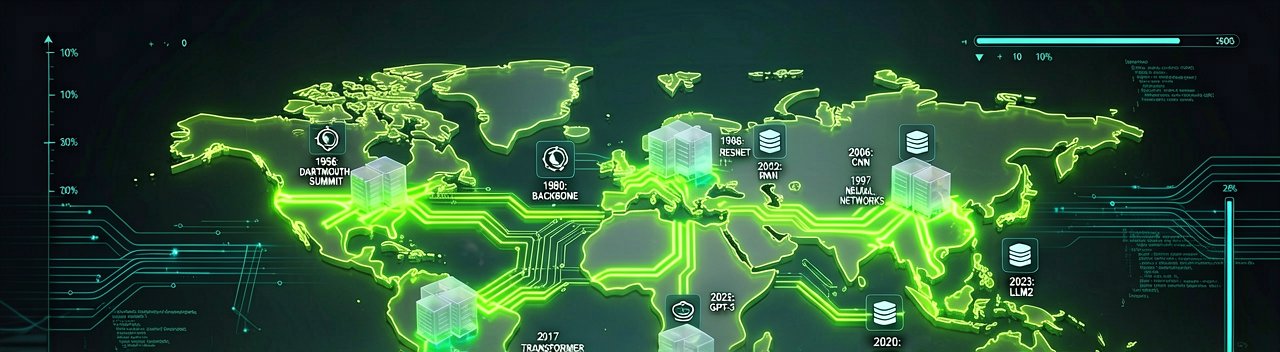
Participants collaborated on action plans to address their countries' needs. They heard from ANSI members actively participating in ISO/IEC JTC 1/SC 42 on artificial intelligence. The workshop helped attendees learn how to engage more effectively in international standards development and implement standards in their regional contexts.
ANSI also adopted the Healthcare Standards Institute standard ANSI/HSI 2800-2025 for AI governance in healthcare operations. This standard establishes a framework for managing AI responsibly in healthcare. It covers leadership accountability, regulatory alignment, data governance, and ethical deployment. The standard addresses the full AI lifecycle from development through continuous improvement.
Healthcare organizations face unique considerations including sensitive health data and patient safety. Standards supporting informed regulatory measures are essential. ANSI explored public-private partnerships for AI in healthcare standards during a July 2024 brainstorming session. Stakeholders found networking and informal discussions extremely valuable.
The United Nations Secretary General High-Level Advisory Body on AI released a report in September 2024 recommending an AI standards exchange. The report, "Governing AI for Humanity," is based on insights from more than 2,000 participants globally. It calls for coordination among national and international standard-development organizations, technology companies, civil society, and scientific panels.
NIST coordinates federal AI standards efforts and released a draft plan for global engagement on April 29, 2024. The final plan, A Plan for Global Engagement on AI Standards, was published on July 26, 2024. NIST's AI Risk Management Framework 1.0 aligns with international standards including ISO/IEC 5338, ISO/IEC 38507, and ISO/IEC 22989.
On March 6, 2026, NIST hosted a webinar on the international AI standards landscape. The session covered the current state of the ecosystem and ITL's progress in accelerating participation. NIST also released A Possible Approach for Evaluating AI Standards Development on January 15, 2026. The report sketches a conceptual structure for measuring whether standards meet innovation and trust goals.
Physical interaction with these systems reveals gaps between theory and practice. Loading times, interface friction, and hardware limitations create real-world constraints that standards must address. A governance framework that works on paper may fail when deployed on aging hospital servers or in bandwidth-constrained environments.
ANSI's GICS Program, launched in 2024, is a three-year cooperative agreement with the U.S. Department of State Bureau of Cyberspace and Digital Policy. The program focuses on capacity building for target countries in international standards development. It covers six geographical regions including South and Southeast Asia, Sub-Saharan Africa, the Middle East and North Africa, the Western Hemisphere, and Europe.
Whether these standards actually reduce risk or merely create compliance checkboxes remains uncertain. Organizations will implement them selectively based on cost-benefit analysis. The real test comes when AI systems fail in production and someone needs to point to a standard that should have prevented it. That moment will determine whether ANSI's work matters beyond conference rooms and workshop handouts.
Artūras Malašauskas is an AI Systems Integrator with 20+ years of production-grade web engineering experience. He has designed, shipped, and scaled enterprise Python/PHP systems for logistics, SaaS, and public-sector clients. For the past year, he has focused exclusively on AI integrations: deploying open-source LLMs, building generative media pipelines (image, audio, video), and engineering multi-agent workflows for real production environments. His standard: reproducibility, security, cost-efficient inference—no vaporware. He documents and evaluates emerging AI tooling, separating verified capabilities from marketing noise. Technical editor at: muza-ai.eu, ai-verslas.lt, ai-naujinos.lt Connect on LinkedIn
Comments