InQI Launches AI-Native Property Intelligence Platform with New Editor and Expanded IQ Apps
Mountain View-based proptech startup InQI announced a major platform release on May 04, 2026, fundamentally repositioning its product from a simple site plan generator into a persistent property intelligence container anchored to a property address. The shift represents a strategic pivot from one-off deliverables to a compounding knowledge system that retains data across projects and workflows.
According to the official GlobeNewswire press release, the company is betting that architects, designers, and builders need a single source of truth rather than scattered tools. Traditional site planning takes days and can cost thousands. Drone scans are faster—but still require scheduling, flights, and processing. InQI's approach eliminates the site visit entirely. Enter an address and within 20 seconds you get a detailed, editable site plan, up to 10 years of high-resolution aerial imagery, and full property data.
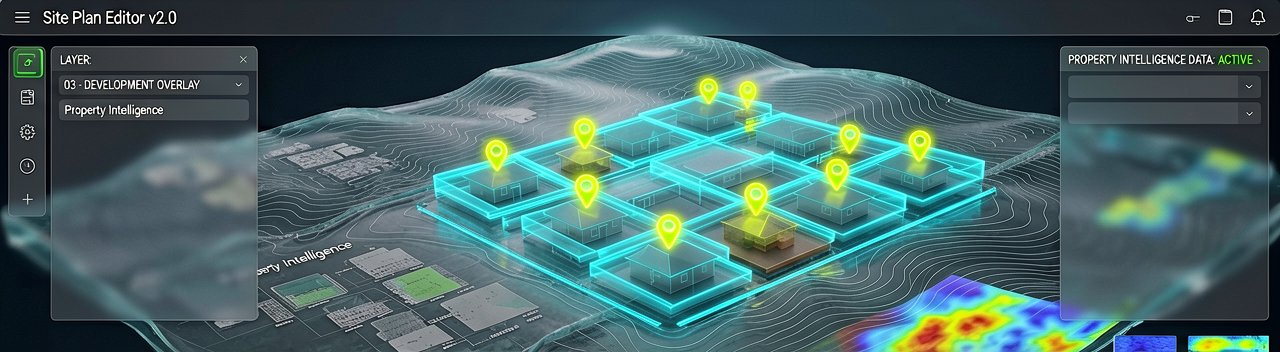
The new Site Plan Editor v2.0 runs on the highest-resolution aerial imagery available. It features a 16-layer system with 5 always-on Primary layers and 11 user-activatable Additional layers. Every layer operates in dual mode—AI Recognition via Nearmap detection or manual Draw Mode. This gives professionals AI speed with full creative control. The physical experience matters here: clicking through layers feels less like navigating a CAD interface and more like toggling overlays on a tablet screen. No more wrestling with conflicting data sources or waiting for surveyors to return.
Three-Tier Binder System architecture creates persistent context across workflows. Account-level Reference Binder, Project Binder, and Public Binder are all LLM-aware. Designers' libraries, project documents, and licensed reference materials become persistent context that compounds across every workflow. This is where the platform diverges from typical AI wrappers. Most tools forget everything after a session. InQI's binders remember. (That's the kind of feature that actually saves time instead of just marketing it.)

Domain-expert AI agents now ship as generally available IQ Apps. Codes.IQ functions as a plan-checker aware of jurisdiction-specific building codes and project zoning. Estimate.IQ performs construction quantity takeoffs with regional cost intelligence. InQuest serves as a conversational assistant with full project context awareness. These aren't chatbots pretending to be experts. They're specialized agents trained on actual building codes, cost databases, and project documentation. The difference shows when you ask about setback requirements for a specific California municipality versus generic construction advice.
3D Modeling generates data-driven models built on real terrain, parcel boundaries, and structure heights. Sun, shadow, wind, and rain simulations run on actual property data. This is data-aware 3D, not presentation rendering. The distinction matters for professionals who need to verify structural feasibility before breaking ground. One-click generation sounds convenient until you realize the underlying calculations depend on accurate elevation data and zoning constraints.
InQI Mobile captures field documentation on iOS and Android that flows directly into project intelligence. Photos, notes, and measurements get geo-tagged and queryable. Field crews can snap a picture of an existing condition and have it indexed within the project binder. No more lost photos in email chains or unorganized cloud folders. The friction of moving from site to office disappears.
Multi-LLM Consensus Architecture represents the platform's most technically interesting feature. Cross-model intelligence surfaces discrepancies between AI providers, giving users a trust signal no single-model platform can match. When three different large language models agree on a code interpretation, confidence increases. When they disagree, the system flags the conflict. This approach acknowledges that AI hallucination isn't solved—it's managed through redundancy.
Independent reporting from Yahoo Finance corroborates the launch timeline and feature set. The coverage emphasizes the platform's positioning against traditional survey methods and drone-based scanning services. Speed and cost advantages are quantified: 20 seconds versus days, no scheduling versus coordinating flights.
Founder Ali Tehranchi framed the release as making a two-year thesis concrete. "We've spent two years building something the industry hasn't had—a place where everything tied to a property address lives, learns, and compounds in value over time. The site plan was always the entry point, never the product." The quote captures the strategic shift. InQI isn't selling deliverables anymore. It's selling a knowledge infrastructure.
The roadmap extends through Q3 2026 with three additional releases. ADU.IQ launches early June 2026 as a specialized agent for Accessory Dwelling Unit workflows. This addresses one of the fastest-growing residential construction segments in the United States. Output Manager.IQ ships mid-June to late July for unified export orchestration producing permit-ready packages. Landscape.IQ arrives August–September with AI-native outdoor design including vegetation detection, impervious surface coverage, and water budgeting.
InQI operates as a technology platform available in all 50 U.S. states. Founded in 2023 and headquartered in Mountain View, California, the company combines aerial imagery, parcel data, building codes, cost intelligence, and multi-LLM reasoning into a unified workflow. The platform serves homeowners, designers, architects, and design-build firms across the United States, with particular strength in California, Texas, Florida, Washington, and other ADU-friendly markets.
Industry context matters here. The AEC sector has been slow to adopt AI compared to software or finance. Regulatory complexity, liability concerns, and fragmented workflows create high barriers. InQI's address-anchored approach sidesteps some friction by starting with the one thing every project has: a location. Everything else flows from there. Whether this actually reduces liability or just shifts it remains an open question.
Competitive positioning is unclear without pricing details. The press release mentions a free signup but doesn't disclose subscription tiers or enterprise pricing. For architects and builders, cost structures determine adoption more than feature sets. A tool that saves 20 hours per project but costs $500 monthly faces different adoption dynamics than one charging $50.
The multi-LLM consensus architecture could become a differentiator if AI accuracy issues persist. Single-model platforms face inherent reliability problems. Cross-validation between providers adds computational cost but potentially reduces errors. Whether users will pay for that redundancy depends on how often AI mistakes cause real-world problems.
Whether users actually pay for it remains the real question.
Artūras Malašauskas is an AI Systems Integrator with 20+ years of production-grade web engineering experience. He has designed, shipped, and scaled enterprise Python/PHP systems for logistics, SaaS, and public-sector clients. For the past year, he has focused exclusively on AI integrations: deploying open-source LLMs, building generative media pipelines (image, audio, video), and engineering multi-agent workflows for real production environments. His standard: reproducibility, security, cost-efficient inference—no vaporware. He documents and evaluates emerging AI tooling, separating verified capabilities from marketing noise. Technical editor at: muza-ai.eu, ai-verslas.lt, ai-naujinos.lt Connect on LinkedIn
Comments