Nasdaq AI Stocks Rally: AMD, Alphabet, and Nvidia Lead the Charge
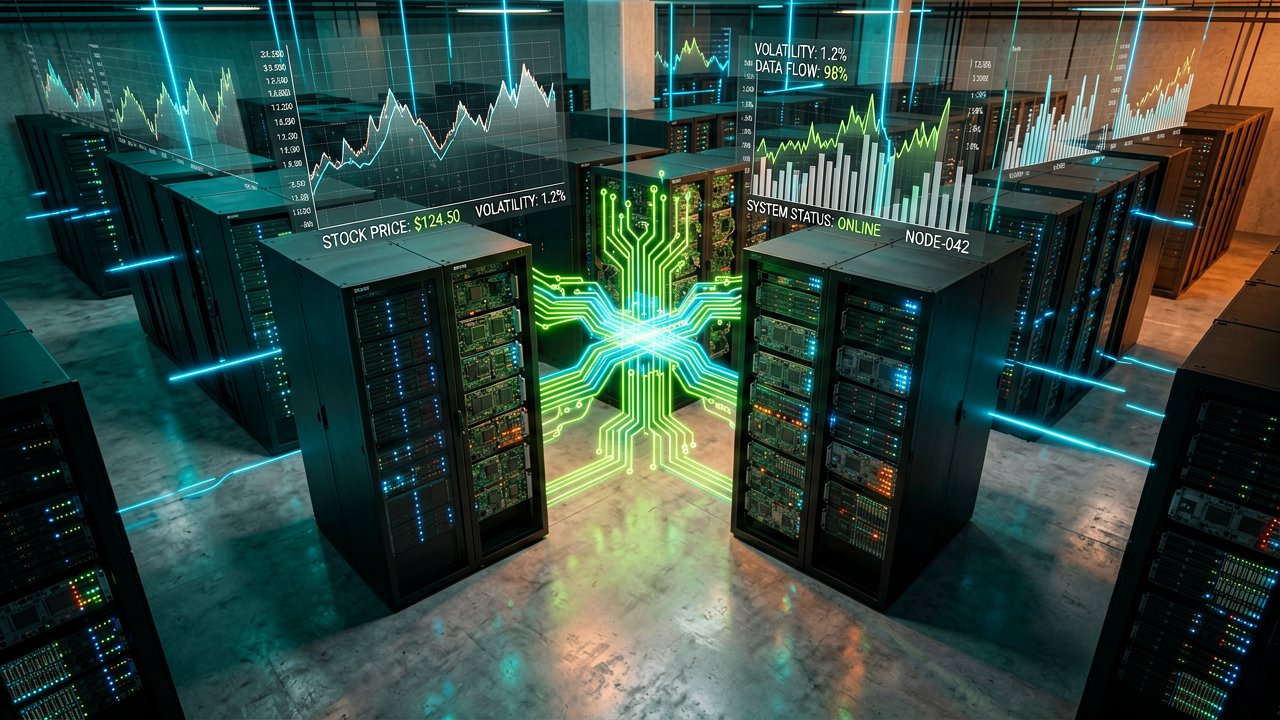
The Nasdaq has surged to fresh all-time highs in May 2026, recovering from correction territory earlier this year. Behind the rally sits a single, massive driver: artificial intelligence infrastructure spending. Five major companies alone are planning approximately $700 billion in data center-related capital expenditure this year, according to analysis from The Motley Fool's AOL coverage.
This isn't abstract speculation. It's physical reality. Server racks are being filled with graphics processing units. Data centers are being built from the ground up. The hum of cooling fans and the glow of status LEDs represent trillions of dollars in projected compute demand.
Advanced Micro Devices (NASDAQ: AMD) sits at the intersection of two critical AI trends: inference workloads and what analysts are calling agentic AI. The company has secured partnerships with both Meta Platforms and OpenAI to supply 6 gigawatts of power from its next-generation GPUs. These deals include warrants in AMD stock, giving the chipmaker direct exposure to two of the largest AI infrastructure spenders in the world.
AMD's opportunity extends beyond GPUs. As agentic AI systems require more orchestration, central processing units are becoming the next bottleneck in AI infrastructure. AMD has established itself as a leader in the data center CPU market and is now developing CPUs specifically designed for agentic AI workloads. The company's chiplet design packs more memory into its chips, while improved ROCm software makes it a stronger alternative in the inference market.
Alphabet (NASDAQ: GOOG, GOOGL) operates on a different strategy entirely. The company's custom AI chips, called tensor processing units (TPUs), were introduced more than a decade ago. This early start has allowed Alphabet to design its entire software and hardware ecosystem around these application-specific integrated circuits. The company recently opened its TPUs to frameworks outside of TensorFlow, prompting customers like Anthropic to adopt them at scale.
Alphabet's eighth-generation TPUs will separate training and inference functions, while the company reportedly works on memory processing units to optimize AI model performance. The custom chip business provides Alphabet with both cost advantages and new revenue streams. The company can train and run inference on its Gemini model at significantly lower cost than competitors using Nvidia's GPUs. It has even begun letting co-development partner Broadcom sell its TPUs directly to some customers.
Nvidia (NASDAQ: NVDA) remains the dominant force in AI computing chips. CEO Jensen Huang has told investors the company holds $1 trillion in cumulative orders for its Rubin and Blackwell chips through 2027. For context, Nvidia's revenue over the past 12 months was approximately $216 billion. Wall Street analysts expect revenue to more than double by the end of 2027.
The company's proprietary software platform, CUDA, creates high customer switching costs that make it unlikely for another chip designer to emerge as a leader in AI training. Nvidia's expansion into networking allows customers to cluster AI GPUs together for training workloads. Morningstar rates Nvidia's stock as 22% undervalued relative to its $260 fair value estimate as of April 20, 2026.
Broadcom (NASDAQ: AVGO) is capturing growth through custom AI chips designed for specific workloads. In Q1 of fiscal year 2026, its AI semiconductor division generated $8.4 billion, up 106% year over year. CEO Hock Tan believes this segment will generate more than $100 billion in revenue by the end of next year, more than triple its current level. Wall Street projects Broadcom's revenue will rise from $64 billion in fiscal 2025 to $158 billion in fiscal 2027.
Taiwan Semiconductor Manufacturing (TSM) serves as the backbone for the entire AI chip ecosystem. The foundry expects AI chip revenue to grow at a compounded annual growth rate in the mid-to-high-50% range from 2024 to 2029. During its Q1 earnings report, the company increased its overall revenue growth guidance for 2026 to 30%.
Smaller players are also capturing attention. CoreWeave offers GPU computing infrastructure primarily used as boosted training capacity with major AI hyperscalers. The stock is up more than 65% in 2026, with Wall Street analysts projecting 143% revenue growth this year and 89% in 2027. Nebius offers AI-first cloud computing infrastructure with a full-stack setup, projected to grow revenue 523% in 2026 and 206% in 2027. Applied Digital acts as a landlord for cloud companies, building data centers equipped to cool and supply power to facilities. Its revenue rose 139% during its most recent quarter.
Supply chain risks remain a concern. More than 30% of the world's helium supply passes through the Strait of Hormuz, and helium is essential in manufacturing advanced chips. However, Taiwan Semiconductor has reserves, and alternative helium sources exist. The chip industry is likely one of the first in line to secure supply (a problem that has plagued users for years, frankly).
Microsoft (NASDAQ: MSFT) remains well off its all-time highs, down more than 20% from peak levels. The company's Azure cloud business is estimated at approximately $75 billion and growing at 30% annually. Morningstar rates Microsoft as 30% undervalued relative to its $600 fair value estimate.
The "anything-but-AI" sentiment that led to a selloff in numerous AI-related stocks during the first quarter of 2026 has left many well-capitalized AI stocks trading at a discount. Even as stocks recover, that retreat has created buying opportunities for investors willing to look past short-term volatility.
Whether users actually pay for all this compute capacity remains the real question. The infrastructure is being built regardless, but the economics of AI adoption will determine which companies truly profit from this boom.
Bottom line: The AI infrastructure buildout is real, measurable, and accelerating. The question isn't whether demand exists—it's which companies can capture value as the market matures.
Artūras Malašauskas is an AI Systems Integrator with 20+ years of production-grade web engineering experience. He has designed, shipped, and scaled enterprise Python/PHP systems for logistics, SaaS, and public-sector clients. For the past year, he has focused exclusively on AI integrations: deploying open-source LLMs, building generative media pipelines (image, audio, video), and engineering multi-agent workflows for real production environments. His standard: reproducibility, security, cost-efficient inference—no vaporware. He documents and evaluates emerging AI tooling, separating verified capabilities from marketing noise. Technical editor at: muza-ai.eu, ai-verslas.lt, ai-naujinos.lt Connect on LinkedIn
Comments