Daniel Tanuro's Ecosocialist Critique of Artificial Intelligence

The political economist Daniel Tanuro has published a systematic ecosocialist framework examining artificial intelligence through the lens of capitalist extraction and ecological crisis. The document, titled "Theses for an ecosocialist critique of artificial intelligence," appeared on International Viewpoint and has been distributed through multiple solidarity networks including Europe Solidaire Sans Frontières.
Tanuro's core argument cuts through the techno-optimism dominating Silicon Valley boardrooms. He contends that AI does not represent neutral technological progress but rather intensifies every defining tendency of late capitalism. This includes the subsumption of labor, resource plunder from the Global South, monopoly concentration, and the degradation of social bonds and democratic capacity.
The theses begin by establishing what intelligence actually means before critiquing AI's claims. Intelligence, in Tanuro's framework, enables grasping difference, apprehending the new, and anticipating possibilities within time's flow. It emerges from non-linear biological evolution. Inert objects lack intelligence. Symbiotic plant and fungal organizations communicate and adapt without anticipation or awareness. Intelligence as defined here appears in the animal kingdom in various forms and degrees.
Human intelligence combines abstraction from limited data, sophisticated communication, thought, and developed spiritual life expressed through complex symbolic achievements. Homo sapiens identify regularities and symmetries from earliest infancy, recognizing what is rare or unusual. This ability, absent in other primates, underpins our capacity to classify objects through reason and penetrate mechanisms through science.

Without human society and communicating bodies, there is no reflexive intelligence, spiritual life, or consciousness. Our intelligence results from physical traits—brain volume and structure, bipedalism, hand specialization, vocal apparatus—and from being a social mammal. Young humans survive only through prolonged parental care. We exchange through complex syntactic language. Our relationship with nature is mediated by labor carried out with tools.
Mind, thought, and consciousness depend on brain development but also on the body in general. These properties are not localizable in precise brain zones. They are secreted in the process of individuation by which humans develop physically, psychically, and collectively.
Human intelligence is not only social but ecosystemic. The capacity to identify and classify forms, regularities, and exceptions is shaped by climate, seasons, and biotopes. Intelligence is enriched by terrestrial fauna and flora diversity and the complexity of their relationships with the physical world.
Intelligence necessarily combines reason and emotion, knowledge of what is, memory of what is no more, and desire for what could be. Emotion—etymologically "that which sets in motion"—arises from tension between self and otherness, the wished-for world and the world as it is. It founds ethics and is an essential part of intelligence. Without emotion, empathy, or ethics, reason becomes dangerously pathological.
The forms of human intelligence unfold historically and ecologically. Humans develop knowledge, techniques, and modes of production in social existence. They transform society, nature, and their metabolism, consequently altering conditions for communication, collaboration, and intelligence. Homo sapiens probably did not think identically before and after writing's invention. Artistic creations differed before and after the steam engine. Symbolic universes vary across the Arctic tundra, tropical forests, and megacities of iron and concrete.
Now the critique sharpens. The breakthrough of AI accelerates the destructiveness of capitalist progress. Capitalism's rise is punctuated by scientific advances. Leaps in knowledge developed means of production, extended trade, and broadened horizons. But this progress is contradictory. By reducing intelligence to reason and reason to profit calculation, Capital mutilates both. The law of value renders reason absurd and plunges emotion into "the icy water of egotistical calculation."
AI deployment intensifies destruction of community bonds and biodiversity, impoverishing social and ecosystemic intelligence sources. While testifying to more extensive knowledge than ever, it narrows scientific investigation fields and encourages research feedback loops. This is the physical reality: data centers consuming gigawatts, rare earth extraction devastating landscapes, water systems drained for cooling servers (a problem that has plagued users for years, frankly).
Despite its feats, AI is not intelligent and cannot be. AI research advances understanding of brain function. Language mastery by artificial neural networks constitutes a major scientific breakthrough. But AI does not think, dream, or imagine. It "speaks" without knowing what it speaks about because it has no world. The future it projects is induced from what dominated the past in statistics. Its inventory capacities are dizzying and partial because its data—our data, which it appropriates—is limited to collective human knowledge circulating on the internet.
AI is human, not "artificial." It exacerbates capitalist extractivism, instrumental reason, and labor subsumption. Algorithms are in the hands of capitalist-engineers seeking profit maximization. Digital giants, through monopoly situations and global influence, evade profit rate equalization. This mechanism of capturing value created by work allows them to accumulate gigantic rents rooted in characteristic capitalist dynamics.
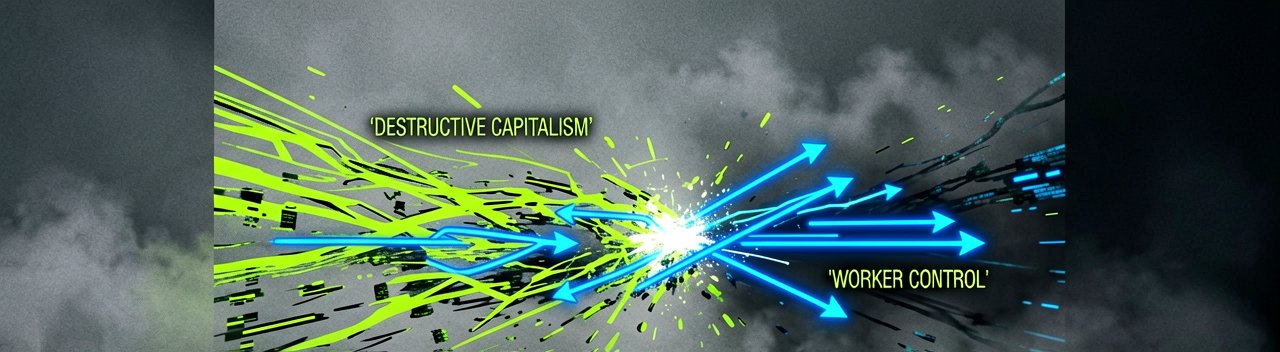
Tanuro advances concrete demands against techno-solutionism from any quarter. A moratorium on data center construction. Removal of AI development from private hands. A ban on military applications. Workers' control across the value chain. These theses are particularly timely given what Tanuro terms "technofascism"—the convergence of Big Tech oligarchs with far-right movements exploiting algorithmic manipulation.
The document explicitly deals with generative AI. The thesis formulation, of unequal length, is not intended to establish certainties but to facilitate debate through exposition conciseness. This matters because the stakes involve digital rights movements, labor organizing, climate justice, and anti-imperialist solidarity.
Whether these demands gain traction depends less on their theoretical coherence than on material power relations. The digital giants have already accumulated enough rent to weather regulatory storms. Workers' control requires organized labor that currently lacks leverage in the tech sector. The moratorium on data centers faces opposition from governments dependent on AI-driven economic growth narratives.
Tanuro's framework offers movement activists a vocabulary for resisting AI deployment without falling into Luddite nostalgia or techno-utopianism. The question remains whether ecosocialist critique can translate into concrete organizing power against platforms that have already embedded themselves in infrastructure, education, healthcare, and governance systems.
Whether users actually pay for this critique remains the real question. The theses are available at International Viewpoint's official publication. Independent coverage from Europe Solidaire corroborates the framework's distribution and relevance to solidarity movements.
The physical experience of reading these theses involves scrolling through dense paragraphs on a device powered by the very extractive systems Tanuro critiques. There is irony in that. But the analysis stands regardless of delivery medium. The question is whether anyone with power will listen.
Artūras Malašauskas is an AI Systems Integrator with 20+ years of production-grade web engineering experience. He has designed, shipped, and scaled enterprise Python/PHP systems for logistics, SaaS, and public-sector clients. For the past year, he has focused exclusively on AI integrations: deploying open-source LLMs, building generative media pipelines (image, audio, video), and engineering multi-agent workflows for real production environments. His standard: reproducibility, security, cost-efficient inference—no vaporware. He documents and evaluates emerging AI tooling, separating verified capabilities from marketing noise. Technical editor at: muza-ai.eu, ai-verslas.lt, ai-naujinos.lt Connect on LinkedIn
Comments