Cleveland Clinic Partners With Luminai to Automate Hospital Operations

Healthcare systems are hitting a wall with administrative bloat. Cleveland Clinic has partnered with startup Luminai to test whether AI can actually run hospital operations end-to-end, not just automate isolated tasks. The collaboration focuses on referral management, where millions of faxes still flood in daily and require manual review before patients can be scheduled.
This isn't another pilot that will vanish into a graveyard of failed healthcare AI projects. The Clinic serves over 15 million patients annually across 23 hospitals and 300 outpatient facilities. Referrals are frequently the starting point for care journeys, and the current process relies heavily on staff manually reviewing faxes and interpreting unstructured information. Every fax must be read, data extracted, and then imported into the electronic medical record to kick off scheduling.
According to Fierce Healthcare, the work of handling referrals depends on manual review of faxes and manual interpretation of unstructured information. Kesava Kirupa Dinakaran, founder and CEO of Luminai, described healthcare's administrative functions as a massive, manual coordination layer. Encoding that work into software has historically been difficult because workflows span systems and point solutions, depend on unstructured inputs, and require embedded business and clinical context at every step.
Recent advances in AI have made it possible to handle that complexity directly. Luminai built a virtual inbox agent that can triage incoming faxes to automate referral workflows. The system determines if a fax is a referral, whether it's high-risk or high-urgency, extracts the data, matches it to the right provider, and kicks off the scheduling process. Every fax that hits Luminai's system gets processed in less than one minute, regardless of volume. In most health systems, that can take days, if not weeks (a problem that has plagued users for years, frankly).
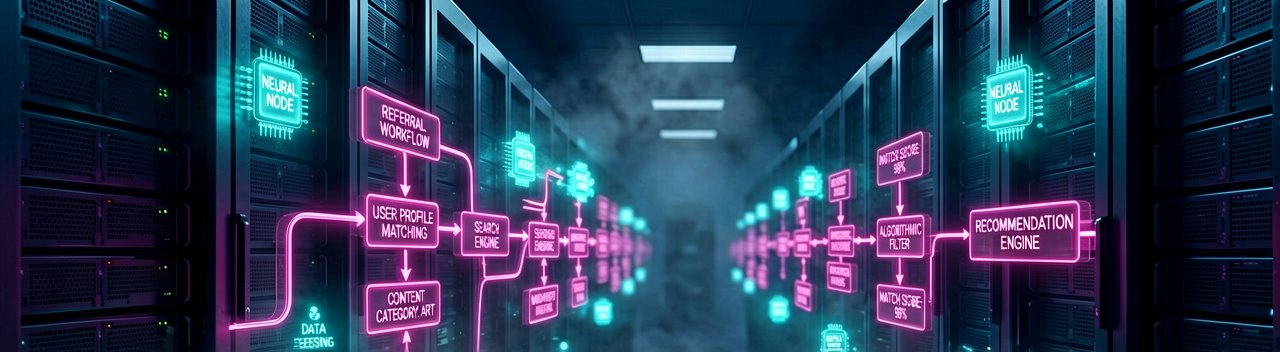
The physical reality of this work is worth noting. Staff members sit at desks surrounded by paper faxes, handwritten notes, and disconnected screens. They manually read each document, extract operational and clinical data, identify if a patient is high-risk, check schedule availability, and coordinate across different systems. There's nuance in it all the way from extracting basic patient details to determining urgency levels. Luminai's platform is designed to translate this messy reality into actionable, structured data while keeping full context intact from start to finish.
Rohit Chandra, Cleveland Clinic executive vice president and chief digital officer, told Fierce Healthcare that referrals were selected as the initial use case because workflows in this space are complex and involve several steps including manual intake, data validation, and coordination across systems. They also require frequent follow-up. "With the advances in AI, we have the opportunity to re-think and transform many of our core functions, this being one of hopefully many over time," Chandra said.
What stood out to Cleveland Clinic about Luminai was its ability to work within complex administrative workflows in a practical way. It was about helping with real operational challenges. As the Clinic saw results in pilot environments, they became more confident that this could scale in a way that was both useful and sustainable. The collaboration has been moving from pilots toward broader rollout.
Luminai's platform combines healthcare-trained AI models, a configurable workflow engine, and human-in-the-loop validation. When a process hits an ambiguity, the system routes work to the right team with full context rather than breaking the workflow. These human interventions are fed back into the system, allowing the platform to learn from every outcome and improve over time. This approach moves beyond simple execution to create a connected system of operational understanding.

The company launched in 2020 and signed on its first health system customer in 2023. Luminai is now working with 20 large health systems. Earlier this month, the AI-native automation platform closed a $38 million Series B funding round led by Peak XV Partners, with participation from Define Ventures and continued backing from General Catalyst and Y Combinator. This brings total funding to approximately $60 million.
According to Luminai's official blog post, U.S. hospitals spend over $1 trillion annually on operations. Administrative costs have grown to nearly double the cost of direct patient care, squeezing margins and putting extreme pressure on health systems. This isn't just a spending problem; it is a structural one. Healthcare operational workflows break down because decisions and processes are fragmented, spread across people, policies, and systems that were not designed to reason together.
Dinakaran grew up in India and, when he was younger, was a professional Rubik's Cube solver, holding the Guinness World Record for the most number of Rubik's Cubes solved in one hour. When he first came across process automation problems, it felt deeply familiar in that these are 80-step problems that should be done in five steps. About eight years ago, he moved to Silicon Valley and began exploring and experimenting with AI to automate complex tasks.
When he was exposed to the American health system, he was surprised that operations primarily still run on people, process, and paper. As he walked through the admin buildings of some hospitals, it blew his mind in terms of the amount of repetitive, deeply manual, very operational work that people were doing. Each health system is its own snowflake. The way work gets done is different everywhere.
While many health tech and AI companies are focused on narrow use cases like scribes and revenue cycle management, Dinakaran says Luminai has its sights set on becoming an administrative operating platform partner to large health systems. The company is using the fresh cash to expand its product capabilities, grow its engineering and deployment teams, and support additional enterprise customers.
Early deployments have achieved automation rates exceeding 80% for certain document types, while reducing manual processing time significantly. For Cleveland Clinic, the opportunity extends beyond efficiency alone. Patient experience is directly shaped by how efficiently and reliably a system can move a referral from intake to appointment. Delays in this process mean patients wait longer for care, and staff burn out from repetitive administrative work.
The broader industry context matters here. Health systems are under mounting pressure to modernize operations while managing workforce shortages, rising costs, and increasingly complex care delivery environments. Many are now looking beyond narrow AI tools toward systems that can operate across functions. The challenge has shifted from finding an AI vendor to solve a specific challenge to deciding which ones can move beyond pilots and actually change how work gets done.
Whether this partnership scales beyond referrals remains uncertain. The technology works in controlled environments, but healthcare operations are notoriously resistant to change. Staff adoption, integration with legacy systems, and regulatory compliance all add friction. The real test isn't whether the AI can process a fax in one minute. It's whether the entire organization can adapt to a system that makes decisions without human intervention at every step.
Whether users actually pay for it remains the real question.
Artūras Malašauskas is an AI Systems Integrator with 20+ years of production-grade web engineering experience. He has designed, shipped, and scaled enterprise Python/PHP systems for logistics, SaaS, and public-sector clients. For the past year, he has focused exclusively on AI integrations: deploying open-source LLMs, building generative media pipelines (image, audio, video), and engineering multi-agent workflows for real production environments. His standard: reproducibility, security, cost-efficient inference—no vaporware. He documents and evaluates emerging AI tooling, separating verified capabilities from marketing noise. Technical editor at: muza-ai.eu, ai-verslas.lt, ai-naujinos.lt Connect on LinkedIn
Comments