QNAP Launches QAI-h1290FX Edge AI Storage Server
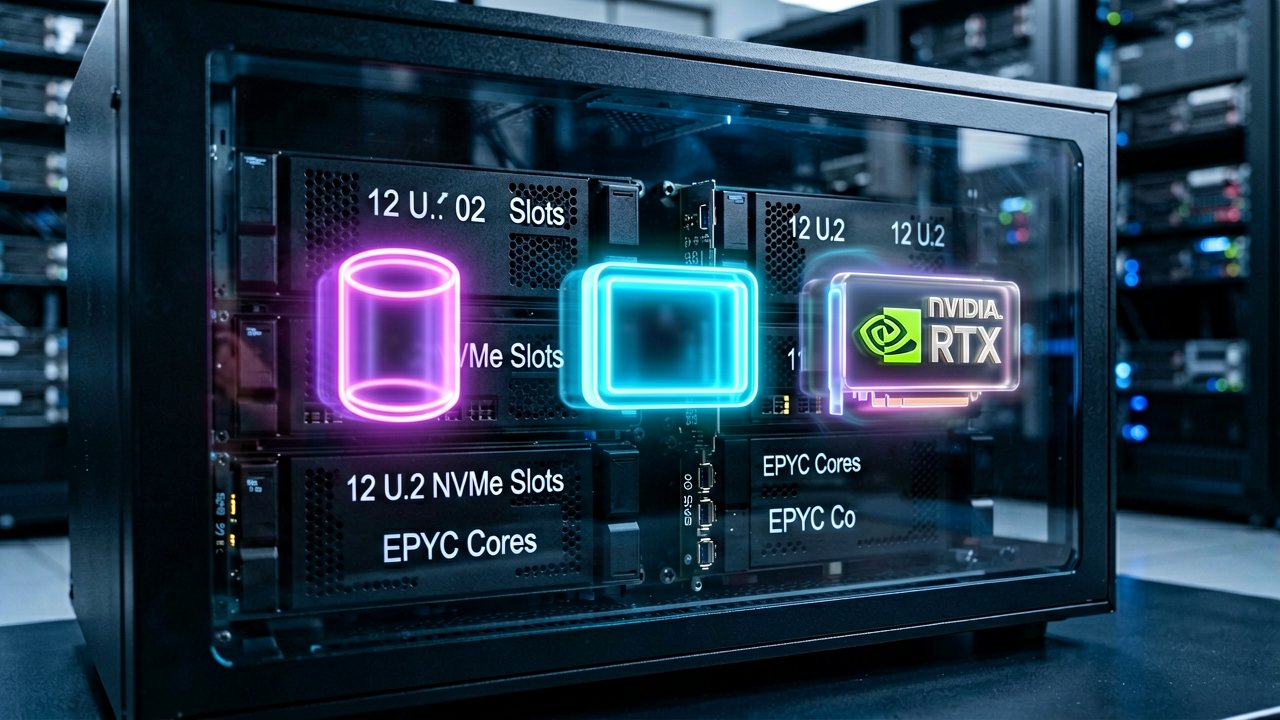
On April 30, 2026, QNAP announced the QAI-h1290FX, a desktop-class edge AI storage server targeting enterprises that want to run large language models and generative AI applications without cloud dependency. The device addresses a growing market segment where data sovereignty and compute performance have become strategic differentiators for organizations adopting AI infrastructure.
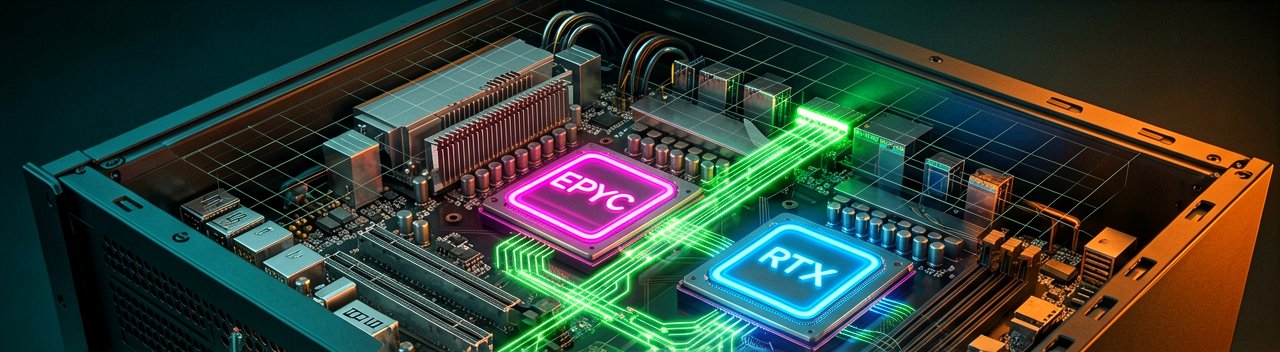
According to QNAP's official press release, the QAI-h1290FX is built around a 16-core AMD EPYC 7302P processor delivering 32 threads of server-class compute power. It features twelve U.2 NVMe/SATA SSD slots for all-flash storage architecture and supports optional NVIDIA RTX PRO 6000 Blackwell Max-Q Workstation GPU with up to 96 GB of GPU memory. The hardware configuration is designed for low-latency inference, full data privacy, and operational control without relying on external cloud services.
Technical specifications from the product page reveal dual 25GbE and dual 2.5GbE networking ports, with PCIe slots supporting optional 100GbE upgrades. The system runs on QNAP's QuTS hero operating system, which uses the ZFS file system for enterprise-grade data integrity, near-limitless snapshots, and inline deduplication. This matters because AI workloads generate massive amounts of data that need reliable storage with consistent performance.
Container Station and Virtualization Station provide native GPU access in containers and GPU passthrough for virtual machines. IT teams can assign GPU resources without command-line configuration, which drastically reduces deployment friction (a problem that has plagued users for years, frankly). The platform supports Docker and LXD with intuitive GPU allocation through a built-in AI app center.
Preloaded AI tools include AnythingLLM, OpenWebUI, and Ollama for rapid private LLM workflow deployment. Additional applications like Stable Diffusion, ComfyUI, n8n, and vLLM are being integrated to expand functionality. This enables users to build on-prem AI platforms and automate workflows in a secure, scalable environment. The physical experience involves clicking through a web interface to launch containers rather than wrestling with terminal commands and dependency hell.
Oliver Lam, Product Manager at QNAP, stated the goal was to eliminate friction in building GPU workstations, installing tools, and configuring complex environments. With the QAI-h1290FX, users can deploy and run AI models right out of the box with full control over data and zero reliance on the cloud. The quote appears in both the official announcement and TechPowerUp's coverage of the launch.
Use cases highlighted include internal AI assistants for knowledge lookup and employee training, enterprise RAG search across contracts and reports, image generation for creative teams using Stable Diffusion or ComfyUI, and AI-driven IT automation through n8n. These applications keep sensitive data in-house while accelerating AI workflows. The device won a TechRadar Pro Picks Award at CES 2026, suggesting industry recognition for its approach.
Performance validation comes from real-world benchmark data under a high-end GPU test configuration with the NVIDIA RTX PRO 6000 Blackwell Max-Q Workstation GPU. The Blackwell architecture supports CUDA, TensorRT, and Transformer Engine acceleration, significantly boosting performance for on-prem LLM inference, image generation, and deep learning workloads. Ollama LLM inference benchmarks demonstrate rapid deployment capabilities for proof-of-concept projects and small to mid-scale use cases.
Remote access options include myQNAPcloud DDNS for custom domain access, myQNAPcloud Link for secure relay connections without opening router ports, and VPN server support via QVPN Service. Whether fine-tuning LLM container setups, reviewing inference logs, or collaborating across locations, the QAI-h1290FX offers reliable access to on-prem AI environments from any device. This hybrid work capability is increasingly important for distributed teams.
The product positions itself against traditional IT infrastructure bottlenecks including high cloud security risks and soaring deployment costs. Over 90% of enterprises cite data security as a top concern when deploying AI, according to QNAP's solution documentation. Cloud-based deployments expose data to potential leaks and compliance risks while stacked licensing fees for cloud models, token usage, GPU access, storage, and virtualization platforms drive up total cost of ownership.
Compatible with QNAP JBOD expansion enclosures for large-scale AI data storage, the QAI-h1290FX enables flexible configuration and rapid deployment. The platform can operate as a CPU-centric high-performance computing system supporting virtualization and enterprise computing scenarios. Whether for AI inference, research and development, data analytics, or applications requiring high core counts and sustained performance, a single desktop-class enterprise platform delivers compute efficiency and data security entirely on-premises.
Whether organizations actually pay for this hardware versus continuing with cloud alternatives remains the real question. The market for on-prem AI infrastructure is growing, but price points and total cost of ownership calculations will determine adoption rates. Time will tell if the convenience of preloaded tools outweighs the flexibility of custom cloud configurations.
Artūras Malašauskas is an AI Systems Integrator with 20+ years of production-grade web engineering experience. He has designed, shipped, and scaled enterprise Python/PHP systems for logistics, SaaS, and public-sector clients. For the past year, he has focused exclusively on AI integrations: deploying open-source LLMs, building generative media pipelines (image, audio, video), and engineering multi-agent workflows for real production environments. His standard: reproducibility, security, cost-efficient inference—no vaporware. He documents and evaluates emerging AI tooling, separating verified capabilities from marketing noise. Technical editor at: muza-ai.eu, ai-verslas.lt, ai-naujinos.lt Connect on LinkedIn
Comments