DOE Aligns $300 Million Behind Fermilab and National Laboratories to Secure US Leadership in AI-Driven Science
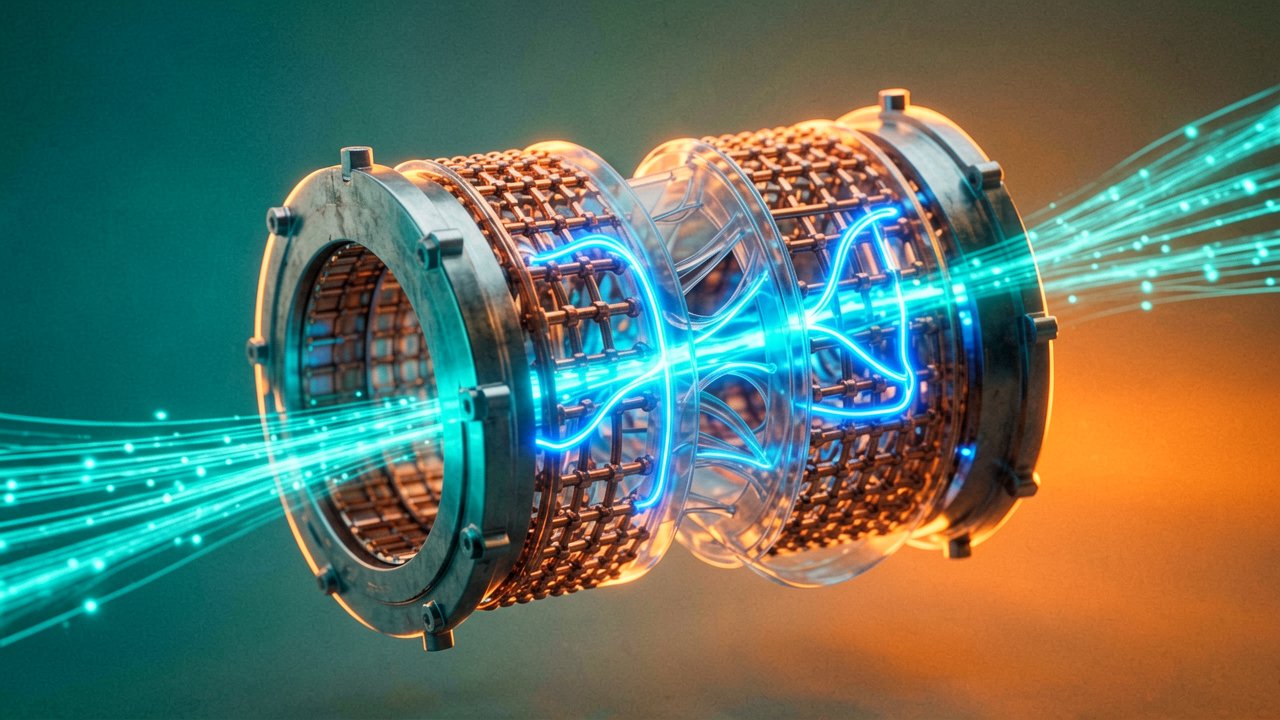
The U.S. Department of Energy (DOE) has channeled massive strategic investments into transforming the nation's premier research laboratories into foundational hubs for artificial intelligence in scientific discovery. As announced by the Fermi National Accelerator Laboratory, these newly awarded resources represent a pivotal shift in the ongoing global technology race, funding critical breakthroughs at the intersection of machine learning, particle physics, and quantum computing.
This capital infusion is deployed under the umbrella of the U.S. Department of Energy Genesis Mission, a sweeping federal initiative designed to leverage AI supercomputing to reshape American innovation. By scaling up intelligent computing infrastructure, the initiative converts enormous pipelines of high-energy physics data into actionable training environments for deep learning models. The primary strategic objective is to secure absolute domestic dominance in advanced scientific computing amid intensifying international competition.
Market Impact and Strategic Positioning
The allocation establishes a permanent blueprint for how public supercomputing infrastructure collaborates with private enterprises. This approach addresses the massive processing demands required by frontier-scale physics experiments. Rather than relying entirely on commercial cloud hyperscalers, the federal government is prioritizing specialized research infrastructure to independently pilot autonomous laboratories and intelligent accelerator systems.
Technical Execution and Hardware Synergy
Under the Genesis Mission framework, labs like Fermilab are integrating advanced artificial intelligence and machine learning models directly into experimental physical processes. Key initiatives include implementing AI-driven resonance control algorithms for superconducting radio-frequency cavities. This integration optimizes complex particle accelerator infrastructure, lowers baseline operational friction, and establishes automated controls capable of managing millions of concurrent data telemetry points.
Expert Commentary: The Convergence of Big Science and Agentic AI
From a technical standpoint, this funding marks the end of classical post-processing data analysis in experimental physics. The immediate deployment of automated control loops within physical hardware establishes a critical foundation for agentic digital engineering. By deploying automated workflows directly at the sensor level, the DOE is building the necessary architecture for self-optimizing instruments. This tactical move positions public science facilities as primary developers of specialized, high-consequence AI architectures.
Behind the Scenes: Inside the Industrial Scaling of Scientific Artificial Intelligence
The transition toward an AI-centric infrastructure at Fermilab marks a profound departure from classical experimental paradigms, introducing an era where automated control systems sit directly inside the physical loop of high-energy physics. Historically, particle accelerators generated vast streams of sensory data that were archived, distributed globally, and analyzed months after an run concluded. By embedding machine learning models directly into the hardware layer, the Department of Energy is shifting the burden of real-time diagnostics away from human operators and onto autonomous inference engines capable of sub-millisecond decision-making.
This operational pivot has triggered a quiet restructuring of the workforce within the national laboratory ecosystem. High-energy physicists are increasingly working alongside computer scientists to co-design domain-specific algorithms, adapting deep learning models to respect the immutable laws of conservation and symmetries inherent in subatomic physics. This collaboration ensures that the AI systems do not produce hallucinations—a common flaw in commercial large language models—but instead operate within strict mathematical boundaries required for high-consequence scientific validation.
From an industrial perspective, the federal government is effectively de-risking advanced computing methodologies that commercial enterprises find too speculative or unprofitable to develop independently. The extreme conditions found within particle accelerators, such as managing massive cryogenics and radiation environments, provide an ideal stress test for resilient edge-computing hardware. Silicon vendors and infrastructure providers are closely monitoring these implementations, as the specialized neural network architectures proven in these labs will likely dictate the next generation of industrial automation and autonomous aerospace control systems.
The geopolitical undercurrents of this funding cycle extend far beyond academic prestige. As international facilities race to construct more powerful accelerators, the primary bottleneck has shifted from raw physical scale to the computational capacity required to interpret experimental anomalies. By prioritizing intelligent automation and real-time data filtering, the United States is positioning its existing domestic infrastructure to outperform physically larger overseas counterparts through sheer algorithmic efficiency, solidifying a long-term strategic advantage in the global technology landscape.
Reading Between the Lines: The Friction Point of Algorithmic High-Energy Physics
The injection of federal capital into AI-driven scientific research assumes that existing machine learning architectures can seamlessly scale to meet the rigorous demands of subatomic physics. However, a fundamental contradiction lies at the heart of this technological integration. Modern deep learning relies heavily on statistical correlation and probabilistic outputs, whereas quantum mechanics and high-energy physics demand absolute, verifiable precision. Forcing black-box models to govern hyper-precise instruments creates an engineering paradox where the speed of data processing could outrun our ability to understand why an algorithm made a specific adjustment.
Furthermore, this massive pivot toward automated science risks creating a severe talent bottleneck that the public sector is ill-equipped to solve. The Department of Energy is competing directly with commercial technology conglomerates for the very engineering talent required to build these autonomous systems. While a $300 million allocation sounds massive in the context of academic grants, it represents a fraction of the capital that private hyperscalers spend quarterly on AI compute and compensation. Retaining top-tier machine learning talent within the strict, bureaucratic limits of national laboratories remains an unaddressed operational hurdle.
There is also an institutional skepticism regarding the true longevity of these specialized models. In the commercial sector, AI models suffer from data drift and require continuous, expensive retraining cycles to maintain accuracy. In a laboratory setting, where experimental configurations change with every new physical hypothesis, the overhead of constantly retraining and re-validating deep learning models could easily eclipse the time saved by automation. If every minor hardware adjustment requires a complete overhaul of the underlying neural network, the promised operational efficiency may prove to be an elusive mirage.
Ultimately, the push for AI-driven dominance may inadvertently narrow the scope of scientific discovery rather than widen it. Machine learning models are inherently backward-looking, trained on historical data and known physics paradigms to predict optimization paths. True scientific breakthroughs, however, are almost always born from anomalies, unexpected human errors, and creative leaps that defy existing data distributions. By outsourcing the monitoring of physical anomalies to algorithms optimized to minimize variance, the scientific community must ensure it does not accidentally filter out the very anomalies that lead to Nobel-prize-winning discoveries.
It appears the future of human discovery relies on teaching silicon processors to look for things we do not understand, using algorithms we cannot entirely explain, funded by a government that expects immediate and completely predictable breakthroughs.
Artūras Malašauskas is an AI Systems Integrator with 20+ years of production-grade web engineering experience. He has designed, shipped, and scaled enterprise Python/PHP systems for logistics, SaaS, and public-sector clients. For the past year, he has focused exclusively on AI integrations: deploying open-source LLMs, building generative media pipelines (image, audio, video), and engineering multi-agent workflows for real production environments. His standard: reproducibility, security, cost-efficient inference—no vaporware. He documents and evaluates emerging AI tooling, separating verified capabilities from marketing noise. Technical editor at: muza-ai.eu, ai-verslas.lt, ai-naujinos.lt Connect on LinkedIn
Comments